Friday, February 10, 2012

London's first snowfall paints the town black and white

It was very un-Australian. Not only did we fail to celebrate our national day on January 26th (I even had a glass of Kiwi sav blanc), we then decided to help our cuzzie bros celebrate the expat version of their national booze fest, otherwise known as Waitangi Day.

We weren't too fussed with the expat version of Australia Day - lining up for hours behind drunk Aussie teenagers for a place in the mosh pit of the Shepherd's Bush Walkabout. Over here, Kiwis celebrate in much more style. Following the route of the Circle underground line, they amass in their thousands, stopping in at pubs alongside each station all the way around.

Drinkin in the street
The Circle Line pub crawl begins at Paddington, goes around to Westminster, where there is a brief hiatus for a mass Haka performance at 4pm, then continues back along to Paddington. Some of our cuzzy bros must have spent weeks preparing their outfits. Pretty much eveyone (except us - we wanted to blend in but not give the game away) was in fancy dress - many of them in matching group outfits.

There were the usual bros dressed as kiwis, sheep, half-naked lifeguards and some clad in All-Blacks jerseys or draped in the flag. But there were some incredibly inventive outfits in the melée, which by the time it reached Westminster numbered over 4,000. There was a guy with a big robe on made entirely of sewn-together beer towels, boasting brews such as Tui, Lion Red, Canterbury Draft and Speights.

Another group took a nod from the hilarious Kiwi drink driving ad that went viral on You Tube. The one where the guy is telling his friend not to drink drive, otherwise he might die, and then he won't be able to have one of his chips because they would be "ghost chups." Well one group was dressed as....you guessed it...matching billowy white sheets emblazoned with packet of chip logos bearing the slogan ghost chips.

But the funniest was a guy who may not have been in costume at all. A Maori guy in a blue singlet, black shorts and big gumboots. Oh, and there was another guy with an 80's style boom box who had shoved his iPod in the cassette deck It was belting out Crowded House, Matchbox 20 and other old-time Kiwi favourites.

Tiny English pubs near Circle Line stations had no hope of accommodating most of the heaving masses of strangely-dressed Antipodeans. People spilled out onto the streets, re-fuelling at Tescos instead of trying to try and battle for a pint. The result was entire streets full of meandering, drinking (and later, urinating) people, staggering towards Westminster.

Unfortunately by the time we arrived to watch the Haka, there were so many people we couldn't actually see anything, but we heard the sound effects of the "HEEEE...." and other war-like noises loud and clear. Considering everyone was pretty drunk and obnoxious, the police were being pretty gentle. There was no pushing and shoving, no ordering people around and miraculously, no arrests. This is in spite of people trying to scale a lamp post so they could get a bird's eye view of the crowd and take pictures.

Choice bro...
Most onlookers were pretty confused - I don't think they'd heard of Waitangi day, and unless they knew about sheep jokes they may not have been able to figure out what was happening just by looking at people's outfits. The event did upset some though, with one ill-humoured expat ranting to the NZ Herald that the revellers had urinated all over New Zealand's reputation.

He should probably relax. New Zealand's black and white colours aren't all that obvious to those not in the know, and besides, most probably confused them for a bunch of drunk, urinating Australians and thought "no surprises there."

Even though the weather had been milder than a Wellington winter, it was pretty damn cold that day - a shame for those determined to flaunt their short -sleeved rugby jerseys and jandals. Later on, after we had managed to actually get inside a pub and nab a table, we noticed the season's first few flakes of snow swirling through the air.

Of course, everyone went bananas and ran outside to throw snowballs at strangers. Within an hour, the whole world was covered in a thick coating of fluffy white powder. Against the stark black night, it really looked like the town had been painted black and white.

Soho blanketed in snow


Earlier that day in front of frozen Trafalgar Square fountain


Sunday, January 29, 2012

Eating out in London

London, with its successive waves of immigrants from Europe, the Caribbean and the Indian Sub-continent, is one of the most multicultural cities on the planet. It should be a culinary melting pot, with an almighty restaurant scene. But for some reason it isn't.

It's true that London offers incredible variety - from sleek French bistros to hip pizzerias, modern Mexican eateries and bloodthirsty Brazilian rodizios, but its not easy to find quality at a reasonable price. In most cities, the "you get what you pay for" adage rings true when choosing restaurants. If you find somewhere cheap, it might be nice but otherwise it isn't surprising, while if you splash out a little more, you are likely to get a good feed in a nice atmosphere.

Unfortunately this isn't the case in London. Cheap food is usually just that - average pub meals or a very shady curry or limp noodle dish. Going upmarket doesn't solve the quality problems. Some of the more expensive restaurants we have tried have been alarmingly disappointing. They are so hit and miss, which makes it hard if you are new in town and picking restaurants out of a guidebook or from the internet.

 In many places, mid-range restaurants are incredibly reliable. They may not have the greatest atmosphere, but you can normally get quite reasonable food and not have to pay through the nose. Finding a nice restaurant that I would actually revisit has been a challenge in London. Many times I have thought the food was just ok, and then received a bill for £60 or more for two people (one course plus a bottle of wine).

London's Soho district, near the West End theatre precinct, is bursting with cafes and restaurants, but we have had some average meals. On Old Compton Street, a Japanese noodle joint called Taro was disappointing and pretty expensive. An Italian place called Little Sicily a few blocks over on Rupert Street was downright horrendous. Here, £6 buys you a limp looking wad of bruschetta, while the main size pastas were bone dry and almost devoid of flavour, and set you back up to £15. Adam said his £16 risotto was like forcing down dry cardboard.

Our Mexican dining experiences have been above-average in London, and far better than the usual "Tex Mex" horrors you might expect to find. Covent Garden's Cafe Pacifico has a lively atmosphere, but the food isn't all that amazing for the price. Chiquito in Leicester Square had some interesting combinations that you don't always see on Mexican menus, such as Jambalaya and Duck Fajitas. Cafe Sol, on Clapham High Street was unexpectedly good. We had deliciously melty enchiladas and juicy spiced sea bass. Boho Mexica in Spitalfields has an amazing Mexican pop-art interior, but will leave you with a much lighter wallet and not really fill you up with their trendy share plates.


Mexican fast food joints have really exceeded expectations. Poncho No 8 is a part of a chain, and not very glamorous - burritos are served subway style, in that you line up along a servery counter and choose your meat, other fillings, salsa etc. But you get a delicious burrito for £6 and you can wash it down with one of a wide selection of Mexican beers in their restaurant-style upstairs seating area. 

 On the whole, Thai restaurants we have tried have been pretty good, if a little formulaic. You can generally get a main curry or stir fry for £8-9, but generally the dish sizes were quite small and there was absolutely no taste of chilli anywhere, but I suppose they are catering to local tastebud settings. We were quite impressed with Thai Square in Islington, and it appears to be a chain as I have come across quite a few other places with the same name. 

There is a weird London trend to blend two or more types of cuisine into a bizarre "fusion with a twist" experience. This surgery is mainly performed on Asian food, like "Chinese-Japanese" food, or Thai-Korean-Malay." I have yet to seen hybrid versions of European cuisine, but I am hoping one day I will run into an "Italian-French-German" restaurant or a "Spanish-Slovakian-Dutch" cafe.

In the North London enclave of Fitzrovia is a bar-cum-restaurant called Jetlag, which has a great bar-like atmosphere, but can't really decide what sort of restaurant it is. It's a great place to go with a group who can't agree on what to eat. The menu is share-plate style, hence its better to eat there in a group, and in the same sitting you can eat Japanese gyoza, lebanese felafel and Indonesian satay. I found the concept incredibly bizarre, although it wasn't outrageously expensive.

Brick Lane's Ambala
East London does better on the variety front - there is a great range of food on offer at all kinds of prices. Once-gritty working class neighbourhoods of Spitalfields, Shoreditch, Whitechapel and Bethnal Green are now firmly entrenched on the city's culinary map. Brick Lane is probably the best known restaurant strip in the area, which is curry ground zero thanks to its sizeable Bangladeshi population. But again, curry houses are pretty hit and miss. In my view the sweet shops are the highlight of Brick Lane. The best is Ambala, which also carries a range of delicious samosa, bhuji and other savoury snacks in addition to some of the sickliest sweets you've ever tasted.

A few blocks away on Commercial Street is the uber-trendy Spitalfields precinct. Centred around the Old Spitalfields market, which used to sell fruit and veg, it us now a highbrow flea market, selling vintage clothes, jewellery, quirky homewares and designs from independent and up and coming fashion labels.

Stjohnbreadandwine.com
Spitalfields may have felt edgy and urbane a few years ago, but now it is definitely on the hipster map, which means it is still cool but no longer cheap. Pretty much everywhere has a great atmosphere, and some London culinary institutions are well worth the splurge - St John Bread and Wine will stretch your meat-eating imagination, and radically overhaul your (probably dismal) view on English food. Hawksmoor, a kind of fine-dining steakhouse, I would love to go to but haven't tried, and is meant to be amazing.


Shoreditch also fares well in the budget-cuisine department, with an entire street of hole in the wall Vietnamese restaurants. Again, these are hit and miss, but at least your wallet is not being punished on every attempt. We ate at one place on two separate occasions, and had completely different experiences, so reliability is not a given. This makes it hard if you eat somewhere nice and then want to go back with a different group of friends - you can end up being burned.

Granted, this isn't a review of London's finest restaurants. Most times we are simply after a decent meal in a place with a nice atmosphere that won't cost the earth. But in this city, looks can be deceiving and you need to do your research in order to uncover the real gems.

Monday, January 16, 2012

The British obsession with manners

Saying "please", "thank you" and "sorry" when you bump into someone might not seem like a big deal, but forgetting to is social taboo in a country that prides itself on pleasantries.

Adapting to social etiquette in the UK isn't exactly a cultural quantum leap for an Australian. After all, we already speak the same language and have a shared history. But there are subtle differences in the way Britons and Australians behave.

In both countries, politeness is appreciated, but Britons seem to take an interest in manners to an obsessive level. In Australia, if someone walks into you at a supermarket or on a street corner, you might hear them mutter "excuse me." Or, you might not, and that's the end of it. In Britain, not only will you hear a resounding "sorry!" from the person who bumps into you, they will even apologise if it is in fact you who bumped into them! People are so in the knack of apologising, that a British friend even confided that she often finds herself apologising to inanimate objects she has bumped into.

The stereotype of the abrupt, rude Londoner might need revisiting. London Underground patrons follow a strict etiquette, immediately moving to the right of escalators to let others pass, and are very apologetic if they walk in someone else's way. The only argument I have heard on the Tube so far was a lady angry at a man who tried to push past her. She wasn't annoyed because of the man's pushiness, but was irked by the fact that he didn't say "excuse me" as he was doing so. She promptly instructed him to "improve his manners".

An obsession with manners is matched by growing fears that standards of politeness are eroding in modern British society. Australians are concerned about this too, amid newspaper reports of people not giving up their seats on buses for pregnant women. In London this problem is tackled by offering pregnant women badges that declare that they have a "baby on board" in the vain hope that someone will give up their seat.

The British are concerned about the effect of modern technology on the way people interact in public. I boarded a long-distance train lately, and had to move along a person who was occupying my (reserved) seat. When he moved, the couple opposite looked relieved, and said they were glad he'd moved as he had been talking on his mobile phone the entire journey, and how rude they found it.

Successive waves of immigration has made a discussion of standards of behaviour a touchy subject, because often different standards reflect the heady cultural blend that now defines London. But a general desire to uphold manners appears to be working, as this article in the Observer, on the myth of Rude Brittania suggests. Those interviewed in a study called Charm Offensive, said civility was the single most important contributor to their quality of life.

Interestingly, the study found high levels of civility in some disadvantaged communities, and some striking examples of incivility in more well-heeled areas. A recent blog post by the Telegraph's Damian Thompson criticising Prime Minister David Cameron's manners referred to his trick of turning his manners on and off to suit his own ends. "He exhibits the calculated rudeness of people with very nice manners," Thompson notes.

Apparently this is a common trait among upper-crust toffs, Cameron and other fellow Etonians (alumni of super-posh school Eton). And it puts paid to the theory that no matter how polite you are or mindful of your own behaviour, this on its own will not command respect or social inclusion. When you are introduced to a British person, they will undoubtedly be polite, but at the same time they are sizing you up, working out which part of the social spectrum to pigeon hole you.

Class isn't supposed to matter as much these days, but it certainly still affects how people behave towards each other. People use a series of cues - such as what school you went to, where you live, what school you send your kids to, which pub you drink in. Even the use of certain words can be an indicator of what class you belong to. For example, the use of "pardon" instead of "excuse me" or "sorry" is extremely frowned upon, and casts you a number of levels down the social hierarchy. Well-bred people say they will have "pudding" after dinner, after they have visited the "lavatory" (can you even imagine that being said with an Australian accent?) whereas the lower-classes will opt for a "sweet", after they use the "toilet."

Being Australian helps you partially avoid this crude classification, as fortunately the class system doesn't appear to apply to us. But our love of egalitarianism and upholding of the "fair go" does come at a cost. While no one will care what school you went to, etcetera, you will automatically be placed in a certain area of "unclassifiables" - you might be referred to as someone from the "New World" or "Antipodean".

Now we all know that Colonialism is hundreds of years out of fashion and the British no longer feel they are culturally superior. But remnants of this Old World attitude remain. Take this theory that attempts to explain the way in which people from the "New World" - Americans, and to a lesser extent, Australians and New Zealanders - speak. Apparently the British talk more from the backs of their mouths, leading to a more muted tone, while Americans use the front of their mouths, resulting in an effect that is quite the opposite!

Not that Brits go around acting superior, but this theory goes some way in explaining how they view their colonial offspring. In truth, many have confided they use the word Antipodean not to be derogatory but because they weren't quite sure whether my accent was Australian or New Zealand. Which is fine, considering that I can't always pick up the difference between a Geordie or a Scouser, and didn't know what these terms meant before I arrived. And its a damn sight better than the American I met that claimed I had to be "either Australian or Canadian."

I've repeatedly heard that Australians are considered very "forward". I think this has to be seen relative to the British tendency to avoid using direct terms, preferring a more awkward, dithering interchange where they dance around a topic without actually broaching it. Americans, I'm told, are even more forward, and will dash up eagerly and introduce themselves at the start of a conversation, while Britons start by discussing the weather and sometimes don't get around to an introduction. Many Britons I've chatted to travelling refer to "that intense American" they met. I'm not convinced they are saying the same things about Australians, but I think they can be struck by our directness, which they can find refreshing - and not necessarily a bad thing.

Monday, January 9, 2012

Tourists in Toronto

Our trip to Canada was a family holiday and we didn’t have to put much effort into working out our agenda for the week - our Canadian-based relatives saved us the trouble. With a white Christmas and frantic Boxing Day shopping ticked off the list, we embarked on a day trip to Niagara, over an hour south of Toronto.

Niagara Falls...tack-o-rama
Before visiting eponymous famous falls, we stopped in at Niagara on the Lake, a quaint little town (extremely touristy but not lacking in charm) filled with immaculately tended historic wooden buildings, specialty shops, cafes and restaurants. From the lakeshore, the view was less than spectacular on account of the rainy, foggy weather – the temperature had once again bounced above zero. But you could still make out the impressive Fort William across the other side of Lake Ontario, on the US side of the border. I had a delicious bowl of steaming Atlantic mussels in a curry-flavoured broth at the local Irish pub for lunch.

I had been forewarned about the town surrounding Niagara Falls, so my expectations were well-managed. It’s probably the tackiest, most gimmicky place in Canada, rivalling Vegas with its bright neon lights, casinos and kitsch entertainment.

The Falls...pretty misty unfortunately
There’s an imitation Tussaud wax museum, some kind of Ripley’s Believe it or Not amusement and the streets are bursting with “Canadiana” souvenir shops selling maple leaf everything. I guess Niagara Falls is what happens when a town wants to attract families to its one tourist attraction, which is awe-inspiring for adults to gaze at but not necessarily all that interesting to kids. 

Unfortunately the fog hung low, adding to the mist clouds already generated by the raging falls, obscuring much of the best bits. The Niagara River forms part of the border between the US and Canada, and a smaller, less impressive version of the falls lie on the US side. It was amazing to stand right up close to the Canadian part and be drenched in mist, watching thousands of litres of water cascade into the abyss each second. But the falls paled in comparison to the much larger and leafier Iguazu Falls we visited on the Brazil/Argentina border in September, and made me wish I had seen Niagara first! 

Toronto City view from CN Tower
Now in full tourist mode, we descended on Toronto’s city centre. Our first stop was the CN Tower, which at 553 metres lays claim to being the world's tallest tower. As you might imagine it offers an unparalleled view of Toronto’s city, suburbs and out over Lake Ontario, although you might as well be looking out to sea because you can’t see as far as the other side.

The first viewing level, at 346 metres, is pretty tame, although it has a section of glass floor where you can look directly down to the street right below you. It makes your stomach churn a little (or a lot if you have a fear of heights!) when you walk out onto it. But it seemed only adults were being struck by vertigo, as it was most popular with kids, who were splayed across the floor, posing for photos and gazing down at the microscopic world below. We were then whizzed up to the second viewing platform, 100 metres higher up, which was a smaller circular walkway boxed in by slanted windows. You could lean over the barrier and stare directly down to the city below, which gave me a pretty good rush of blood to the head. 

Waiting for the Zamboni to clean the ice
We attempted ice skating at the downtown rink, but our timing was terrible. After waiting in line for nearly half an hour to rent skates (which were totally blunt and made my ankles roll in weirdly), we jumped on the ice only to be called off five minutes later so the cleaning machine could do its rounds. We shivered as the wind howled through – it was about -10 degrees - and our toes quickly went numb. Right on cue, the cleaning machine broke down, so it took about half an hour for the ice to be cleaned. We resumed skating, but it was so crowded with kids and teens in full-show off mode, weaving in and out of the hordes that we’d had enough after about 10 minutes.

A trip to North America wouldn’t be complete without attending a sporting event. We went to the NBA, witnessing the season’s first home game of the Toronto Raptors. Taking our seats in the nosebleed section, it soon struck me how incredibly steep the bleaches in basketball stadiums are. I suppose it means that more people can be crammed in without feeling too far away, so everyone gets a reasonable view of the action. 

Raptors' fan central!
The Raptors’ opponents, the Indiana Pacers, got away with an early lead in the first quarter, but by half time the scores had just about evened up. After this, the Raptors pulled ahead at times, but were then equalised by successive three-point shots from the Pacers. The Pacers then pulled away by about 10 points late in the third quarter, and despite valiant efforts by the Raptors to make up the difference, the Pacers ended up winning by five points. 

Although I like basketball, I don’t  follow the NBA so the game's outcome had no bearing on my enjoyment. I loved the atmosphere, the enthusiasm of the home side supporters, especially their attempts to psyche out the visitors by waving around complimentary white sports towels every time they had a foul shot.
The NBA is played at the Air Canada Centre, which is right in the heart of downtown Toronto and within easy reach of a string of bars and restaurants, to which we gravitated after the game. We had dinner and drinks at Fionn Maccools, yet another Irish pub. While it followed the standard Irish pub format, the food menu was a standout – I had the most delicious beef and kidney pie, topped with mash rather than the usual tough, flaky pastry. The burgers enjoyed by other members of our party looked equally delectable. 

We continued to posh Belgian-inspired beer hall Bier Markt. Again, this concept is nothing new, but the interior was pretty cool, very minimalist, dark and almost club-like, and there was a DJ who was playing some great old skool hip hop tracks – I even heard one of my favourite Pete Rock and CL Smooth tracks, The Real Hip Hop. And, unlike most bar DJs, he was actually mixing the records together properly! 

The most remarkable feature of Bier Markt is, unsurprisingly, beer. It has to have the most extensive selection of beers, Belgian and French (no really, there are other French beers besides Kronenbourg), German and Dutch, as well as drops from right around the world, the humble Coopers’ Sparkling Ale being the Australian contribution. 

So as well as having traditional Belgian abbey-brewed stalwarts like Leffe in bottles and Hoegaarden on tap, there were also Bavarian beauties Paulaner and Erdinger, Canadian boutique drops and a surprising number of US brews that seemed a cut above the terrible Budwiser and Miller brews.

After this much colder day, there was a pretty decent snowfall. We went for a stroll walking on a trail through the woodlands of suburban Toronto the next day as delicate snowflakes fluttered consistently down to a now sizeable blanket of snow. Winter wonderland achieved!

Friday, January 6, 2012

A very Canadian Christmas


With winters colder than a deep freeze and pancake-flat environs devoid of major ski resorts, Toronto might seem an odd place to visit in December. But for us the purpose was to visit family rather than embark on a wild adventure, and visiting Canada greatly increased our chances of having a white Christmas. 

But on arrival, we were disappointed to hear that it had been an exceptionally mild autumn, and barely any snow had fallen. There had been a good dump of powder a week or so before we arrived, but the temperature had risen again and heavy rain had washed the snow away. 

We spent Christmas day with some in-law relatives at Parry Sound, about three hours’ north of Toronto, which increased our white Christmas chances even more. However, there was no snow on the ground when we arrived on Christmas Eve – we were assured that snow was predicted, but there was a good chance of a chilly but snow-free Christmas day. Where’s the fun in that?

Our non-denominational prayers were answered in the wee hours of Christmas morning. I awoke, in a jetlag induced haze at about 4am to see tiny snowflakes wafting down to rest on a thin, whitish covering on the forest floor. By the time I woke up properly at 9am, a healthy, powdery carpet was visible. Success – my first white Christmas since the 1980s! 

Parry Sound, a secluded collection of well-tended wooden homes arranged around a pretty, forest-lined lake, is a wonderfully peaceful retreat. Not many of the houses on the strip where we stayed seemed to be occupied permanently, instead serving as summer lakeside cabins. But a few hardy souls live there year-round, their houses running off private dirt roads that aren’t maintained by local authorities. In fact the people we stayed with maintained their own road, laying down gravel and ploughing it after heavy snowfalls several times each winter. 

The lake itself was partially frozen when we were there, in the sections where water barely flowed. At one end a collection of rapids collected to form a small waterfall, creating a current that defied freezing. Further up, near a boat launch, a man tiptoed out onto the ice with a sledgehammer. After striking several times into the hard, slippery expanse, he concluded that the ice was three inches thick, and not yet safe to walk around on. Official guidance states that ice should be at least six inches thick before you can walk or skate on it, but people in these parts are known to chance it on four-inch thick ice. 

Christmas day festivities took a decidedly Canadian turn from the get go. We awoke to the smell of pancakes cooking for brunch, which we devoured with fresh berries and maple syrup. It turns out that most maple syrup I have consumed in my life is fake, because the real stuff, tree sap syphoned out of maple trees, is an extremely rare – and expensive – commodity. Our hosts were kind enough to provide the real deal and a bottle of generic “syrup” so that we could taste the difference. 

The present-giving session began with the young generation – two three month old babies, whose haul far outstripped anyone else in the room! Our family had already opened most of our presents before the big day, so we wouldn’t have to cart extra stuff up and back from Parry Sound in an already crowded rental van.

There was something for everyone in our hosts’ quirky take on the Secret Santa tradition. They play slightly differently to your average Kris Kringle or Secret Santa game, where you are assigned a person for whom you buy an anonymous gift. This game was far more conniving. Instead of buying for a specific person everyone buys a generic gift to a certain monetary value, and gifts are placed in the middle of the room. You then draw a number out of a hat to work out who gets first dibs at the pile of presents. You’d think it would be ideal to draw number one, because that gives you pick of the litter, right? Wrong! Number one simply gets to pick a gift and is stuck with it, while the next player can either pick another gift or choose to steal number one’s (already opened) gift. 

The Secret Santa bounty
Players continue to pick or steal gifts in order of the number they have been assigned. If a gift is stolen off someone, that person gets to either open a new present, or steal a gift from someone else. It’s advisable not to get too attached to any particular gift, as it is highly likely another player will pinch it from you at another point in the game. There are limits on how many times a gift can be stolen, and at the end of the game it was a fight to the finish as some of the more popular gifts changed hands until the limit was reached.

I noticed a clear strategy employed by veterans of the game – technically the gifts were contributed anonymously, but afterwards it was pretty clear who had bought what. Many players fought hard to end up with the gift that they contributed to the game! In contrast, Adam and I did not want what we had put in, because our presents were so generic, they weren’t anything that we really needed. Other players had simply bought something they would like and then battled for it. A different strategy altogether! 

It snowed on and off for much of Christmas day. We headed down to the lake with fishing rods and lures, but quickly concluded that it was too shallow to fish off the shore, and too easy to get snagged in the rocks and reeds. Many of the residents had wooden boat pontoons moored just offshore and tethered to trees, but they were frozen in place so we couldn’t pull them back in and jump on.

Don't fall in!
Christmas dinner was divine, with thick, deliciously moist slices of turkey, homemade cranberry sauce, stuffing and beautiful mashed pumpkin (sorry I refuse to call it squash) smothered in rich gravy. For dessert, there were individual baked cheesecakes with a choice of Toblerone, Ferrero Rocher or candy egg flavours. What a feast, and what a relief to enjoy it in a cosy heated house looking out on a crisp winter’s day in a snow-flecked forest! A far more agreeable climate to quaff this kind of food than when it is 30 degrees outside with the harsh Australian sun beating down! 

We returned to Toronto on Boxing Day, passing through the outer suburbs in time for another North American tradition – the sales. In true North American spirit, sales are not confined to just one day, but are held over Boxing Week, a term that up to now I had never heard of. 

Captivating Parry Sound
We parked outside an enormous drive in mall, the kind where a sprawling one story warehouse-type building squats amid a sea of car parking. This design suits lazy types who can drive up to their preferred store, go shopping, and are within staggering distance of their car when they are done. I suppose it makes sense if you are buying heavy items like furniture. 

Most of the shops in the mall were pretty underwhelming, and I can’t say Canadian fashion exactly screams style, but we did manage to walk away with a few cut-price bargains. We had to work for them though – it was quite a challenge wading through the heaving masses of couples, families and groups of teenagers. 

The most impressive shop in the mall was Outdoor World, a department store-sized behemoth selling anything adventure-related. Its auditorium-style interior was adorned with a brutal display of taxidermy – stuffed bears, moose and reindeer, several bird species and even a few (and I’m praying fake) polar bears. At the entrance was a giant freshwater fish aquarium, housing among other things, a meaty-looking catfish. A hunting section stocked rifles, air guns and hunting kit. Adam was inspired by the impressive range of hunting and fly-fishing outfits, including camouflage gumboots and those enormous wading galoshes that come up to your waist.

Friday, December 30, 2011

What are the odds of a white Christmas in London?

This may seem a delightfully vague, almost rhetorical question, but to the English it is an incredibly serious matter, considered with mathematical precision.

Newspapers have been reporting the mathematical probability of a white Christmas for days, and thousands will drop into the bookmaker to place a bet either way. After a cold snap last weekend, it was reported that the odds had narrowed to 9-2, but have widened right out again since the arrival of a puff of mild air off the atlantic, and even the weatherman is saying that a white Christmas is "now unlikely."

Oxford Street Christmas lights
With weather a favourite topic of conversation among Englanders, its no surprise that you overhear discussions on white Christmases everywhere you go, particularly after a few snowflakes fell on London for the first time a few days ago. But even though their hopes of building snowmen on Christmas morning have been dashed, secretly everyone is relieved that this year's leadup to winter has been a little more blizzard-free than last year.

For the past two months, people have been remarking how warm it is (although temperatures were still a good deal cooler than a Sydney winter), compare to large snowfalls they saw early as last October, and a full-on snowstorm just days before Christmas.

The pre-Christmas buildup has been intense here - the shops have been decorated since late October, and groups of carollers have been strolling about in the evenings for weeks. A small choir has even invaded Liverpool Street station, their dulcet tones spreading out over the waves of hurried commuters. Oxford and Regent streets have been rigged up with complex displays of lighting in the shape of giant cobwebs and department stores like Selfridges and Harrods are so illuminated they are difficult to look at.

Selfridges all lit up
Hyde Park has been turned into "Winter Wonderland", a sort of Germanic themed Christmas market, with an ice rink, amusement rides, and big huts selling mulled wine, hot cider, bratwurst and other treats and delights. 

The general level of people's enthusiasm is also in overdrive - most seem to have been counting down the days until the big day for a couple of weeks now. In Australia Christmas coincides with the summer holidays, and most people take a pretty substantial break, so I suspect the excitement is more about getting some time off work, and getting to go to the beach instead of staring out at the nice weather through the office window.

Here, people are getting into it big time. Mince pies are being quaffed by the truckloads, homes are being lavishly decorated and embarrassing-looking Christmas jumpers are being dusted off. Adam even had a "wear your Christmas jumper day" at his work. People are busy decorating their homes, and if you don't have a tree, tinsel and some outdoor lighting scheme you are dismissed as being "bah, humbug."

We visited some family in Belfast a couple of weeks before the big day, and the excitement was palpable. Adam's cousin and her family were big into the event. With two small children, there was a flurry of decoration, stocking-hanging and letter writing.

Outside Belfast City Hall

They had even signed up for a personalised video letter from Santa, where you put in your child's name, what they want for Christmas and say whether they have been naughty or nice. The child then gets a video message, which tells them whether they are going to get their desired gift. You can even look up stats on which awful parents around the world actually had the message say that their kid was naughty and wouldn't be getting anything!

Belfast City Hall was all lit up, with Christmas-themed markets in little gingerbread houses lining the foreground. Crowds braved the chills and sleety rain to munch on Bratwurst, sip mulled wine and shop for candies, fudge and tacky nic-nacs to line Christmas stockings. There was even a "meats of the world" stall, selling burgers made from Ostrich, Kangaroo and Wild Boar among other things.

The historic Crown hotel
Downtown Belfast has some delightful little alleyways leading off one of the main shopping streets. Wander down one of these and you stumble on an amazing variety of little pubs and eateries. We had delicious hearty seafood pies at the Morning Star. There is also a cluster of historic pubs around the Europa Hotel. The interior of The Crown is a sight to behold - it is covered floor to ceiling in intricate stained glass - which was requisitioned from another important construction project taking place at the time it was being built. There are also a row of ornately carved wooden alcoves, offering groups a quiet place to sit around their own private table.

Tuesday, December 6, 2011

Wallabies in Wales

Seeing your national team play an away match while you are on the road is a big thrill. But to see the Wallabies playing in rugby-mad Wales, where an entire city comes out to party every time there is an international test, is a near-spiritual experience.

Wales rugby merchandise
Cardiff is just a two and a half hour train ride from London. When we boarded the 9am service from Paddington, the carriage was already full of Welsh rugby fans (or England supporters in disguise) lining their stomachs with cans of guinness and bloody marys in plastic cups - they had even remembered to bring along celery sticks!

Wales is somewhat of an underdog amongst the top tier nations of the rugby world, but it definitely wins full marks for having the most heart. The fiercely determined side showed this by nearly toppling France in the semi-final of the 2011 Rugby World Cup, losing by just a point but never once giving up hope - there was even an attempted shot at goal from the halfway line in the dying minutes of the match.

The fiercely proud Welsh, with their never-say-die attitude, are passionate about their history and culture and are fighting to protect their language. They are doing a fantastic job of it, with Wales officially a bilingual nation and one in five people speaking the Welsh language - a mean feat considering its difficult grammer and tongue-twisting pronunciation! 

And they are absolutely nuts about rugby. While it is almost impossible to find a pub in London that will put a rugby match on their tellie - they're permanently glued to football - rugby is the national sport in Wales. Cardiff comes to a standstill every time there is an international match played - its central streets are pedestrianised and the stadium is right in the centre of town, right by the bar and restaurant precinct. The result is mayhem - the city's narrow arteries are clogged with red and green clad rugby afficionados and every pub is packed to the gills.

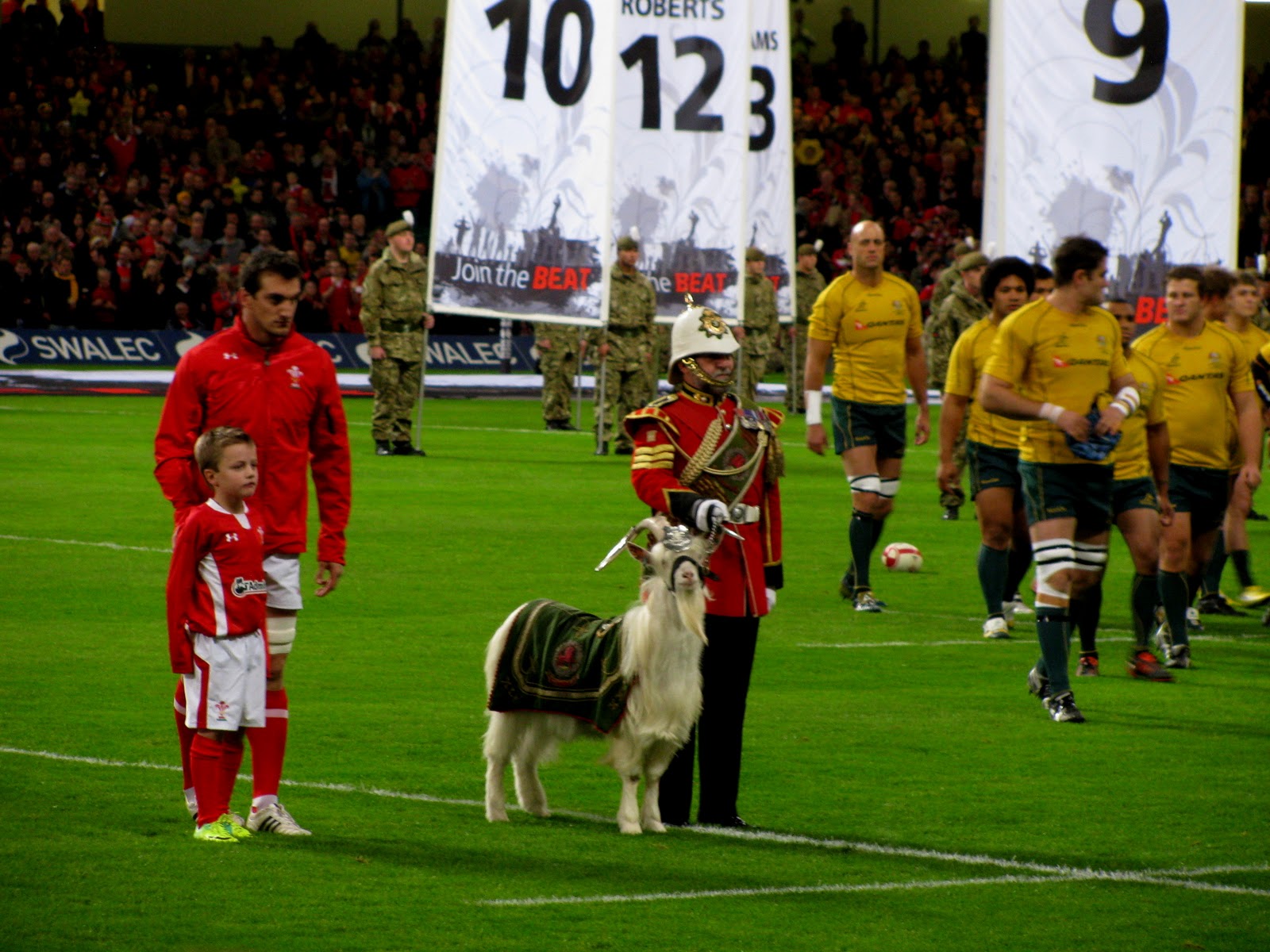
The Welsh regimental mascot - a goat with silver tipped horns!
The Australia v Wales match wasn't part of any official tournament, and its outcome didn't actually have any bearing, but this didn't bother the Welsh. The pre-match build-up in Cardiff's millenium stadium pulled out all stops.

Nearly a whole quarter of the seating was taken up by choral singers from all over Wales, who performed traditional hymns in Welsh. Wales has a strong tradition of vocal performance, being dubbed the "land of the song" and is the home of the eisteddfod, a gaelic music and culture festival.

As their beloved starting team was announced, the crowd roared, and was nearly drowned out by vertical pillers of flames - presumably something to do with dragons - being lit around the edges of the stadium. The bellowing spectators weren't much interested in the particulars of the opposing team. The announcer even started introducing the players in reverse order, and didn't realise he had started at number 1 even though the pictures went from number 15, until he reached halfback Will Genia's name!

Fire breathers
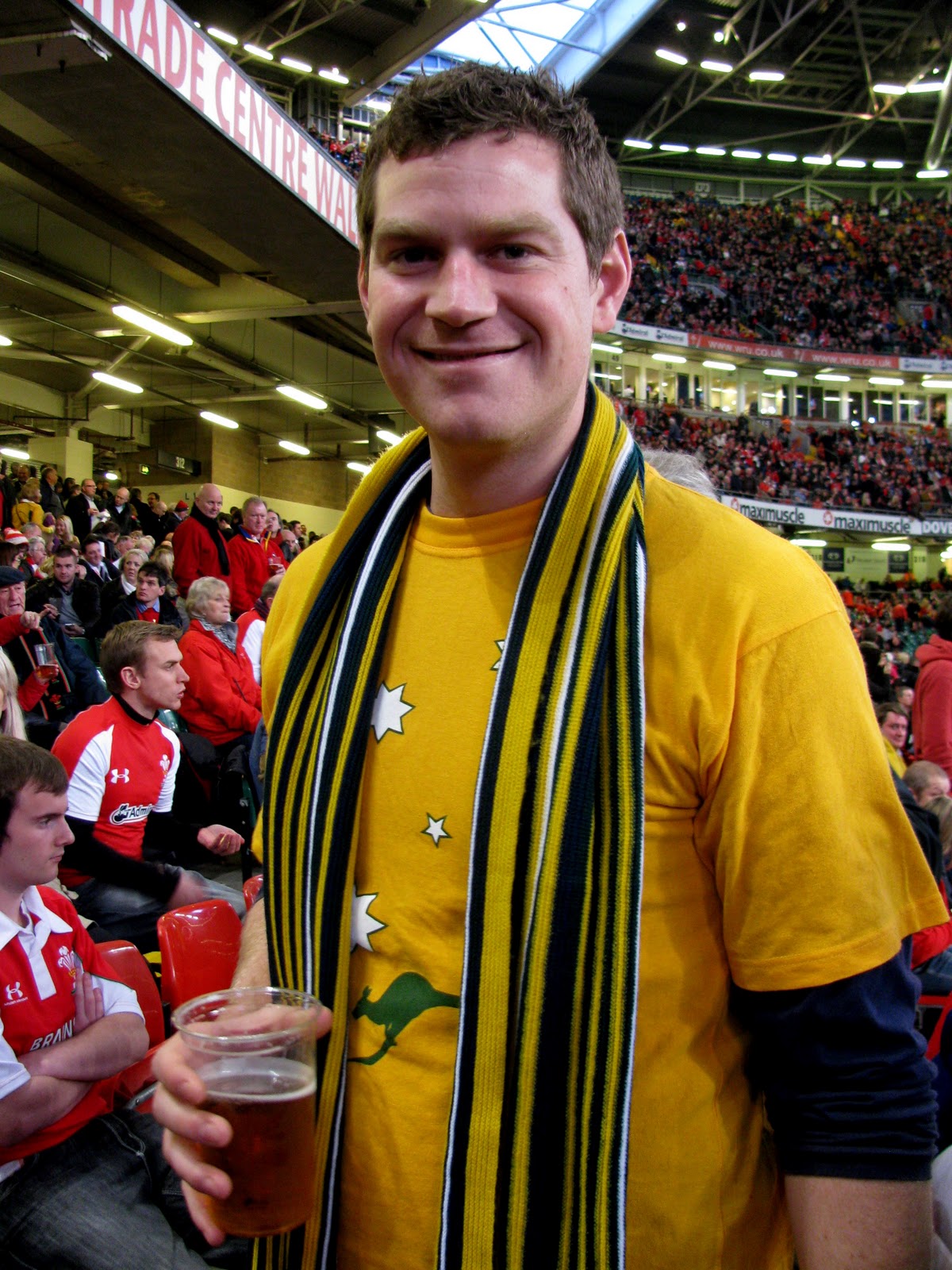
There is one problem with seeing your team play an away game. It is very difficult to get excited when every time your team does something good, everyone else is silent or you have to contend with a chorus of exasperated sighs. We went to the match with a rugby-mad Welsh family, which are members of the Welsh Rugby Union, so you can imagine how many fellow Wallabies supporters were in the vicinity. It is quite eerie shouting out encouragement to your team when they score, only to be met with silence and the odd death stare.

The home side had a reasonably strong start, and by the end of first half either side could have come away with a victory. The Wallabies initially looked under pressure, and the crowd responded eagerly with constant singing and chanting. But their cries gradually faded as enthusiasm wore off, dawning on the fans that Wales would probably lose. When the Wallabies started a 21-point scoring streak early in the second half, the silence was deafening.

Wallaby pride in a sea of red
The Wallabies won 24-18, but Wales was not denied a fairytale ending when they scored right on the 80th minute - the never-say-die resolve intact. The try scorer was national hero Shane Williams, a winger playing his final match for Wales before retirement. If you didn't know the outcome, you wouldn't have guessed that Wales lost as thousands of rugby fans converged excitedly on central Cardiff, where thousands were already installed in pubs watching the match on TV.

On the obligatory post-match pub crawl, we called in at a number of establishments along Mary Street, the main drag in the entertainment precinct. All were incredibly crowded, stuffy and played terrible 1980s music. We eventually retired to Bridgend where our Welsh hosts live, half an hour from central Cardiff, and plonked ourself down in a bay window seat at the local boozer.

Our Wales weekender would not be complete without a drive around the rugged South Wales coastline. At the seaside town of Porthcawl, where miners would take their families to a company-built holiday resort or caravan park, surfers were dotted in the choppy breaks, even though it was December and the water temperature down to single figures.

The ruins of Ogmore castle on the river Ewenny
The area around nearby Ogmore beach is clustered with rolling sand dunes and is popular with horseriders who gracefully canter through on their steeds on their way to the open expanse of beach. This is the largest sand dune complex in the UK, and was used to film parts of Lawrence of Arabia. Unfortunately we didn't really get too close to the beach, being winter, and fat droplets of rain had started to fall. It was extremely cloudy so visibility was poor, although you could still see a vague strip of land across the Bristol Channel to Somerset county in England.

Other local landmarks we visited on our little adventure included the ruins of Ogmore castle, a Norman construction dating from about the 12th century. Perched on a flood-prone river bank, this sight is somewhat overshadowed by a path of enormous "stepping stones" that allow you to cross from one side of the river to the other. A stone bridge with round sheep-sized holes in it used to function as a sheep dipping station. Farmers would push the sheep through the holes and into the river below, stripping the sheep of lice and other nasties in their wool before they were sheared.

South Wales is incredibly green, thanks to the plentiful supply of rain, and this part of it boasts lush, arable farmland. Narrow country laneways are lined with ancient stone walls, many of them dry stone meaning they are just very strategically placed rocks with no mortar to join them. The village of Merthyr Mawr has a beautifully preserved collection of thatched cottages which once belonged to a large nearby estate and used to house the servants and other staff. The cottages are arranged around a village green, their thatched rooves fitting snugly over their windows.

In Bejing, everything is on the menu!

The quality of the food in Beijing exceeds expectations on all levels, from cheap noodle bars and street food to swanky dining establishments. Most places we went were surprisingly good value, although all hotels and restaurants slap on a 15 per cent service charge. You can get a steaming bowl of wanton noodles or a big basket of dumplings for 10 yuan ($1.50) at a hutong eatery, or a fancy meal out for 100 yuan ($15.00) per person.

Baozi
Finding a nice meal at neighbourhood eateries is a lucky dip, as most menus don't have English translations. The best strategy is to find one with pictures of the dishes displayed on the walls, and point to anything that looks tasty. Trying to learn the names of dishes in Mandarin is basically an exercise in futility, as no one will be able to understand your feeble attempts at pronouncing the language. I just stuck to hello, thank you and used my fingers to indicate the quantity of whatever I wanted.

For breakfast, we indulged in Baozi – a sort of oversized bready dumpling that was almost the texture of a pork bun and filled with spicy beef mince. They are sold in little shops all over Beijing, stored in stacks of metal steamers.

At dusk, Donghuamen, or Snack Street as it is better known, comes alive with a seemingly endless row of food vendors, staffed by an army identically clad in white chef’s coats and red sunvisors. There are skwers of just about anything you can conceive, from westerner friendly chicken and beef to insects including scorpions, grasshoppers and the downright bizarre, snake and sheep’s penis.

Can't believe I ate one of these critters!
Inspired by Karl Pilkington’s “An Idiot Abroad” I was determined to try the scorpion. I was a little discouraged when I saw a tourist eat one of the crunchy insects, much to the horror of her Chinese companions who refused to touch the stuff. Undeterred, I bought a skewer, and to my surprise it actually didn’t taste so bad, probably due to the delicious barbeque marinade and the fact that it was so overcooked it had the texture of a kettle chip.

We had an amazing roast duck feast at Beijing Da Dong, actually two because we liked the place so much we ended up going back a few days later. The famous ducks are strung up and baked in an enormous clay kiln which looks like a woodfired pizza oven. They are tended by dedicated chefs who haul the cooked specimens out with long sticks. The ducks are then hung up on a rack and another chef tips them upside down and pours a rather copious amount of fat out of them. They are then plopped on platters and taken out and sliced at diners’ tables by servers with white coats and surgical masks.

Peking duck is carved with surgical precision
It wasn’t just the outstanding (and surprisingly lean) Peking Duck that had us coming back for more. Da Dong has an extensive and exquisite menu, presented in an enormous volume that numbers over 100 pages. There was an amazing variety of beautifully presented entrees, including mushrooms accompanied by tomato beer in a teacup, Szechuan spiced chicken with a tube of microscopically diced watermelon and passionfruit paste, and a delicate pomegranate seed salad. I spotted a dish made from fairy floss at one table – it was served on long stalks that were placed in an edible garden. Even the ubiquitous complimentary fruit served at the end of the meal was delicately presented on a mystical bed of dry ice.

Another must-taste on the culinary agenda is hot pot, Beijing style. We were ushered into a dining room clad in garish red and gold decorations and sat at an enormous table (way too big for the four of us) equipped with a lazy Susan and individual hotpot burner. These brassy burners were vaguely reminiscent of a fondue set, with the stock bubbling in a ring around a central tower, and a kerosene burner underneath.

Food coma - delicious Beijing hot pot
The concept of hotpot is simple. Your order stacks of raw meat, sliced thinly and rolled up, vegetables including mushrooms, bean sprouts, spinach and lotus root along with other delights like bean curd, dumplings and various meaty balls. The raw materials appear on the lazy Susan within seconds piled high on enormous platters and you cook them yourself in your hotpot and fish the finished products out with your chopsticks.

Some foods, like meat slices and greens, cook in seconds while the dumplings and balls take a few minutes. It’s easy to forget what you have brewing in there. Waitstaff buzz around the table, topping up your hotpot with extra stock and skimming off any gunk that accumulates at the top of the broth.

Arguments over who should pay the bill are common in Beijing. In Chinese culture only one person pays the bill for the group, but this is often not decided on until the end of the meal. We saw a very heated argument between members of a group over who would pay, and the loser (who did not have to pay) ended up storming out of the restaurant.

See! I really ate a scorpion
Finding decent accommodation in Beijing is not that easy – most of the listings on various travel sites have been trashed by unhappy customers. Staying in a courtyard hotel on one of the hutongs is a great way to get in amongst the action, but the problem is most cab drivers will not be able to find them, and your attempts at even saying the name of the street will prove futile.

Nonetheless, we were extremely happy with Sitting on the City Walls. Tucked away in a maze of alleyways behind Jingshan Park, a stone’s throw from the forbidden city, The spotless rooms were set around a beautifully atmospheric covered courtyard, decorated with Buddhas, rock art and even a replica terra cotta warrior and lots of tables and comfy lounges to sit at.