Tuesday, November 29, 2011

Xi'an's incredible Terra Cotta army

In 1976, a farmer innocently digging a well just outside the former Chinese capital of Xi’an unearthed one history's most amazing archaeological finds. The farmer discovered an army of life-size figurines made from clay, buried just three metres below the surface in an area close to the tomb of Qin dynasty emperor Shihuang Ling who died in the 3rd century BC. 

Over 2000 of these gems, dubbed “Terra Cotta Warriors” have been unearthed in three separate plots, along with life size terra cotta horses,  The warriors are arranged in battle formation, with a vanguard of armourless younger soldiers at the front of the battle lines and flankers to the side. Still more have been identified but not yet excavated.

The warriors, which are over 2000 years old, are amazingly crafted. Each was handmade from coils of clay, then kiln-fired and glazed in bright colours. There are a number of different designs – generals, officers, ordinary soldiers and kneeling archers. The level of detail in the warriors is incredible – you can even see individual strands of hair and intricate carvings on their armour.

The warriors are displayed in situ at the excavation site. You visit them in a series of pits, where they still are arranged in battle formation. Unfortunately their bright colours have faded, and the excavation process has been halted until archaeologists devise a way to preserve the delicate clay oxides. Some of the better preserved warriors are presented in glass display cabinets, giving you a close up look of their fascninating detail.
We visited the warriors on a day tour of Xi’an. Our guide, Jackie – his English professor was a big fan of Jackie Chan – was a Xi’an local, and a wealth of information about the discovery of the warriors and also how they had helped spur an enormous tourism boom in the city.

The warriors were a fascinating sight, but they don't need a whole day to peruse. Luckily there were plenty of other things to see in Xi’an, China’s fourth-largest city with a population of 12 million. As the former ancient capital of the middle kingdom, Xi'an has some beautifully preserved architecture from the Tang dynasty. Our day tour also took in a visit to the stately seven-story Big Goose pagoda. It is surrounded by a complex of temples, all built in traditional Tang dynasty style. 
We couldn't sneak a peek inside the giant pagoda itself, but were allowed in a temple in front of it where people were saying prayers and lighting incense before an enormous gold buddha adorned with what is now more menacingly known as the swastika symbol (why Hitler chose to pilfer a symbol of peace and
At the gate of the city walls
enlightenment I will never know). My parents got in trouble for stepping on the threshold on the way out, which is a bit rough as all the doorways in these traditional buildings have giant wooden planks across them that are hard to get over. There was also an incredible room with jade bas-reliefs covering the walls that told the life story of Buddha in several different stages, from his youth, to when he decided to seek enlightenment and his later life. The carvings were amazingly delicate, and used several different shades of jade as well as a myriad of other stones to depict buddha, his followers and his surroundings.
Later, we ended up at one of the entrance gates to the perfectly intact walls which frame Xi'an's downtown district. Unlike sections of the Great Wall, these city walls are in such good shape that it is possible to rent a bike and ride on top of their 13km circumference, or simply stroll along the top, a beautiful way to see the city skyline without being caught up in a traffic snarl. 

Sunday, November 27, 2011

Traditional splendour meets relentless progress in Beijing

Spending a few days in China's booming capital Beijing gives you box seats to the amazing transition taking place in the world's mst populous nation, as millions of people each year move from impoverished rural provinces for a taste of modern capitalism. Many of the physical changes to the cityscape occurred in the lead up to the 2008 Olympic Games, but on a human level the metamorphosis continues.

Amazingly, this sprawling metropolis of 19 million people is only China’s third largest city, behind Chongqing and Shanghai. Like most Chinese urban jungles, it is immaculately well planned, arranged around a set of concentric ring roads spiralling out from the centre.

Beijing is spread out, even at its bustling epicentre. The roads, arranged in a neat grid pattern, are very wide and the blocks are enormous. Looking at a map gives you the impression that the city is quite compact, until you realise it can be up to a kilometre between major thoroughfares! There is also a slick modern and efficient subway, although this hasn’t done much to curb the city’s alarmingly choked arteries. It is possible to get stuck in appalling traffic jams at any hour of the day.

Lantern-lined Ghost Street (Guijie)
Most of the city’s tourist attractions are handily clustered in the centre of town around Beijing’s historical heart, the Forbidden City and Tiananmen Square. Nestled among the traffic-choked boulevards of the Dongcheng district is a maze of alleyways known as hutongs, which provide a fascinating glimpse into traditional Chinese life. Hutongs are jammed with hole in the wall restaurants, where workers slurp up steaming bowls of noodle soup, small grocery stores stacked with cigarettes, rice wine and vegetables and traditional Chinese courtyard houses hiding behind high brick walls.

Courtyard houses are shared by several families who are often part of the same work unit, which, after the immediate family, is the building block of Chinese social life. Members of work units not only live together, they also holiday together, visiting other parts of China on guided tours, wearing identically coloured hats and following a flag-toting guide.

Many run-down Hutongs are being cleared for developments
Hanging in a hutong and peeking into bicycle-crowded entranceways is the best way to observe ordinary Chinese people go about their business. There is always something happening in the alleys – I walked past three ladies lounging around on a couch outside a house, gossiping away, and several groups of men arguing heatedly over games of Chinese chess.

Houses in many of the city’s hutongs are pretty run-down, and since the construction boom leading up to the Olympics many have been cleared to make way for shiny new developments. Sadly one of Beijing’s last remaining cultural institutions is gradually disappearing.

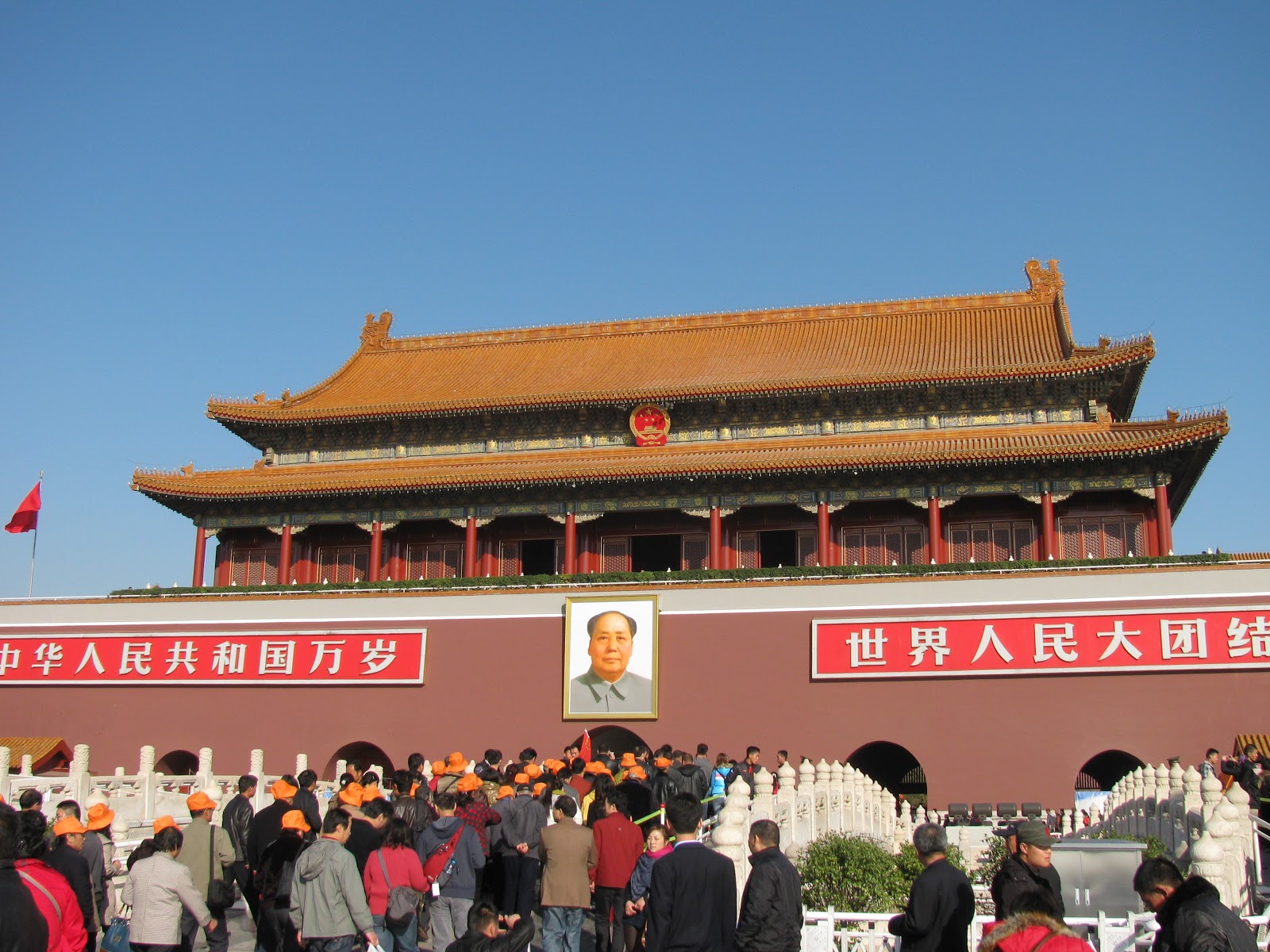
There is an impossible number of attractions and entertainment options in Beiiing, and like most things in China, everything is done on a grand scale. The Forbidden City, once the heart of imperial China, is no exception. Passing under the Meridian Gate opposite Tiananmen Square, the stately main entrance bearing an enormous portrait of Mao Tse Tung, you are instantly aware of the enormity of the place.

Entrance to Forbidden City
There are another five identical gates to pass through before you reach a dizzying labyrinth clustered with 20 or so palaces, plus other interesting sites housing ancient calligraphy and ceramics collections and other royal treasures. The palaces were predominantly built during the Ming dynasty in the 1600s. Many were destroyed (often repeatedly) by fire and later rebuilt and updated during the later Qing dynasty which ruled until the fuedal system was brought down in 1911. Many buildings had amusingly grandiose names. My favourites were the Hall of Mental Cultivation, The Palace of Gathered Elegance and the Hall of Martial Valor. I also loitered around the Hall of Literary Glory, hoping some to absorb some good vibes.

It seemed the emperors had palaces for all occasions. There was the resting palace, where the emperor would have some downtime before important state visits or war meetings, palaces for the various armies of concubines, and palaces occupied by different emperors at various times throughout history. At the top of the site sits the imperial garden, a tranquil area dotted with dome-shaped pavilions surrounded by cypress trees and rock gardens.

All buildings are of a similar design, with identical roof tiles, colourfully painted beams and upward-sloping eaves adorned with tiny dragon figurines. The network of walls in the city, both inside and out, are all painted red. Aside from the enormity of it all, the most amazing thing about the Forbidden City is how incredibly well-preserved the buildings are, both inside and out. Many of the palaces are still decorated with their original objects – elegant wood-carved furniture, ornaments and beds still made up with mattresses and bolsters.

Beijing’s parks are built on a similarly grand scale, and are another great way to gain an insight into daily life. We visited the Tian Tan, built 600 years ago during the Ming dynasty. The centrepiece is the Temple of Heavenly Peace where people went to pray for bumper harvests. The park, set over more than 100 acres, also contains a tomb and other imperial buildings including a fasting palace, where the emperor would avoid meat, alcohol, women and other vices before a big event.

Smoking men
Curiously, there is an entry fee for the park, and it costs extra to visit the palaces, but we didn’t bother because there was quite enough to entertain us just strolling along the cypress-lined avenues and exploring the various gardens. One area was packed with groups of exuberant cards and chess players, while on benches under the cypress trees people sat, smoked and chatted in groups of twos and threes. There were even small choral groups practicing under the trees surrounding the rose garden. A conductor faced the group, who followed a book of song verses attached to a music stand.

The Chinese seem to make the most of their playtime. Despite the early winter chill, they turn out in droves every morning to practice tai-chi in the park. Others group together for ping-pong tournaments in neighbourhood parks, or play hacky sack with curious bouncing objects shaped like badminton shuttlecocks.

Despite increasing levels of car ownership – which often cost Chinese families more than the value of their homes – bicycles and scooters are the preferred means of getting about. Beijing is an amazingly bike-friendly city. Besides being pancake flat, there are dedicated bicycle lanes on every road. Still, cycling around the city is not without its perils, mainly because bigger vehicles automatically assume right of way, and at every intersection cars turn across bicycle lanes whenever they feel like it.

Cars are allowed to turn right on red lights, and scooters share the bicycle lanes. If that wasn’t enough, cars often sneak in there too, and park right across the lane. There is also the danger of pedestrians stepping out on the street without looking. I saw three traffic accidents – all involving pedestrians – during my time in Beijing.

Sculpture at 798 Art Zone
Being a pedestrian automatically puts you at the bottom of the pile. Even though all of the intersections are marked with green men, they do not make a scrap of difference, as every time you cross a road you are stalked by turning cars, scooters and bicycles, many of which are electric so you can’t hear them coming. Some of the streets are over 10 lanes wide, so crossing them can be quite an experience!

Riding around the city was an exhilarating, if not slightly perilous experience. We rode out to the edgy 798 contemporary art zone, a precinct of galleries, cafes and restaurants in a disused East German factory. The trip took us right out near Beijing airport, somewhere between the fourth and fifth ring roads. There was an amazing variety on exhibition there in the muddle of independent galleries - from Chinese contemporary paintings to kooky sculptures to a Tibetan photo collection to North Korean propaganda art - where we got in trouble with the thought police for taking photos.

Thursday, November 24, 2011

Another bloody Aussie in London

It seems like there is never a good time to move to the UK, especially not since the country has been paralysed by stagnant economic growth and rising unemployment since the financial crisis. The usual question we were asked when we told people of our desire to up stumps to London after our big trip to South America was "why?", quickly followed by taunts of "you don't realise how bad things are over there," and "the Australian economy is booming, so why leave?"

Two things: first, Australia is a microcosm, a tiny market that, although it has a healthy economy, doesn't have the breadth of job prospects in journalism and engineering (mine and Adam's respective professions) than the much larger UK, which lets not forget, is on Europe's doorstep. Second, the Australian economy is booming - if you work in the mining sector, an industry which I have absolutely no desire to cover, but which occupies many column inches in the Australian media. And I have no desire to move to Perth, should Adam wish to work for a resources firm.

We touched down at Luton airport (ironic that it is called "London Luton" because it is in the middle of the countryside), our backpacks stuffed with smelly, falling apart clothes and various souvenirs including Amazonian hammocks, Brazilian sarongs, Guatemalan scarves and Oktoberfest beer steins. Fortunately for us, we both have EU citizenship thanks to our Anglo-Irish heritage. Adam is even luckier to have a British passport because he was born in Peterborough before at the age of two his family embarked on a world odyssey, finishing up in Australia when he was 11.

Another thing that has made settling in much easier are the ranks of Adam's relatives dotted around the UK. Our accommodation anxieties were quelled by an offer to stay with a cousin who lives just to the east of Central London. Whitechapel and Spitalfields, former industrial and warehouse precincts, are better known as the former hangout of bloodthirsty serial killer Jack the Ripper. Part of the council borough of Tower Hamlets (being a stone's throw from the Tower or London), are in the process of being refurbished and renewed with slick warehouse conversions and modern apartment blocks popping up in among tired brick blocks of council flats.

East London has a strong history of migration, having been home to successive intakes of new arrivals for hundreds of years. The Huguenots, a band of French and Flemish protestants, made the area their home in the 1700s. London's Jewish community then settled in the 1800s and established textile factories after the sewing machine was invented. Jewish families have since moved westwards as they became more established, but they left behind clues of their existence, including a row of bagel houses.

Bangladeshis are the latest custodians of the area, and as a sign of the times, the former Spitalfields Great Synagogue now operates as the London Great Mosque. It's focal point is Brick Lane, a long narrow alley clustered with curry houses and supermarkets, where the air is heavy with a heady blend of cumin, garam masala and green chili aromas. Gaudy sari and gold jewellery shops line the surrounding streets, and discount clothes merchants run a labyrinth of stalls on nearby Petticoat Lane.

Whitechapel is also home to a large numbers of Pakistani and Somali residents , as well as the more established afro-Caribbean community. This heady mix gives the area a completely different feel to other parts of the inner city, and the large muslim population means that at times I am the only person on the street not wearing a head covering. Many simply wear a hijab along with their usual Western-style clothing, but it seems like more and more women are now dressing more traditionally, and opting for full face and body covering with garments like the burqa.

Our new view
The city's financial district is just a few blocks west, making Brick Lane and the now trendy enclave of Spitalfields a popular drinking and dining destination for hoards of socially conscious bankers and lawyers, many of whom have eschewed establishment areas of North and West London for a pad in the edgy East End. Thanks to an urban renewal project taking place noisily across the road from the flat, a big ugly brick building that used to serve as RBS's data centre has been demolishished, leaving us with a brilliant view that includes London's controversially iconic office tower known as the Gherkin.

Friday, November 18, 2011

Prague road trip

It was a pretty simple equation. Renting a car in Germany works out cheaper than taking a train, you can go as fast as you like on (most sections of) the autobahns, and Prague is just a five-hour hop from Berlin. Solution - road trip!

Caning down the autobahn in our hatchback while being overtaken at 180km/h by enormous Audis and BMWs was exhilirating. But the thrill soon wore off and we discovered it was much more interesting and to cruise the back roads that wound their way through the lush green countryside and through gorgeous little hamlets clustered with immaculately tended gingerbread houses. Fortunately we had a Sat Nav that told us where to go, saving us from getting lost and countless potential arguments!

On the way to Prague we stopped overnight in the town of Gorlitz, which sits on a river that forms part of Germany's eastern border with Poland. From the river bank you can sit in a tranquil courtyard cafe and gaze across at Poland. There is a stark contrast between the beautifully painted, perfectly presented homes of Gorlitz and the run-down grey soviet megastructures in the Polish town of Zgorzelec on the other side.

Landskron, the local Gorlitz brew
Gorlitz is one of the few towns in former East Germany that wasn't heavily bombed in the Second World War. The majority of its beautiful medieval and baroque buildings are intact and wonderfully preserved. It seemed like quite a prosperous town as well, despite only emerging from communism 20 years ago. Several large companies, including Siemens, are based in the surrounding region.

Continuing to Prague, we drove over the border to Poland (I think being Australian you get a thrill out of crossing land borders just for the fun of it), just to see what it was like. The condition of the roads deteriorated immediately, as did the quality of the breakfast and coffee on offer - lukewarm sauerkraut roll and machine-made espresso). I can't really give you an objective report on Poland given that we spent a sum total of a couple of hours there, and then made a beeline for the Czech Republic.

The roads, buildings and countryside all seemed to improve the minute we emerged from the forest separating Poland from northern Czech. Czech farmhouses are all boxy two-storey dwellings, and look remarkably large. We did drive through one unfortunate valley where a big brown haze settled over the area, thanks to a bunch of smog-belching brown coal power stations that are used to power Prague. Life expectancy in this region is well below other parts of the country, and its no surprise that many people have moved away and the remaining residents are plagued with health problems.

Prague's captivating Old Town Square
The first thing that struck me about Prague, other than how similar it looks to Florence, is how medieval it is. So many of its buildings, towers and churches were built in the 1400s or even earlier. The cityscape is lined with ramparts displaying the emblems of family crests, with Prague castle perched on a hill overlooking the river. Prague's oldest bar (or so they claim) is still standing, a dank dimly-lit establishment smelling of straw where you can drink Pilsener out of big ceramic mugs.

It's easy to see why Prague is so often described as an outdoor museum - its historic centre, clustered around Old Town Square, is mesmerising. The buildings are in immaculate condition - their facades beautifully restored and masterfully decorated with intricate period features and lots of gold leaf paint. Many have Russian-style spires on their roof, a gentle reminder that you are in Eastern Europe and not Italy.

Absintherie
Prague has definitely been discovered. Its tourism industry is on steroids, and when we visited in late September it was crowded with big tour groups, but strangely it retains a quirky, old-world charm (although accommodation wasn't that cheap as prices are rapidly rising). It is a hit with middle-aged museum afficionados and obnoxious youths alike - thanks to the arrival of cheap Easy Jet flights it is now a popular stag weekend destination English lads.

Its universal appeal may be because Prague has something for everyone. You can spend your stay gazing at medieval artefacts in Prague Castle, you can have booze-fuelled benders at strip clubs or absinthe bars (the Czech republic being the home of the magic green fairy) or you can simply wander around the city's maze of back alleys and gaze at the magnificent view of the river from one of the many bridges, soaking up the atmosphere.

Stalin shows off his iron fist
As this road trip was a last-minute addition to our stay in Berlin, we only had two days in Prague so we didn't get around to that many sights. As has been the case in other cities, we found the main event - Prague Castle - a little stuffy and a bit of a chore to get through, and enjoyed some of the more kooky sights more. The Museum of Communism was an absolute standout - fascinating, hilarious and downright terrifying all at once. As expected, it had lots of Commie propaganda (including some great anti-US anti-capitalism posters) and lots of info about all the idiotic programs the party ran, including collectivised agriculture, rationing and polluting heavy industry.

More surprising was a collection of relics on display - from military uniforms to pictures of gymnasts and old telephones to my personal favourite, a statue of Stalin with his classic "iron fist" raised. The museum chartered the rise of communism in the post-war period (amazingly the US bailed out Czechoslovakia in WWII but was then quickly turned into an enemy, hence the anti-US propaganda) and gave graphic detail on the hardline regime. Phones were bugged, conversations eavesdropped on, and anyone trying to leave the country was shot on sight.

Czech cuisine is famously hearty, so we weren't exactly gunning for goulash at every meal, but sadly we found the food in Prague a bit hit and miss. It's probably better if you dine in a nice restaurant, although I've heard the quality doesn't vary too much with the price. There are lots of nice-looking neighbourhood joints dotted about the place. The goulash is a lot cheaper than other dishes such as duck, pork knuckle or (Adam's favourite) steak tartare, and the one I had was pretty grisly and served only barely lukewarm. We had more success with the wine - there was only Czech wine at this place, and to our delight it turned out to be a beautifully smooth Pinot Noir - who would have thought?

We managed to strike a fabulous compromise between budget hostel and comfortable guesthouse accommodation with the Czech Inn. A beautifully restored 19th century building with a big downstairs bar, it is technically a hostel but you can rent apartments (which look like they were renovated yesterday) on the top couple of floors. The apartments are self-contained with stainless steel kitchens and a loft-style living space. The only catch is that they have two bedrooms - great for two couples but if it is just the two of you, the living space and bathroom is shared with another couple, which feels a little odd.

Saturday, October 1, 2011

Big bad Berlin

Berlin is Germany's capital and its economic, scientific and creative powerhouse - truly a well-oiled German urban machine. An immense effort to rebuild the heavily bombed metropolis after the war has endowed it with a sleek central core of stylish modern buildings nestled among several refurbished or untouched historic stone buildings. Its tree-lined streets link together an incredible number of parks and green spaces - covering nearly a third of the city's overall area.

Bicycle is the way to get around Berlin
Most of Berlin's spacious avenues have bicycle paths and many intersections are equipped with special traffic lights, making this a great way to explore the city, whose sights are relatively spread out. Rather than squashing everything into one crowded centre, Berlin has four or five smaller centres, which reduces traffic congestion and makes life much easier for pedestrians and cyclists.

It's easy to forget that 3.5 million people live here. The atmosphere here is laid-back, almost mellow, with so few traffic snarls, quirkily dressed hipsters pedaling slowly by on vintage bicycles and everyone giving each other a cheery "HALLO" to greet each other. With more galleries and museums that you could possibly hope to see in a single visit, alternative living thrives in Berlin. Grafitti appears to be tolerated, vegeterianism is popular and recycling is king.

By German standards, Berlin seems like quite a tolerant city. It is very multi-cultural now, especially with its large Turkish population, many of whom live in the neighbourhood of Kreuzberg. Besides doner kebab joints on just about every street corner, there are lots of Chinese, Thai and Vietnamese restaurants in the inner city. We were so delighted with this - and intensely craving Asian food - that we had at least three pho noodle soups during our visit.

Berlin has a well-deserved reputation for having the world's best nightlife. Groups of eclectic youngsters prowl the streets, where the party is to be had just about any night of the week. On Saturday nights the streets are packed with revellers with beers in their hands as they warm up before hitting the clubs. Its not uncommon to see devoted partiers wandering around in broad daylight on a weekday after several big nights out.

As any Berliner will tell you, its all about the techno. Its Berghain club, built in a disused power plant, can accommodate up to 1800 party people under its 18-metre high roof. As well as chic bars packed with trendy types hanging out of them, huge grafitti-soaked warehouse complexes draw huge crowds, banging out music from dusk to dawn. There is an entire precinct in the edgy eclectic neighbourhood of Friedrichshain, containing at least five separate warehouses all pumping out different types of music, as well as an open-air bar with lounges and, wait for it, a volleyball net suspended over a surface of imported sand.

The wall and the post-war occupation zones
On first glance, its not obvious how much this freakishly organised, party friendly city has been through in the past 100 years. Berlin hides her scars well. They start to show themselves when you visit the many memorials to the horrors the city's residents endured during the Second World War and the ensuing division during the Cold War.

The infamous Berlin Wall, one of the strongest visual icons of the Cold War, is still intact in parts of the Eastern side of the city. It has been opened up to artists to decorate, and the East Side Gallery as it is known, is now a series of murals, from the cheesy, to the thoughtful to the flamboyant. It stretches along hundreds of metres of concrete breezeblock that used to be topped with razor wire to prevent residents of East Berlin escaping to the West.

Like the bloodthirsty Khmer Rouge regime in Cambodia or the bombings during the Troubles in Northern Ireland, the thing that most amazes me about the Berlin Wall is that this bizarre, inhumane situation occurred during my lifetime. I was 10 years old when the wall came down in 1989, a bit too young to understand the significance of it all. To me it looked like Berliners were having a giant rock concert on top of some concrete slabs and doing a lot of graffiti for fun.

It has been an incredible experience to get a close up view of the wall and learn more about the events surrounding it. This year is the 50th anniversary since the wall was constructed by East Germany to stop an exodus of its citizens amid falling wages and rising poverty in contrast to the increasing prosperity of the West. The Checkpoint Charlie museum - the border crossing used by Allied personnel since the occupation of West Berlin after the war - has amazing stories of escape, bravery and tragedy as East Berliners hid in cars, swam across the river and in one case even invented a light aircraft - in order to escape the communist regime.

Checkpoint Charlie
The museum was created shortly after the wall's construction by historian Rainer Hildebrandt. It has cars with hollowed out sections, a chair lift, a hot air balloon and a small pedal powered aircraft used to cross the border. Those caught trying to cross into West Germany would be shot on sight. As many as 600 people were killed trying to cross the Berlin Wall in between 1961 and 1989.

A peaceful tree-studded park adjoining the bank of the Spree River plays host to a Russian war memorial, commemorating the estimated 26.6 million Red Army casualties in WWII. At one end of a long pitch are twin marble structures boasting hammer and sickle communist symbols. An imposing black statue of a soldier dominates the other end - he is carrying a sword, which is pointed at his feet which is cutting a swastika symbol in half.

Russian soldier breaking apart a swastika
Even more stirring is a visit to the Jewish memorial and museum. The memorial is quite a strange design - a series of rectangular concrete slabs rising unevenly out of the ground, across a large plaza. I'm not sure what the significance of the slabs are - they could represent graves or how the concentration camps looked perhaps. The museum itself is downstairs, and besides being modern and equipped with all sorts of multimedia exhibits, tells this horrific story of the Jewish Genocide remarkably well. There is a section on various Jewish families from different parts of Europe, with information on what they did before the war, where they were taken to and what happened to them. There was a surprising amount of documentary evidence - letters, photos and videos which made the exhibit much more personal, instead of having to present long passages of text about what occurred.

The main touristy area stretches from the historic Brandenburg gate (where Ronald Reagan made his famous speech imploring Mikhail Gorbachev to tear down the wall) through to an island on the Spree river studded with museums to the funky shopping district Alexanderplatz. Its not always easy to tell on which side of the former wall you are standing on just by looking. Some of the utilitarian soviet-style constructions aligning main drag Karl MarxAllee (formerly named after Stalin) are a dead giveaway. Berlin has great neighbourhoods filled with cafes, restaurants and bars on both sides of the river, particularly Friedrichshain and Kreuzberg. We discovered lots of cool clothes shops and cafes along Oranienstrasse as well as along Kopernickerstrasse in Kreuzberg.

We were fortunate enough to stay with some friends who live in Berlin, who gave us a great lowdown on things to do, lent us bicycles, cooked us delicious vegetarian food and helped us understand many things about the great lifestyle that people in their city enjoy. And we were completely charmed by their beautiful 2 1/2 year old daughter Leyla, who kept us entertained throughout our stay.

A mural on part of the remains of the wall


Sunday, September 25, 2011

Oktoberfest

Strap on your lederhosen and hold on to your felt hats for the world's biggest beer-centric celebration. Oktoberfest! And where better to celebrate such a finely crafted beverage than in Germany's southern state of Bavaria, which has been perfecting the fine art of brewing for centuries. It still enforces strict beer purity laws to ensure its lagers, weiß beers and sweet dark dunkels remain the world's finest.

If you thought Oktoberfest was just another silly excuse to order enormous steins of beer, swing them around and spill them everywhere, well, you'd be partly right. But there is so much more to this mega-party than giant beer halls, bratwurst and pretzels. In Munich, Oktoberfest is held in the city's enormous showground, and is like a big carnival (think the Easter show without all the horsies), with rides, entertainment, food and of course beer. I was quite surprised to see little kiddies rocketing about the place, lining up for the rollercoaster and quaffing hotdogs.

Although it only happens once a year, the sheer size and solid construction of some of the beer halls looks like they are there to stay. Some of the big brands like Lowenbrau and Paulaner can seat thousands of people on long wooden bench tables inside as well as in the ubiquitous Bavarian biergartens. Crowds are kept entertained by oom pa pa bands replete with tubas and accordians, and are kept on their toes by tough-as-nails beer wenches armed with up to four one-litre steins per hand, and who think nothing of shoulder-barging revellers who get in the way.

Rockin the dirndls
Keeping your beer wench (which I'm told in this part of the world is a perfectly acceptable term) happy is an absolute must at Oktoberfest, otherwise you will be ignored and unable to get what you need - more beer. You can only be served drinks while sitting at a table, and its best to slightly overpay for each beer, as if you tip well she may even take a shine to you and start coming around more often.

It can be difficult to nab a table, which seat up to 10 people, once the festival swings in to full gear on nights and weekends. This does end up working out well, as it forces you to befriend groups of Germans in order to get a seat and be served. We ended up meeting lots of groups, some from Munich but many from all over the country who flock southwards for beer season. Beer drinking is a national sport all over Germany, but it seems nobody does it quite like the Bavarians.

Oktoberfest is celebrated annually as a commemoration of Bavarian King Ludwig II's wedding 201 years ago. Many of the original traditions are still in force. The most hilarious part of the festival is the lengths that people - both Germans and foreigners - go to to re-create the traditional dress. For the boys, its the suede leather lederhosen shorts, while ladies doll themselves up in floral frocks and fluffy white blouses, an outfit known as the dirndl. A felt hat with rope band and feather sticking out of it tops off the ensemble.

Uber-short lederhosen
We were quite keen to give the traditional dress a go, until we found out that they cost about 100 Euros ($135) an outfit, so we settled for daggy Robin Hood style hats instead. Finding affordable accommodation in overflowing Munich for the festival was also tricky, with spartan dorm beds in crowded hostels fetching up to 70 Euros a pop ($95). We opted to crash in a tent for three nights at a camping ground about 20 minutes from the town centre. It was organised by a bus company who also ferried revellers to and from the Oktoberfest site.

I can't say it was the most luxurious accommodation package we've ever experienced, what with having to pay for hot showers and toilet paper and getting extremely measly ''free'' breakfasts. The camping ground was absolutely packed, with about 10 other companies operating the same thing, and 150 happy campers in our group. Not that we spent a great deal of time at the campground anyway, and I was one of the lucky ones whose air mattresses didn't deflate while we were there.

It was much more fun to be at Oktoberfest as part of a big group, and there was always some good value people on hand to hang around with and fill up a beer table. It was a massive Aussie-fest - probably 90 per cent of those on the tour. After 10 months in South America meeting more Europeans than Aussies, it was quite a shock to meet the guy who lived 3 blocks away from us in Erskineville.

Say what you like about drunk Aussies, but at the end of the day they do know how to party, and are very outgoing and eager to meet new people, which made it easy for us to bond with our German brethren. After spending the first night in the Hofbrauhaus beer hall in central Munich laughing hysterically at Germans dancing on tables in their lederhosen, we spent the whole of the next day at Oktoberfest. We started in a big group at the Lowenbrau hall and moved out with a smaller posse to check out some of the rides. Luckily we did this nice and early in the day before too many steins had been consumed.

We then paused to sip on steins at a bar that was actually a rotating merry-go-round. You could sit on a horse with your beer and just watch the world go by. Later on it was off to the ginormous Paulaner tent, where the beer wenches were getting a little stroppy as it was approaching 5pm, when many of the tables are reserved for corporate groups arriving after work (can you imagine rocking Oktoberfest with your boss and all of your work colleagues? Only in Germany!)

After that it was harder to get a table, but we managed to sweet talk our way onto one at the biergarten at the Hacker tent, where everyone recharged with roast chicken and I retreated to half-steins.

Neuschwanstein castle
Thankfully the following day, the tour operators took our sleepy hungover selves into the stunning Bavarian countryside to check out Neuschwanstein castle, a two-hour drive from Munich. The relief was palpable. It was much more pleasurable to sip in fresh country air and walk around a beautiful regal pile than face another stein. The castle, built in the alpine foothills as a refuge for King Ludwig in the mid 1800s to commemorate his pal and hero, composer Richard Wagner.

Unfortunately Ludwig met a sticky end in suspicious circumstances in 1886, before the castle had been completed, so parts of the interior on the second floor remain unfinished. I know all this trivia because we had a guided tour (something I almost never sign up for, had I not been on a massive guided tour already): But it was totally worth it to hear the hilarious voice of our petite, serious-looking guide, who had obviously been taught to project her speech so everyone could hear. Combined with a heavy German accent, the result was priceless, slowing down to emphasise words in this huge scary tone, ''the...castle...was...NEVAR....FINISHED.''

It's a pity Ludwig wasn't around to enjoy his masterpiece, because it's a pretty elegant crib. The walls are decorated wtih murals that represent various Wagner works, and there are amazing woodcarvings on doors, walls and above the obligatory royal four-poster bed. Even the royal john looked like a stylish throne.

Surrounding the castle is a network of tracks through the forest, including one that takes you to a bridge over a ravine directly opposite, where tourist hoards gather to get the money shot of the castle. We walked a little further uphill, and made it up to a beautiful lookout where we had an amazing aerial view of the castle, the surrounding hills and the town and neatly-tended fields below.

That evening, it was back to Oktoberfest. It was a tamer affair for our group, as we didn't arrive until 7pm. The Germans were in full-flight, whacking steins together and dancing on tables. It was Friday night, and absolutely packed, with tens of thousands of revellers staggering up and down the lanes of the fairground. Luckily we managed to bag half a table in a beergarden, having been refused entry to three others which were too full. We had fun laughing at people on a ride that was like a really fast, slippery travelator - many people stacked it straight after they hopped on.

Sunday, September 18, 2011

Buenos Aires - Palermo & Recoleta

Leafy Palermo's avenues are lined with plush modern apartment blocks. This inner city neighbourhood, a few kilometres north of central Buenos Aires, has a much more upmarket demographic than the artsy hipsters crowd in San Telmo. Groups of women in expensive-looking leather boots walk their precious pooches among middle aged ladies pushing designer prams with their well-heeled husbands.

Palermo is criss-crossed by a network of grand tree-lined avenues. The enormous Avenida Liberador has a roundabout with a huge statue of Simon Bolivar, the leader of independence movements across South America. Avenidas Santa Fe and General de Las Heras are the area's commercial centres, and are lined with shops, delis, wine stores and cafes. Many of the quieter streets are home to neighbourhood steak houses, which serve up delicious juicy tenderloins, creamy potatoes and crispy salads.

One side of Avenida Liberador is lined with a series of rolling green parks, from the Buenos Aires racecourse and polo club (another British sport that enjoys unlikely popularity), to the Japanese Garden and jogging mecca Parque de 3 Febrero. This park has a tarmac circuit built around a geese-filled lake and historic houses, and is crammed with exercisers - joggers, walkers, cyclists and the ubiquitous Buenos Aires rollerblader. When we went on a Saturday there were rollerblading workshops, where groups were being taught various tricks and how to roll in and out of a series of cones.

One of Palermo's grand avenues
A couple of Palermo's parks are frequented by another Argentine peculiarity - professional dog walkers. There are so many dogs in the city that this has become a respected profession. Dog walkers must be licensed, can take up to eight charges with them (although in reality many have many more), walk them for two hours twice and day and some even have veterinary training so they can look out for ailments.

We found a park that was like a depot for the dog walkers, with up to 100 pooches running around or tethered to the ground. Seeing dog walkers in action is a hilarious site, as they cruise down the streets with an army of pooches hanging off a messy tangle of leashes.

Dog walker - this one is a beagle specialist
Palermo was our home for a week of our stay in Buenos Aires. We rented an apartment close to the subway station, just off bustling Avenida Santa Fe. Our place was a studio shoebox but had a spacious terrace to enjoy in the springtime sunshine. After months of being on the road and staying in mangy hostels, it was so nice to have our own pad again and cook what we liked in the kitchen.

All of our neighbours in the apartment block were super-friendly, and eager to make small talk when when we bumped into them in the lifts. Very different to the hostile looks I used to get from unfriendly neighbours when I lived in Sydney's inner suburbs!

Neighbouring Recoleta is even more upmarket than Palermo. I felt decidedly under dressed in my well-worn backpacker garb when walking the streets. All of the women here are very well-dressed, and hang out in fancy coffee shops and bakeries, sipping tea and nibbling on Argentine delicacies media lunas (small custard-filled croissants) and alfajors. These are sweet biscuits lathered with gooey caramelly dulce de leche, smushed together like oreos and covered in either meringue or chocolate.

Giant mausoleums at Recoleta cemetery
Recoleta's star attraction is its cemetery, which is like a mini-city of enormous marble and stone mausoleums. It is laid out in a grid radiating from a central statue of Christopher Columbus, with the mausoleums arranged like houses along a series of avenues.

Some of the tombs were so well-constructed, they looked bigger and sturdier than much of the housing we have seen people crowded into throughout Latin America. Many luminaries are buried here, including Evita Peron, several former presidents, doctors and scientists.

Recoleta is also home to a number of art galleries, including its local cultural centre and the Bellas Artes or fine arts museum. Both were free. The cultural centre had an interesting photographic exhibition called the people of Buenos Aires. It had quirky shots of all types of people, including street toughs, homeless people living under freeways, children, corporate types and some of BA's many immigrant groups including Chinese, Japanese and Bolivians.

Sadly, Buenos Aires is our last stop in the Americas, after 10 months learning Spanish and travelling from Baja California in Mexico through Central America to Colombia and through South America. Buenos Aires is amazingly mellow and easy to deal with in spite of being such a large city, and was a definite highlight along with Rio de Janeiro, Mexico City, Havana and Bogota. We are heading to Europe now, on our way to the UK where we hope to find work in our respective professions (journalism and electrical engineering). We will be in Germany for two weeks, just in time for Oktoberfest! Stay tuned for our next adventure as El Mundo hits Europe.

Our apartment block in Palermo

Wednesday, September 14, 2011

Buenos Aires - San Telmo & La Boca

Every Argentinian I've ever met will mention how "European," or how similar to Paris is their stately capital city Buenos Aires. Travel guides reckon that Argentina is oddly positioned in Latin America, and feels greater kinship with its European cousins, from which the overwhelming majority are descended, than its neighbours Brazil, Bolivia and Chile.

We may be visiting a place in the bottom corner of a developing continent, but Buenos Aires does its very best to convince you otherwise. There are the stunning grand baroque buildings adorning its the central Plaza de Mayo, including the president's crib, Casa Rosada (pink house) and the Catedral Metropolitana. Spanning out from the so-called microcentro are a web of grand avenues. And by grand I mean WIIIDDDE. One of them, Av 9 de Julio, is about 20 lanes wide and has four separate pedestrian crossings to help you across this enormous road.

Argie ''European'' pride
The streets of the centre are lined with beautiful 19th century apartment blocks, boasting posh little shrub-lined balconies. We could be in Paris but there are not nearly enough trendy cafes. Instead, there are cheese-filled delis, shops selling empanadas, grocery stores with giant butcher shops in the back and takeaway shops selling steaks, burgers and sausages.

If you face north to the Rio de Plata (which you can't see much of because there is a giant marsh in the way), to the left there are a series of giant parks, upmarket apartments and trendy shops in the barrios of Recoleta and Palermo. To the right is the slightly more shabby but equally trendy neighbourhood of San Telmo, followed by the seedy former port district of La Boca. We divided our 10-day stay in Buenos Aires along this axis - four days being urban hipsters in a grungy hostel in San Telmo, and the remainder in a stylish modern apartment in Palermo.

Like Argentina itself, San Telmo has had a riches to rags history, but is in the process of clawing its way back into the spotlight. With rows and rows of tattered colonial mansions, San Telmo was originally built as an upscale area, until sickness plagues drove the urban elite to move further north. It then became more of a ghetto, as the big houses were subdivided and overcrowded with large families. More recently, as artists and general boho types became interested in the area, it is starting to gentrify again.

In cafe/bar El Federal at San Telmo
Quirky clothes, antiques, homewares and bric-a-brac shops have popped up along San Telmo's cobblestone streets. They sit among the more established institutions of plush corner cafe/bars, so diverse that you can go there for a coffee, a cake, a glass of wine, a sandwich, or even a steak at just about any hour of the day. These little haunts are beautifully decorated, the walls lined with wine and fancy sherry bottles, historic pictures and antique bits and pieces.

Calle Defensa is a focal point for San Telmo, where you can find the most interesting shops and restaurants, particularly its intersection with Calle Chile, which is lined with sandwich bars and cafes that stay open until late. Further along Defensa is plaza Dorego, which plays host to a big antiques fair every Sunday. We missed the fair but arrived in time to see the tango dancing which takes over the plaza in the evening. A giant dancefloor with big speakers is set up in the plaza, and couples just show up and practice their moves. 

Do you tango?
Steak houses are another key institution in San Telmo. As in most of Argentina, you don't have to pay top dollar at a swanky place to enjoy a tender, perfectly grilled hunk of meat. We had a good tenderloin (called lomo) and an average bife de chorizo at Don Ernesto on Calle Carlos Calvo, although we suspect we were given ''gringo grill'' treatment after we ordered our steaks jugoso (medium rare) and they came out decidedly medium - no blood in sight. We also shared a butterflied t-bone at Desnivels on Defensa, which was not quite as tender, and again overcooked. To our dismay, other diners in the place had managed to order thick pink juicy steaks - obviously we need to learn the Spanish word for ''still moo-ing.''

A few blocks east of San Telmo near the waterfront are a series of canals that were dredged out with the intention of becoming the new port (when the original one at La Boca became too small). In typical Argentine style, the digging took too long - by the time it was completed 30 years later, the canals were too narrow to accommodate the recently expanded berths of modern ships. The project was abandoned and the area fell into decay, joining the many other square kilometres of disued port areas around the city.

Stylish modern buildings line the renewed canal precinct
But the bulldozers moved in and created a huge urban renewal area, to rival that of Docklands, Canary Wharf (and maybe one day Barangaroo?). The canals, or diques as they are known, are lined with tarted up warehouses (a la Jones Bay Wharf), modern business park style squat office blocks and shadowed by huge apartment towers. Wide paved walkways line the canals and are popular with power walkers, dog walkers and, another Buenos Aires specialty group, rollerbladers.

That's right - its not the 90s any more but no one told the Argies. Rollerblading is immensely popular here - people drive from all over BA to these wide, flat expanses to pull on their 'blades and go for a cruise. We spotted many people practicing fancy moves - going backwards, spinning, breaking suddenly. There were a couple of skateboarders out and about but their numbers paled in comparison compared to the rollerblading crowd.

The No 10 Messi jersey is a market fave
South of San Telmo, clustered around the disused port area (which nobody has yet bothered to rebuild) is La Boca, a far shabbier part of town. Colonial buildings are far more dilapidated here, and many are boarded up and look like they have turned into squats. We took a stroll down here one Saturday - despite the usual warnings of it being ''dangerous,'' we found it perfectly fine to wander down the main drag, although it didn't really provide much entertainment in the form of shop and/or people watching.

La Boca's smelly waterfront area - its thanks to the black estuary-like riverbank - has a wide footpath, but it isn't populated with the usual walking and rollerblading crowd. Further along though is a buzzing precinct filled with markets, tango bars and restaurants. Along El Caminito (the little walkway), the shops and houses are painted a variety of vivid, clashing colours. There are tarted up makeshift dwellings that look like they may have been constructed from shipping containers. Adding to the colourful medley are bright street murals.

Tuesday, September 6, 2011

Swept away by Igauzu Falls

View of the falls from Brazil
Forming part of the border between Brazil and Argentina smack bang in the middle of a semi-tropical rainforest, the mighty Iguazu falls is not exactly convenient to anywhere. It is a 16 hour bus ride to Sao Paulo in one direction and 17 hours to Buenos Aires in the other direction. But it obviously has a lot of pulling power - people endure bus rides of up to 24 hours to visit this magical natural wonder.

The falls can be viewed from both sides of the border. Divided by islands in the river into about 275 separate waterfalls, they gush downwards and are between 60 and 80 metres in height. Its possible to see more of the waterfalls in one hit from the Brazilian side of the border, giving a general overview of the area.

The Brazilian side has several lookout points dotted along a 1500 metre walking track. It culminates with a bridge over the river right in front of the breathtaking Devil's Throat area, a 150 metre wide u-shaped portion of the river where the water rushes through incredibly fast, creating an enormous cloud of mist which soaks you right through when you are on the viewing platform.

View of the falls from Argentina
Visiting from the Argentine side, while slightly more expensive than the Brazilian side, allows you to get more up close and personal with the falls. It has several different walks you can take through the national park which wind their way very close to some of the falls. There is a viewing platform practically underneath the Salto waterfall where you get thoroughly drenched - fortunately the mild climate means you are dry again within minutes. Another trail takes you above the waterfalls so you can watch them crashing down into the lower part of the river.

The highlight of the Argentine side is the track up to the other side of the Devil's Throat. While on the Brazil side there is the bridge that brings you underneath and to the side of it, on the Argentine side the platform walkway gives you a birds eye view. It is almost hypnotic standing at the platform, watching the water crash down into the misty abyss below. We were standing there in awe for about 10 minutes, when suddenly the water current must have increased because we were dumped on by a huge misty cloud of water. Check out our Devil's Throat video.

View of the Devil's Throat from Argentina
There was an amazing amount of wildlife in the park, considering it was pretty packed with tourists. We spotted an endangered Brazilian tapir along the roadside when we were on the bus back to the visitors' centre. We were dismayed to find about 50 tour buses parked out front when we rocked up to the Argentine side at 10am, yet still the park was alive with the chirping of brightly coloured blue birds and there were dozens of coati - a rodent-like creature with a tail like a racoon and a long bendy snout - sniffing around in areas where people were eating. On the way to see the Devil's Throat, there was a decent-sized alligator snoozing on one of the islands in the river.

Alligator!
Although we were incredibly reluctant to leave Brazil - it has been one of the highlights of our trip so far - we opted to stay at Puerto Iguazu on the Argentine side, which is a smaller, friendlier (and cheaper) town than industrial Foz do Iguacu on the Brazilian side. We arrived in Foz do Iguacu after a 16 hour bus ride from Sao Paulo, took two local buses to get from the bus station to the falls (despite what the Lonely Planet tells you, buses to the falls leave from a different bus station to the long distance terminal) and visited the Brazilian side before crossing into Argentina.

From the falls, we jumped in a taxi to the border post on the Iguazu river, a few kilometres downriver. Once we got our exit stamps, we walked across the bridge to Argentina. The cement siding on the road was painted Brazil's national colours of green and yellow until exactly halfway, when they changed to Argentina's light blue with a white stripe. Apparently the two countries had to share the cost of building and maintaining the bridge, and couldn't agree on the colour scheme!

We enjoyed our stay in Puerto Iguazu - it was a nice introduction to Argentina, a friendly little town and beautifully easy to navigate after our time in the big cities of Sao Paulo and Rio de Janeiro. We liked our hostel Residencial Uno, located on a quiet residential street of town, which had friendly helpful owners, a nice terrace to chill out on and five beautiful Alsatian dogs as pets.


Eating our way through São Paulo

All you can eat sushi!
Sprawling São Paulo does not boast the spotless beaches or stunning vistas of its coastal neighbour Rio de Janeiro, but it has a style and finesse that makes it worth visiting this non-stop metropolis. The city's attractions are not always obvious on first glance – you have to look more closely to discover its gems.

It is highly recommended to arrive in São Paulo with an empty stomach and pack a big appetite. This mega-city is absolutely bursting with places to eat, from neighbourhood grocery stores called lanchonetes to pizza parlours, French bistros and sushi bars. There are also 24-hour bakeries where you can have sit down buffets or hamburgers, pizzas and enormous sandwiches made to offer at any hour of the day. We went into one at 3am and ordered massive roast beef sandwiches with rocket, cheese and pineapple, and the place was packed with people of all ages doing the same, like it was a completely normal thing to do!

The secret behind São Paulo’s amazing gastronomy is its cultural diversity – it is the biggest, most multicultural city in Brazil. Its divine Japanese cuisine is thanks to the biggest Japanese community living outside of Japan. Besides offering amazing foreign cuisine, São Paulo has also taken traditional Brazilian favourites, such as rodizio or buffet, churrasco meat barbeques and chopp or draft beer and perfected them. The city is also awash with traditional Portuguese botequim bars which sell ice-cold beer, caipirinhas and snacks such as cod ball croquettes and meat sandwiches.

Teatro Nacional
São Paulo isn’t a mecca for sightseeing – it does have a couple of museums and cathedrals to gawk at, but its historical centre of town is quite run down, having been neglected in previous generations. Work is being done to improve the areas around Praça da Sé and Praça da Republica, in between which the beautifully domed Teatro Nacional sits.

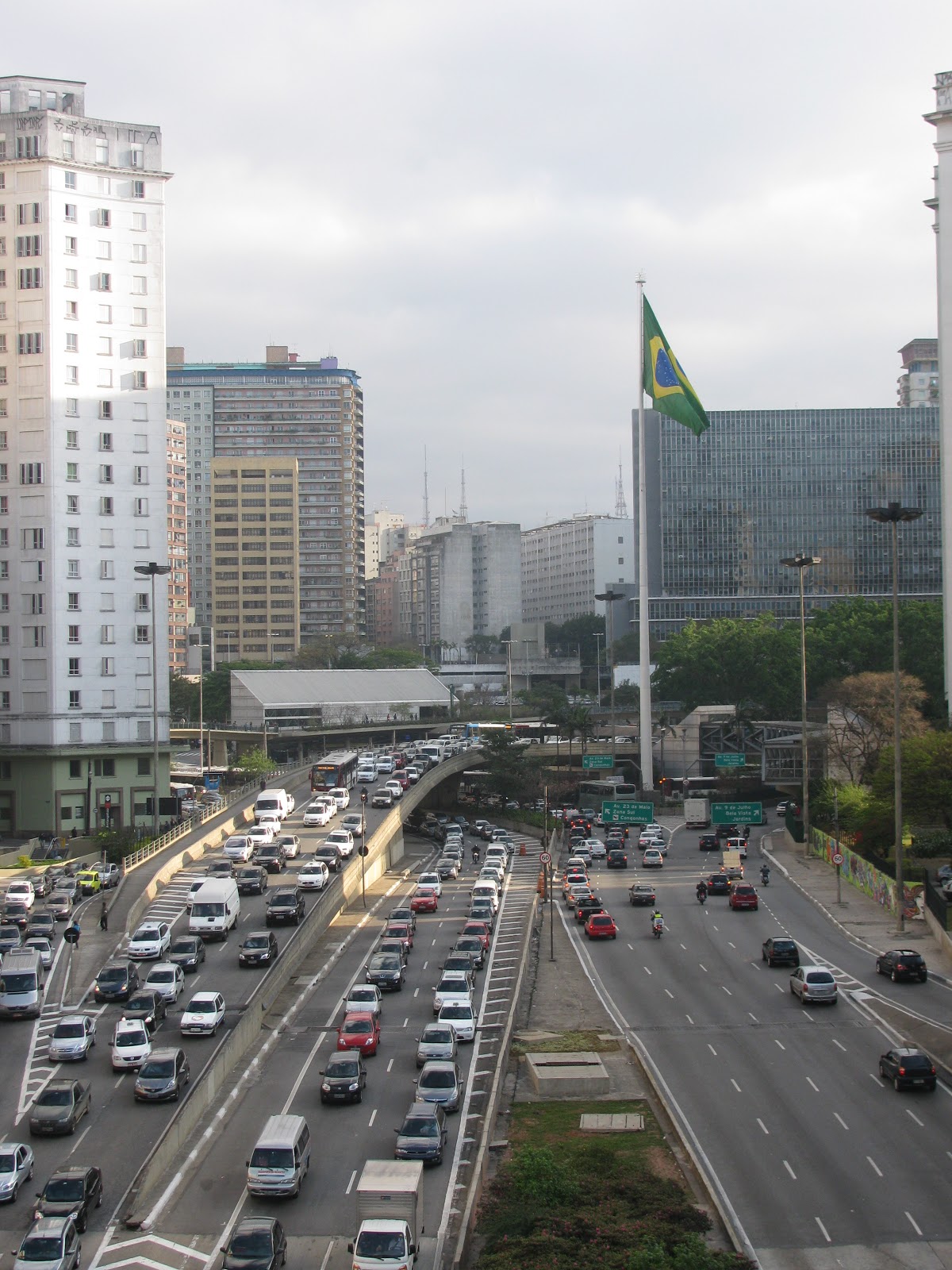
The centre of town is quite a weird place because it is such a hotchpotch of different architectural styles. You’ll find a row of Parisian-style apartments next to a dull grey 70s-style throw up with tiny windows and no balconies. It seems as if the city was built with little to no planning in mind – unlike other mega-cities there are no grand avenues or colonial quarters, and hardly any big parks or public spaces.

The city’s central market, Mercado Municipal, is freakishly clean and organised compared to other Latin American markets. Fruit stalls are neatly stacked, butcher stalls have meat sealed in chilled sections behind glass cabinets and there is a restaurant-style eating area in a mezzanine level food court. Downstairs we found an amazing lanchonete or sandwich shop selling the most amazing variety of pasteis, which look like very large pasties stuffed with various combinations of meat, chicken, fish and gooey catupiri cheese, a runny white concoction that looks like liquefied Laughing Cow cheese.

Tall buildings dominate the skyline in every direction – from the centre it looks like most of the city’s 20 million residents live in vertical villages and work in office towers. True, São Paulo is the industrial and financial engine of Brazil, being its centre of manufacturing, automotive, high-tech and luxury goods industries. But its world-class restaurants, metro system and freeways mask another side to the city which is safely tucked away from tourists’ eyes. While there are many wealthy people living here, there are also millions living in slums away from the big end of town, and its high crime rate is a persistent problem.

Just south of the centre, skyscraper-lined Avenida Paulistana is São Paulo’s commercial and financial hub. Further out from this, and easily accessible on the city’s fabulous metro system, are a bunch of trendy bohemian neighbourhoods where locals congregate to eat, shop, party and stare at artworks. The concrete-clad urban environment is made more interesting by the amazing array of street art and murals on just about every street corner.

Vila Madalena is an artsy, upmarket neighbourhood a few kilometres from the centre. Its main intersection is packed with huge pub-style restaurants. Quieter side streets play host to an interesting collection of art galleries, quirky clothes shops and fancy restaurants. On Saturdays the area comes alive with markets – fruit sellers take over the main drag Rua Mourato, selling all types of fresh produce, including cheese, olives and nuts.

Film projectors and old dial phones for sale
A few streets away, past rows of antique furniture stores and the imposing family tombs in the São Paulo cemetery, there is a giant antiques fair. We spotted an amazing variety of goods on offer here, to action figurines of Astro Boy, Bananas in Pyjamas and other 80s favourites to old Brazilian vinyl records, film projectors, army helmets, swiss army knives and even a rocket launcher!

The antiques on display were impressive – entire sets of polished silverware, napkin rings, trifle servers and sherry glasses, as if every Nana’s house in the whole city had been raided and put up for sale. There were also more modern items you would expect to find at markets such as jewellery, quirky artworks, baby clothes and fresh flowers.

One of the many things we couldn’t leave Brazil without trying is its national dish, Feijoada. This delicacy is a bean stew with assorted cuts of pork, including ribs, fillet, sausage and optionally, ears and various piggy insides. It is served in a giant bubbling cauldron, and accompanied by rice, spinach, crunchy fried crackling and this strange powdered cassava stuff called farofa which is sprinkled over top and used to thicken up the sauce. The stew has this amazing smoky pork flavour, and the meat falls right off the bones.

Crowds gather outside Consulado Mineiro waiting for a table
We were instructed to head to Consulado Mineiro, a Brazilian culinary institution located right opposite the markets. It was overflowing with people drinking on the pavement, waiting for a table. We had to wait an hour but decided it was worth it. It helped that we could order beers and drink them on the sun-drenched pavement. An order for two costs 60 reals ($35), and is absolutely enormous. It could easily have fed a family of four. Nevertheless we were prepared for the challenge and arrived for the task with totally empty stomachs. We nearly managed to polish off the entire stew, but there was still plenty of rice left. It was so filling that we had trouble walking home, and had to lie down for a siesta shortly afterwards. We didn’t need to eat anything  for the next 24 hours!

We had intended to check out more live music and clubs in São Paulo, but we were a little put off the first night when we went to a restaurant that had a band playing (sitting down at one of the tables) and we were automatically charged a cover charge without being told – it just showed up later on the bill.

Feijoada food coma
Fortunately Casa Club, the hostel where we stayed, had it all worked out for us – they had a different live band on every night, and sold ice buckets packed with beers in them for under $10. There was a great banjo-toting funk band on the Saturday night that played a bunch of Brazilian favourites before switching to covers of popular music later on in the night.

Casa Club’s bar was really popular with the locals, and was packed out every night. The locals were super-friendly and always eager to chat – and practise their English. Everyone in the city we encountered were very nice, and went out of their way to help us, even if they didn’t speak English. We were lost in the city with our map out (ok, and kind of arguing about which direction to walk in), when a guy stopped to help us, gave us directions and even walked part of the way down the street to make sure we were going the right way!