Saturday, August 27, 2011

Rio de Janeiro - Lapa and Santa Teresa


I go to Rio...de Janeiro
Brazil's first Portuguese colonial masterpiece needs no introduction. After all, it stars in so many bossa nova classic songs such as Copacabana, Girl from Ipanema and as my mother pointed out, Peter Allen's cheesy classic I go to Rio. It's barely a fifth of the size of Sao Paulo, but Rio de Janeiro is in many respects the pulsating heart of Brazil.

From its steep rainforest-covered outcrops overlooking squeaky clean apartment towers and precariously perched favelas clinging to the sides of the hills, this bayside city oozes energy from every oraface. Although probably most known for its beaches, there are endless things to see and do Rio's city centre and inner ring of suburbs, Lapa and Santa Teresa.

Walk a few streets this way and that, and the urban landscape changes completely. The commercial centre of Rio is, like most major cities, pretty non-descript, but just a few blocks over in the bohemian district of Lapa, the streets are lined with the plastic tables and chairs of Brazilian-style bars called botecas, restaurants and samba clubs.

Street murals in Santa Teresa
Lapa attracts big crowds on the weekends, especially on Friday night when its main drag Mem da Sa closes for a carnaval-style street party. Drumming troupes wallop out driving rhythms to the crowds drinking and dancing all over the street. Music erupts from the samba clubs lining the main drag, and there were also several clubs open in nearby alleyways. On one section, on a median strip underneath Lapa's giant white Roman-style aqueduct which splices the district in half, street vendors sell beer, popcorn, hamburgers and delicious Brazilian churrasco - an exotic word for chunks of grilled meat on skewers. But if you didn't want to leave your place in the crowd to go and get a drink, it didn't matter. Guys with trays of caipirinhas, Brazil's ubiquitous sugar-cane cocktail, circulated through the crowd.

While the party is on every night in Lapa - which in the past well-to-do locals wouldn't touch with a barge pole as it was a seedy, depraved red light district - Fridays is the night to go and experience it. Unfortunately the samba club owners realise this, and charge hefty entry prices for acts that on other nights you can go and see for free. We refrained from paying a cover charge, and instead opted to revel in the street outside the clubs, where you could still hear the music.

Colonial mansions of Santa Teresa
The street party attracts a diverse crowd. Everyone was there, from well-dressed groups of girls on the prowl to pickpocketing favela youths - one wandering hand dived into the pocket of my dress, where luckily there was only a map and some lip balm. There were even a few old guys busting a move outside the samba clubs at 5am. One guy with a toothless grin was asking us for money one minute, and then laying down his moves with us the next!

Lapa's parties showcase Rio's diversity in its full splendour, but the stark contrasts between the haves and the have nots are more blatant when you take a walk up any one of its steep hillsides. Giant, swanky white apartment blocks line the beaches and the trendy suburbs around the city centre, while rambling colonial mansions are tucked into the hillsides of leafy neighbourhood Santa Teresa. Its cobblestoned streets, lined with concrete retaining walls, are decorated with an amazing variety of street art, from council-commissioned murals, to throw-up graffiti pieces to all types of weird and wonderful characters and other spray-painted decorations.

One of Rio's many favelas
The area is quite mixed, with everything from schmick mansions to run-down tenements and even a giant castle jutting out of the hillside. Then there are the favelas, which occupy the steeper parts of the hillsides. Santa Teresa has no less than six separate favelas, interestingly all of which are marked on google maps, perched a stone's throw from stately colonial mansions protected by big rendered walls and razor wire. It is easy to make a wrong turn and accidentally stumble into a favela. It would be easy to get lost in the maze of streets but thankfully there is a tram line on the main one winding up the hill, which ferries people to and from the Corcovado, atop which the behemoth concrete Christ the Redeemer sits.

Santa Teresa's open-sided trams, or bonde as they are known locally, are an iconic part of this hilltop suburb. But tragically the day after we visited the area, there was a horrific accident where one of the trams lost control, skidded 50 metres down a hill and then hit a lamp post. This nearly sliced the tram in half and left 5 people dead and 27 injured. The accident made the bbc news and took place just minutes from our hostel. Some people staying there were walking up to take the tram and arrived on the scene right after it happened.

Visiting the famous Cristo, recently voted by internet poll as one of the new seven wonders of the world, is readily do-able by either tram, bus or simply walking up the hill. To admire the statue itself it is easier to go to one of the surrounding hills. The main point of going to the statue itself, and paying the entrance fee, is to admire the stunning 360 degree city views. Its height and central location means you can see all the weird and wonderful pockets of Rio, from the south zone and the beaches, to the city centre and all the way up to the less wealthy northern region.

Looking out to the Sugarloaf and the Atlantic beyond
The problem is, the weather isn't always amenable to a pretty Cristo sighting and Corcovado visit. Many tourists get their way up the hill, only to discover that the statue is shrouded in clouds, making it impossible to see the city laid out below. This was the case when we walked up the hill - so instead of going up to the Corcovado and paying the entrance fee, we opted for the lookout on a lower hill opposite. Looking out across the city, we didn't quite get the same panorama but were still able to see out to the beaches and over the coastline to Rio's other hilltop stunner, the Sugar Loaf, an almost vertical lump of rock that sits on a peninsula jutting out to the Atlantic.

There is so much to see in Rio that we thought it easier to try out two different neighbourhoods - the samba capital Lapa and leafy Santa Teresa for the weekend, and then relax at beachside Ipanema and neighbouring Leblon for a few days afterwards. It´s not always fun staying in the middle of a big, bad city but fortunately we lucked in on a fantastic hostel which made our stay so much better. Books Hostel is located in the heart of Lapa, right near the arches under which the weekly street party takes place. It´s a great place to hang out and meet people, and owners Renato and Felipe are really friendly and helpful and create a relaxed vibe.

Sunday, August 21, 2011

Island fun on Morro de São Paulo

Our search for the perfect Brazilian beach led us as far north as the idyllic Jericoacoara and south to the pristine sands of Arraial d'Ajuda, but in the end we found the best option right under our noses. The secluded peninsula of Morro de São Paulo, one of five settlements on the island of Tinharé, can be reached by a two hour speedboat ride from the city of Salvador.

Beach 2, Morro de Sao Paulo
Morro de São Paulo is not exactly a tranquil tropical paradise; it has definitely been "discovered" by Brazilian and foreign tourists alike. Yet it somehow manages to retain a laid-back feel - development has been kept to a minimum. Many of the homes and shops have been there since colonial times, their painted façades and terracotta roofs looking out at the calm turquoise Atlantic ocean. 

To get there we took a catamaran for 75 reais (about $40) from Salvador's Terminal Maritimo Turistico, in the centre of town behind Mercado Modelo. It was a rough ride, despite being in a two-hulled boat, and we were covered in sea spray after the 60km journey.

The peninsula consists of three beaches (uninspiringly named beaches 1, 2 and 3) connected by a long walkway. Along the second, biggest beach, it becomes a wooden boardwalk, separating a wide, sandy expanse from a row of shops, restaurants and bars. After running alongside the first beach, the path winds its way up the hill and over to the ferry wharf on the other side of the peninsula. Every shop along this part seems to be selling havaianas, Brazil's famous native brand of flip flops (sorry to my fellow Aussies but as this is a blog also read by non-Aussies, I have to use international English) - you can even find a pair in the supermarket for $5 a pair.

Sadly, the beaches here aren't great for swimming, thanks to great colonies of rocks implanted in the sand. It's possible to swim at high tide, when the water comes up so far it practically envelops the entire beach. There are some tracts of beach that are rock-free, but the bottom is a little muddy so the visibility isn't great. After searching for a perfect swimming spot for days we abandoned our plan to swim laps, and instead were contented to wallow in the shallows.

Luckily, there is plenty to distract you from the lack of a perfectly-formed beach. In Brazil, it seems that most of the action takes place out of the water. Morro de São Paulo offers people watching par excellence. Its most interesting mix includes locals hanging about selling coconuts, playing soccer and beach volleyball, toned young Brazilian couples in skimpy bikinis and super-small male briefs (Tony Abbott eat your heart out), middle aged women dressing as 20-somethings and the odd French or Scandinavian family on holiday. 

Brazilians have invented their own take on beach volleyball, combining it with soccer so that instead of using your hands, your feet, knees, head and even chest are used to get the ball where it's going. Instead of serving with their arms they place the ball on a little mound at the back of the court and boot it into play. There is also a steady stream of locals going around to people on the beach trying to sell a host of other activities, from boat trips to kayaking and trying out the peninsula's zip line, which runs from the lighthouse on the cliff top down to the first beach.

On Brazilian beaches, less is more
Before embarking on a beach holiday, Brazilians seem to check their inhibitions at the door. No matter what their body type (although some obviously work pretty hard on theirs), they appear totally comfortable strutting about in extremely brief swimwear. I couldn't believe how popular budgie smugglers are on the beach, especially among middle-aged men. Brazilians have adapted the humble speedo, giving it slightly more coverage, sort of a very brief bike short look, and this is what the majority of them get around in.  

At night time the local guys, after an intense beach football match, would fire up a charcoal grill and make churrasco - lump after lump of exquisitely tender beef, which is cooked medium rare, sliced up and consumed on the spot. Stalls bursting with fruit and vegetable displays line the boardwalk, offering to liquify your favourite fruit into a caipirinha, made with Brazil's version of sugar cane rum, cachaça for five reais ($3), or for a little more into a caiprioska made with vodka. 

It was often tricky to negotiate the section of the boardwalk on the second beach that was lined with restaurants, especially when you walk along as a couple. When alone, everyone assumes you are not in the market for a meal. Some of the touts were a little enthusiastic, and would bail us up with either a big diatribe in Portuguese that we could barely understand, or worse, a fog-horn style of English with all of the vowels mixed up. On the whole though they were not too pushy and you are able to say 'no' politely and easily.

Restaurants and eateries at Morro de São Paulo offer everything from cheap sandwiches and hamburgers, to buffets where they weigh your food and charge by the kilo and fancy seafood restaurants serving up giant dishes that two people can share, from lobsters, crabs and other shellfish to local favourites moqueca, a palm oil and tomato based fish stew, and bobo de camarão, prawns in a hearty cassava stew. 

There are also churrasco restaurants where you can get all the grilled meat you can handle for 30 reais - $18. We found the best-tasting and good value meals away from the over-priced beach zone. Further up the hill you can find places selling executivo meals of the day for 15 reais, where you can chose from prawns, fish, beef and chicken and sides of beans, rice, mash and salad.

Absolute beachfront
Lining the beachfront is a row of bars with plastic tables, chairs and deckchairs selling snacks such as pasties and empanadas, perfect for washing down caipirinhas and beers. To our surprise and relief, Brazilians are masters at keeping their beers super-chilly. Fridges are turned down to just above zero degrees and each drink sold is encased in a screw-on cooler that leaves the stodgy Aussie stubby cooler for dead.

We arrived with an open-ended schedule, and eventually booked a flight out of Salvador which then gave us nine days to bask in the sun (and occasional storm) and sand. We had reserved Pousada Barra Vento, on the third beach, for three nights. It was a nice loft room with a great balcony in a thoughfully-run place, but we changed after three days to the beachfront Pousada Grauça, where we scored the front room with a balcony overlooking the beach and the walkway. Our first-floor room was so close to the beach that when the tide comes in, you could stare over the balcony directly down to the waves lapping gently at the sea wall. A very difficult place to leave, needless to say!

Our first-floor balcony


Monday, August 15, 2011

Dancing to a different beat in Salvador

Vibrant Salvador is a feast for the senses, yet its charm does not lie in the colour explosion that is its immaculately preserved colonial district, the Pelourinho. Nor is it drawn from its fortuitous location, perched atop a rugged peninsula jutting out onto the Atlantic Ocean.

Salvador’s true appeal comes from its defiant and indefatigable people, many of whom are descended from West Africans captured and brought to Brazil as slaves to work on sugar plantations over three hundred years. Slavery was abolished in 1851, yet the traditions it entrenched in these people in the face of adversity continue to this day.

It’s incredible how much of their culture Africans have brought with them and preserved in Brazil over the centuries. Salvador, capital of the north-eastern state of Bahia, remains the hub of Afro-Brazilian culture. Most notably, the Africans did not have their multi-deity religion, Candomble, squashed by the Portuguese, as happened to many other indigenous nations throughout Latin America.

Candomble survived because the African slaves cleverly disguised certain aspects of worship to resemble Catholicism, and were thus permitted to practice their religion. It is based around a group of deities, known as Orixas, each with their own unique outfits, responsibilities and a day of the week. Ogum is said to closely resemble Jesus, being the son of God, and has a nemesis that dwells in hell like the devil.

The female Orixas are illustrated wearing head turbans and brightly coloured skirts with big hoops in them. It’s easy to spot women dressed up as various Orixas throughout the Pelourinho, ready to lure unsuspecting tourists into restaurants or to eat at street stalls.

Woman dressed as an Orixa goddess
Another tradition kept alive during slavery and after is the capoeira dance, which has been popularised into a form of aerobics around the world. It was originally just a free fight between slaves, but when their masters beat them for fighting they adapted their moves into a slower-moving, but equally confrontational dance, set to pounding bongo drum rhythms.

Capoeira artists, whether talented or amateur, also prey on tourists wandering around the Pelourinho. Cast even a sideways dance at a mock fight and inevitably you will be mobbed by people demanding money for looking at the performance. The nicest way I can describe it is an extremely pro-active form of busking, bordering on consensual mugging in some instances. Sadly, the pushiest people are often after money for the more average performers.

Salvador is a sightseer’s delight – there are a zillion museums, monuments and churches to check out – but as usual we couldn’t really be bothered with all of this, even though we were disappointed when we later found out that some churches were decked out with gold bullion. We did visit the Afro-Brazilian museum, which catalogued the history of slavery in Salvador and had displays on the Orixas and contained some wooden carvings and intricate metal ornaments (and to Adam’s delight, and anyone who has seen the Will Ferrell Saturday Night Live sketch, a big cowbell).

The Pelourinho is perched atop a hill overlooking the Atlantic, its cobblestoned laneways running parallel to a sheer drop, below which the city’s commercial district sits. Scores of police patrol this hilltop touristy area bordered by disadvantaged neighbourhoods, but apparently this hasn’t stopped large numbers of muggings from taking place.

Ironically, children pose the biggest threat. A guy staying in our hostel was approached by one who threatened him with a broken bottle, and got away with his wallet, camera and phone. Another guy we met in Bolivia had been surrounded by a whole group of them who had promptly relieved him of the contents of his pockets. Sadly, many of these kids live on the streets and some are addicted to crack.

Salvador provides instant evidence that Brazil is a country of dramatic wealth contrasts. Its downtown area is ragged and rundown. We found ourselves on a street leading down the hill from the immaculately presented Pelourinho is lined with dilapidated buildings housing drinking dens and whorehouses, with hookers hanging about on the cracked pavements.

Barra Beach
The neighbourhoods lining the upmarket marina area on the waterfront are also run down and contain many condemned buildings. The small beaches opposite them are lined with rubbish, tents and shanties. But then again, I can think of plenty of worse places if you are going to be homeless.

Further up this coastal strip, the shanties disappear, making way for imposing modern apartment towers enclosed in razor wire fencing with security guards sitting in locked offices at the entrances. But the seediest part of town had to be the pedestrian walkway on the side of the freeway leading to the flashy apartments. Even though there were police stationed at the entrance, about 200 metres further down, groups of people were sitting down against the concrete walls, preparing crack pipes.

We were pretty surprised to see people doing it in public, and not really sure how these people would react to a couple of tourists interrupting them. But to our amazement, they simply smiled and said “Olá.” Maybe it would have been different if they didn’t have any crack left!

Closer to the tip of the peninsula is the affluent beachside neighbourhood of Barra. It is home to a strip of fancy hotels, apartment buildings and waterfront restaurants, but when we strolled up and down the road that hugs the ocean on a Sunday afternoon, the atmosphere was electric. Narrow beaches were crowded with people sitting fading beach umbrellas with stalls selling coconuts, guarana drinks and beer everywhere you looked.

But the best thing we observed about Brazilian beach culture was how liberated people are with their bodies. They just stroll about town in their super-brief swimsuits, men in little more than boy-leg budgie smugglers and women in microscopic bikinis. In short, there is a lot of flesh on display (in some cases a little too much), but everyone just seems so darn…comfortable in their own skins.

A final upside of the African influence on Salvador is its amazing cuisine, made even better by the variety of seafood on offer thanks to its coastal location. A standout is the moqueca, an amazingly rich fish and seafood stew cooked in dende or palm oil, and flavoured with tomatoes, onions and about a million spices. It tastes even better washed down with a few caipirinhas, made with Brazil’s famous cachaca sugar cane spirit, which go for just under $2.50 a pop.

Delicious moqueca fish stew

Sunday, August 7, 2011

Bolivia’s wild east

Bolivia's appearance usually conjures up images of its bleak and unforgiving highland region where nothing but short tufts of grass, llamas and women in bowler hats and layered skirts can survive. It’s true that the altiplano, a 4000m altitude plain sandwiched between two mountain ranges supports 70 per cent of the population but most of Bolivia’s land is far more inviting. As you descend, the bald mountains turn into rolling green hills covered in dense rainforest, leading eventually to the flat, steamy Amazon jungle.

Heading east and away from the mountains, we stopped for a night at Cochabamba (a name that sounds curiously like the Spanish coche bomba, meaning car bomb). The town’s name was the most exciting part in an otherwise bland, westernised grid of streets surrounding a typical Latin American central plaza. It was filled with bland Sizzler and TGI Friday-style family restaurants, latino style, with funny names like “Dumbo” and “Globo”, which seemed immensely popular with the local, wealthy-looking inhabitants.

It was when we arrived in Santa Cruz that we began to notice stark differences between the highlands and eastern lowlands. Firstly, everyone we spoke to seemed a lot more laid back than their Andean counterparts. That’s not to say that people at bus stations, hostels and shops were any more competent than other Bolivians – there was the usual litany of mistakes at every turn. In total three separate hostels double-booked our rooms, and one even had to turn us away even though we had paid in full because they had nowhere else for us.

Toffee apple man
Santa Cruz, despite being Bolivia’s largest “city” with well over one million inhabitants, retains a cozy small-town feel in its bustling but relaxed centre. It did not have the chaotic, manic feel of La Paz, but the drivers were still mental and it was difficult to cross roads. There’s more diversity in this area of Bolivia than in the highlands, where indigenous Quechua and Aymara people dominate.

In the east, up to 10 per cent of the population is of foreign extraction, with groups from other South American nations, US and European expats and curious colonies of uber-religious German and Russian Mennonites. These oddballs get about in traditional garb, the women with scarves that look like the habits that nuns wear, aprons and flowered skirts. The men meanwhile dress like American trailer trash, with blue denim overalls, flannel shirts and high-peaked truck stop hats.

Samaipata
The city has some fairly fancy-looking neighbourhoods, with sprawling Spanish villas surrounded by razor-wire fencing and expensive cars trawling the streets. We spotted at least three Jaguars. But there are also a lot of homeless people on the central streets, toothless hawkers selling nick-nacks that no one wants and women with small children curled up on rugs and begging on street corners.

Santa Cruz is a nice place to walk around and hang out in for a day, but there’s not all that much to do here, so we headed to Samaipata, a beautiful colonial hamlet tucked into the surrounding foothills, for a few days. The town is a stone’s throw from the Amboro national park (which is a loose term given that people still live within its bounds).

Tree-fern love
If Santa Cruz is laid back. Samaipata is practically horizontal. Everyone knows everyone and it is very easy to find people. We ran into the people we had met at the hostel in Santa Cruz within a couple of hours of arriving, so we had a group to go on a hike with into the national park the next day.

Amboro Park was only set up in the 1970s, and it quickly became clear that hiving off a big chunk of land that was already used by local people for various purposes was not going to work. The government eventually allowed people back into sections of it, and cows are given virtually free reign through the lush primary rainforests that cover a row of mountains that face Samaipata and neighbouring towns. Still, the park is home to pumas, ocelots (small, leopard-like cats) and many bird species.

Cow-pats aside, it’s a great place to witness Bolivia’s incredible diversity, as you can hike up to the ridge line and pass through a number of completely different eco-systems. We started the hike on a creek bed surrounded by cacti and other desert-style scrub and walk up to where the forest starts, where there are acacia trees and other dry scrub with crackly bark and dry leaves.

Horsing around with Frank
As we ascended, we reached the point where the clouds hang over the forest, providing more moisture and humidity, which makes the canopy far thicker and means that shade-dwelling plants can thrive. Here, amazing giant tree ferns, some up to 10 metres in height, started popping up among the other trees. The forest floor was also covered with many types of smaller ferns, which reminded both Adam and I of hikes we did in New Zealand as children.

This wasn’t really a strenuous hike, as we stopped regularly to listen to explanations about the different types of trees, which ones had medicinal properties and general information about the local area by Frank, our eccentric German guide. 

Frank had the energy and of a small child, and enthusiastically explained all the amazing properties of ferns, how they reproduce by little leaf stubs unfurling (that we know in kiwi speak as the Koru) and charged his machete into the dead leaves that created compacted mounds after they fell to the forest floor. Also popular was the “cement tree,” that emitted a tough metallic noise when Frank tapped it with his machete.

Toucans
A highlight was seeing a group of four green toucans – which are notoriously difficult to spot in the wild – screeching and play-fighting in the tree tops. They were smaller than the other more common orange-beaked black toucan which I had seen at an animal refuge in Peru, with pointier beaks.

From the top of the ridge, we could see all the way along the tops of the mountains to another chain of hills behind, and peeked into the Amazon jungle that lay beyond it. Opposite the ridge was a totally pristine area that the government forbids access to, and on either side were hills used by farmers that had fields in a patchwork of colours. The sky was amazingly clear (often it is clouded over by farmers burning their fields), and the only clouds visible were ones that clung to forested hills a fair distance away.

Our time in Samaipata coincided with Bolivia’s independence day festivities. All week, schoolchildren had been marching around the main plaza with instruments and batons, practising their marches for the big parade. On the night, kids held cute upside-down five-pointed cellophane stars lit from the inside by candles in green, red and yellow, Bolivia’s national colours. 

Independence day merchandise on sale
 The musical skills of most of the kids left a little to be desired, but there was usually two or three kids that could hold the tune while the rest struggled to follow. It was cute to watch the smaller children taking their role in the parade really seriously, marching in time with the music with their knees high in the air, while the teenagers just rushed on through as quick as they could. There were also big cellophane floats made of the same colours in the shape of model aeroplanes and larger upside-down stars.


The temperature had shot up by at least 10 degrees when we returned via the bumpy, half-paved road to Santa Cruz, with gusty warm breezes blowing through town. Apparently the big fluctuations in temperature are due to northerly winds blowing down from the Amazon, alternating with southerlies coming straight off the Antarctic. It was great to have that warm balmy feeling in the evening after weeks in the chilly highlands. We stayed in a colonial guesthouse with a leafy courtyard and a pet toucan called Simon roaming around, whose giant orange beak was so big it looked like he would topple over.

Toucan Simon
Santa Cruz is our last stop in Bolivia. From here we are travelling by train across the low-lying savannah of the Pantanal and over the Brazilian border to a town called Corumba. This trip used to be known as the “death train,” but we have been assured that improvements have been made to the tracks, and that our 13-hour first-class service will be comfortable! But this is Bolivia so it’s anyone’s guess!

From the Brazilian border we will take a bus to the nearest big town, Campo Grande, and then fly across Brazil to the Atlantic coastal city of Salvador. Travelling overland to Brazil rather than flying straight to Salvador saves us hundreds of dollars, as airfares shoot up when you travel international in South America, but domestic flights are relatively cheap.

Saturday, July 30, 2011

Salt flats Uyuni, Bolivia

The night bus ride from Bolivia´s capital La Paz is one of the most horrendously chilling and uncomfortable rides ever. Worse, you are lied to in the face about it by the bus company. Deluxe bus with reclinable seats, heating, the works, they say.

We stupidly listened to a travel agent who told us not to book the tickets (which were a fraction of the price) at the bus terminal because those companies had poor quality buses. Instead we got ripped off and thrown on a bus with rattling windows right next to a door that didn´t seal. It got so cold that the windows were thickly iced over by dawn. Had we not been lied to about the lack of heating we may just have pulled our sleeping bags out.

At dawn we were unceremoniously dumped on the side of the road in the bleak Vegas style dump of Uyuni, where it must have been about -10. We had nothing booked, and our arms were clawed at by touts trying to sell us tours, but strangely no offers of accommodation. Some touts offered rooms and dragged travellers to the hotels, only to discover that there was nothing available.

Heating is absolutely non-existent in Uyuni - even the Canadians and Swiss people we met were complaining about the cold. We did a couple of laps of the town centre before stumbling on the aptly named "Palace Hotel," a concrete construction with absolutely no heating. It boasted an infamous Latin American suicide shower, where the shower head is wired up and electrified and it is really easy to give yourself an electric shock, but sometimes hard to regulate the water temperature and actually get a hot shower.

But staying in this freezing concrete town wasn´t all in vain - we were here to visit the amazing Uyuni salt lake, 12,000 square kilometres of blinding salt-encrusted whiteness. Its safe to say that there is nothing else in the world that looks quite like it. Once lying on the bottom of the ocean, it was shoved 4km above sea level thousands of years ago and its location on the harsh Andean high plain adds to the visual spectacle, complete with fossilised pre-historic fish and coral.

Salt flat tours are a little predictable, with most agencies stopping off at the same sights along the way, including the salt refinery, a curious rust-heap of old steam train carriages, a building made of salt bricks and a cactus-studded island. Everything was amazing, but each time our 4WD Land Cruiser stopped, we were barked at to get out, take photos and shoehorned back in quickly, sometimes too quickly to really take in the incredible landscape. Our theory is that the quicker our driver got us through the attractions and to our sleeping stop at the end of the day, the more downtime he got.

Just driving across the blindingly white expanse was an experience in itself, especially in a part where it had recently rained, so the mountainous backdrop was mirrored back onto the salt flat. But the most surprising part of the day was the potential for taking ludicrously stupid photos, playing on the flatness of the landscape and its monotone colour. It was so easy - just put an object such as a wine bottle in the foreground of the shot, lie flat on the salt flat and put the camera as close to the ground as possible, and have the other person stand further away so that it would look like a minature version of them standing on the object. The results, as you can see, had us in stitches.


We continued further south along the bleak, rocky high plain, which became increasingly chilly. Snow covered volcanoes appeared and the already scrubby vegetation disappeared. It had snowed recently, and part of the track we drove along had snow banks piled high on either side. Most lakes we passed, which normally boasted bright colours, were frozen over.

By now we had reached the very southern tip of Bolivia, a national park bordering Chile and Argentina. The jewel of this area is the Laguna Colorada, an immense rust coloured expanse of near-freezing water that lay in front of a row of imposing snow-flecked mountains. Incongruously, it is home to a colony of flamingos that feed on naturally occurring krill in the lake, which gives it its red colour, and in turn colours the birds´ feathers. A real case of you are what you eat!

We tried to enjoy the serenity, but by this time the sun had set behind the mountains and the wind was howling, and besides the flamingos were proving extremely difficult to photograph. The numerous frozen flamingo corpses lining the lake shores were a telling sign that we shouldn´t hang around too long!

Laguna Colorada
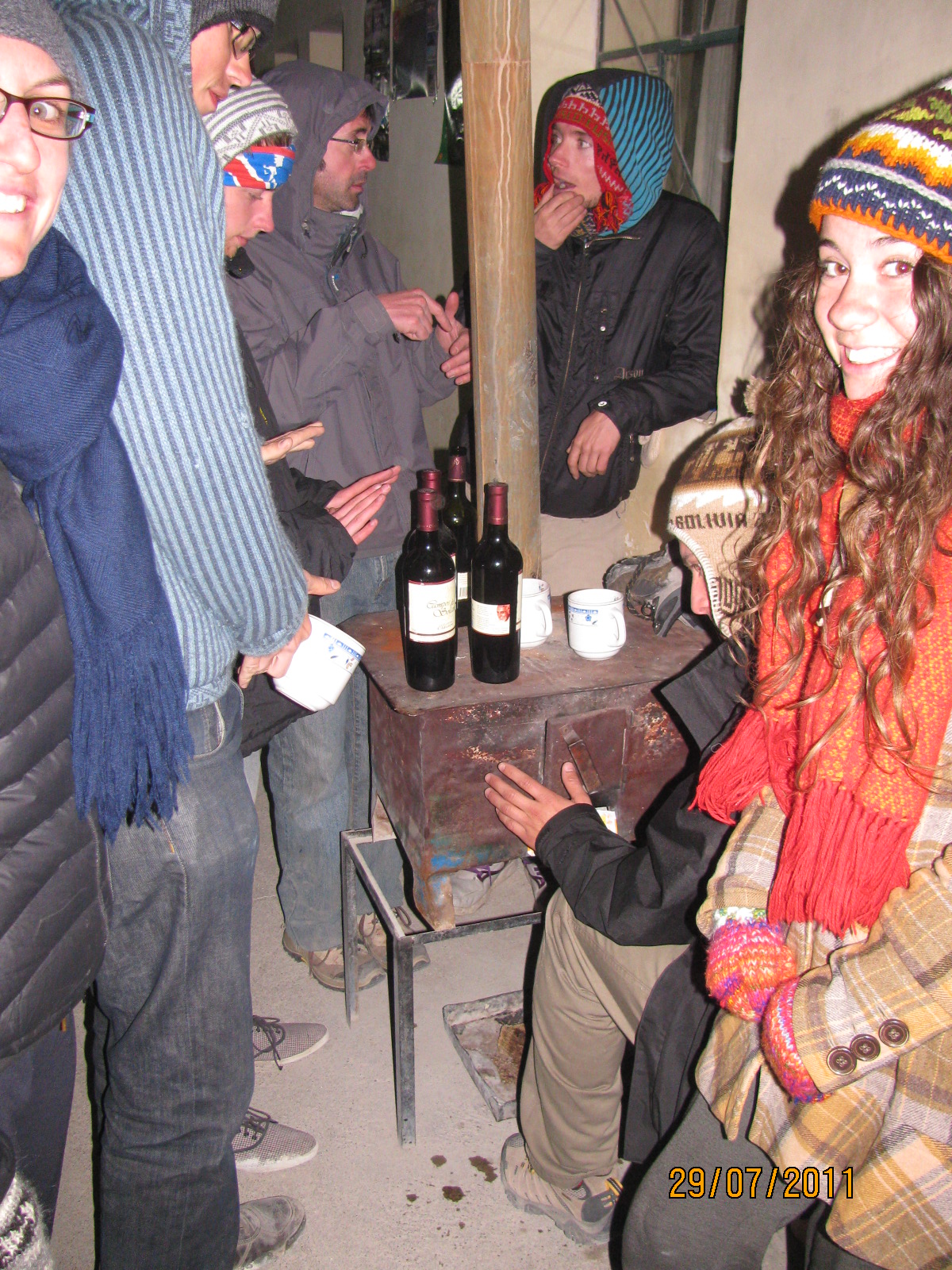
Our "lakeside" accommodation had been described to us by the tour company as "basico". Well they were right about one thing. It was a rectangular concrete row of rooms with a common area running alongside, and only a meagre wood stove to heat the whole facility. At least they sold wine, but it was so cold we had to heat it on top of the fire before drinking it. In the morning the window of the bedroom was caked in inches of ice and our five litre bottle of water was frozen solid.

The final day of our tour involved a brief stop at the Chilean border, in a super-remote part of the Atacama desert that was knee-deep in snow. Finally it was time to drive back up to Uyuni, which now seemed like a pumping metropolis compared to the remote Bolivian altiplano, but we did manage to squeeze in a visit to some extremely steamy geysers with bubbling mud and a breakfast swim in some thermal springs. It was surreal to be sitting in a hot bath with snow and ice just metres away in the frozen lake.

Warming the vino on the crappy stove
We were kept entertained on the long car trip by the amazing mountains, lagoons, crazy rock formations and wildlife. Despite the bleakness of the landscape, there were countless herds of llama, alpaca and vicuña, a kind of a cross between a camel and a llama, and lots of very woolly pigs. We also spotted rarer creatures, a magestic mountain fox and an obese Andean rabbit.

After this schlep our next aim is to escape the cold on a heated (we hope!) night train up north, where we will descend a few thousand metres - and the beer will not be so stupidly fizzy when poured out of the bottle. Next stop; the mediterranean climate of Cochabamba.

Monday, July 25, 2011

Loopy La Paz

I've discovered a new meaning of chaos: La Paz, Bolivia's unwieldy unofficial capital city - at the world's highest altitude. Approaching the city on the bus from the main "highway" is a pretty nondescript experience - until the bus throws itself headlong into the incredibly steep canyon in which the city precariously sits.

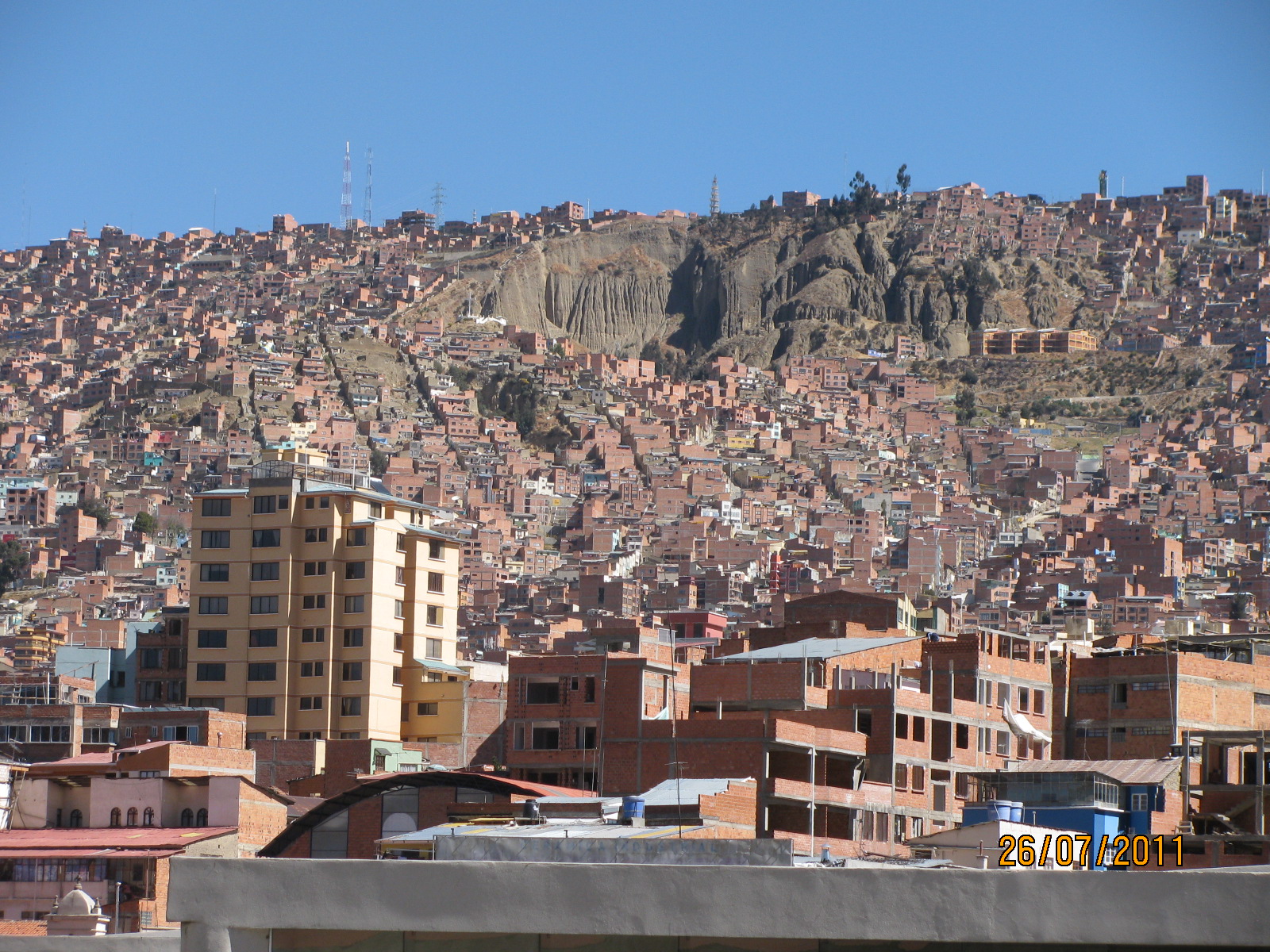
The main part of the city - government buildings, plazas, office buildings etc - occupy the base of the long, narrow canyon, with the fancier residential neighbourhoods in the lower, southern districts. Arising steeply up the sides of the canyons to dizzying heights of over 4000 metres are unwieldly masses of DiY red-brick shoeboxes.

But La Paz's unique mountainous setting, in the shadow of the gorgeous 6000+ metre Mt Illimani, affords stunning views from just about any street a few blocks up from the flat centre district at the bottom of the canyon. And funnily enough, the red brick (there is also a lot of makeshift mud brick throw-ups) blends in almost perfectly with the surrounding mustard-coloured hillsides.

Aside from Prado, the main north-south drag in town, the streets in La Paz are arranged up the hillsides like a tangled mess of spaghetti. Some are so steep you feel like you need those gay trekking poles to help you stay vertical as you climb up. Towards the top of the canyon you really feel the altitude quickening your breath and burning your lungs.

Unfortunately, Bolivia's drivers do not take into account the windiness, narrowness or gradient of the city's streets when they hit the roads. Crossing roads here is absolutely terrifying - even more terrifying than crossing Mexico City's 10-lane boulevards. Little green men for pedestrians are absolutely non-existent here, and even when the typically choked roads are moving at a snail's pace, it is difficult to weave between cars as they simply rev their engines and barge into you to fill up the gap.

But La Paz's chaotic streets are the main attraction here. From the Inca ladies tucked inside street stalls to shield from the cold, to mini buses rolling past with their conductors yelling out their destinations as fast as race callers "SanPedroAeropuertoSopocachiElAlto", you are never short of some entertainment.

Peaceful Inca lady protest
You can buy almost anything at the markets and street stalls which line most of the centre of town, everything from batteries to bread, tissues and beauty products. The informal economy to which these street stalls contribute has played a central role in Bolivia's economic improvement over the past 20 years and reduced its dependence on its ailing silver mining industry

The city is also home to frequent demonstrations, which require police roadblocks, further exacerbating the traffic chaos. Revellers at one protest, which marched up the main street on a Friday afternoon, attracted even more attention as countless (extremely loud) firecrackers were let off. Another more mellow affair took place a few blocks up the hill where bowler hat-clad Inca ladies waited patiently outside a government building.

Cheap eateries abound in La Paz, but we skipped these in favour of restaurants, where you can get a really nice meal for a fraction of the price in most other Latin American countries. We had enormous tandoori chicken baguettes at an English pub (ok so we were only there to watch the rugby), delicious falafel and shish kebab at a Middle Eastern restaurant and hearty beef Madras at a British Indian curry house. Ok so by now, after eight months on the road we are missing the variety of foods we enjoy at home.

Apart from working out our lungs climbing the hills on a quest for the best lookout in town and gawking at some impeccably dressed indigenous ladies in shiny full skirts and delicately woven stalls, we spent a good part of our time in La Paz watching the final matches of the Copa America, Latin America's premier football tournament. We delighted in yelling "GOOOOOOOOOOOLLLLL" for as long as possible after every goal, and giggling that it was a "gay" final when Paraguay and Uruguay qualified.

Sunday, July 24, 2011

Down at the Copa

Fans of the latino bossa nova classic "Copacabana" will cast their minds to the iconic beachside suburb of Rio de Janeiro, but our trip across the bleak Andean high plain across the Peruvian/Bolivia border bought us to a very different Copacabana.

This town, just kilometres from the Bolivian border, also abuts a body of water - Lake Titicaca, arguably the world's highest, sitting pretty at an altitude of 3800 metres above sea level. In fact, the lake is so big it pretty much looks like a sea, with lurid royal blue water and strong wind-induced currents that make the water lap energetically at its grey-sand beaches.

The only thing that really gives Titicaca away as a lake is a backdrop of imposing mountains. On the Peru side, they are the bleak, treeless hill tops common all over the altiplano, in stark contrast to the majestic snowy peaks of the Cordillera Real or Royal Mountain range on the Bolivian side.

Getting to Copacabana from Cuzco should have been a cinch. An overnight bus to a non-descript Peruvian town called Puno, and change in the morning for a three-hour hop over the border to Copa. Our mistake was attempting to plan ahead and book both bus tickets with the same bus company, assuming there would be a bus with seats assigned to us.

Arriving in freezing Puno at 4:30am with just a few Peruvian soles (about $3) to our names, we had to wait in plastic chairs in the bus terminal until 6am when the bus company ticket office opened. The attendant took our onward ticket (which was just a note scrawled on a bit of paper) and walked us over to a different bus company counter. This company then issued us with a ticket for a bus that not only left later, but was 1/3 of the price than what we had originally paid in advance.

Sunset on the lake
When I queried the price difference and asked why our bus company sold us a ticket for a bus service that did not exist, they simply said that if you buy the ticket in advance somewhere else, that office takes a commission and this explains the price difference. I said that they should pay us the difference or refund our money - after all there were at least five other operators going to Copacabana that we could have gone with for less.

By this time an extremely narky lady had turned up to the ticket office and told us to go away and stop bothering her, so naturally one of my no-sleep-trying-to-express-outrage-in-Spanish arguments ensued. This of course had no effect, but luckily Adam spotted a police officer trying to help out another couple who had also been ripped off (nice to know we weren't the only ones!). He said we should be paid the money and went over to the company to demand it. It should have been that simple but in typical latino fashion several phone calls had to be made to the other office in Cuzco, then the head office, then god knows where.

It quickly became apparent that the police officer meant well but was effectively impotent in the situation. During the kerfuffle the lady at the other bus company who had issued the cheap ticket snatched it off us because we hadn't given her the original proof of purchase (we were showing it to the police officer to try and get our money back). Meanwhile the clock was ticking and it was two minutes until the bus was due to depart, and we had no ticket and no refund. And no local currency to pay the ridiculous 50 cents "bus station" tax.

At the eleventh hour the ticket snatcher returned our ticket, held the bus for us and ushered us on, unfortunately minus the refund for our massive overpayment but at that point we were exhausted and pleased to get out of there. And we learned a lesson - never buy bus tickets for an advance destination! And lesson two - Peruvians are nice people but given the chance, will always try to fleece a few extra soles off you.

The tranquil lakeside retreat of Copacabana was not a huge visual departure from other Peruvian towns in the highlands, but we soon noticed a distinctly more laidback feel, and a slower pace of life in general. From getting stuck behind large groups of highland Inca ladies dresed in bowler hats, shawls and full skirts spreading themselves out across the pavement, to waiting in a shop for a simple transaction or sitting in a restaurant for up to an hour before receiving a drink, Bolivians do not seem to be in a hurry.

Inca ladies may look sweet and innocent in their curiously layered outfits and bowler hats positioned precariously on their heads with long black braids falling down their backs, but is is immediately clear that they are in at the top of the social hierarchy here. They control the vending stalls that line the streets, work in the shops and are the masterchefs calling the shots in family restaurants.

Fresh caught trout
For a country where nearly one-quarter of people are said to be malnourished, there are some extremely large ladies waddling around here. They're generally not tall, and with the layers of shawls, aprons, blankets, skirts and petticoats they get around in to stave off the cold, have a positively spherical appearance. I can't work out if it is all the layers they wear, or whether they stash their valuables under their aprons or whether they all become obese after the age of 30.

Perfectly positioned on the shores of Lake Titicaca, Copacabana's many cheap and cheerful family run restaurants serve up delicious versions of the regional delicacy - trout, or trucha as it is locally known. For 35 bolivianos, or $5 Aussie dollars, you get a massive slab of grilled tender pink flesh, crispy at the ends but deliciously tender in the middle, along with piles of rice, salad and hot chips.

In the 24 hours we were in Copa, we managed to order the trout three separate times, each done differently. The first was simply cooked in lemon and butter, the second was smothered in a blissfully gooey coating of cheese and the third was sauteed in white wine and garlic.

While sitting at an outdoor cafe, we were approached by one of Latin America's ubiquitous wandering shoe-shine guys. Normally our shoes are not of the shineable variety, but Adam was wearing some rubber-soled slip ons with a leather upper. Adam instinctively said no, but the man looked at us with pleading eyes and said in a hoarse voice that we could pay him whatever we wanted.

Adam relented, and as the guy was shining the tops of his shoes, told us that he was a Peruvian who had come to Bolivia in search of work but had been unable to find anything. He had resorted to shoe-shining, to the unfortunate discovery that barely anyone in Copacabana had leather shoes. "Everyone wears sandals and sports shoes here," he lamented. As a result he was trying to get back to Peru, but had nowhere to live and was sleeping outdoors, in subzero temperatures. We gave him his bus fare back to the Peruvian border town, and said that we hoped that his luck would soon change.

Many travellers stay longer at the lake to take tours to some of the islands - Isla del Sol, with its Inca ruins is the most heavily promoted, and there are man-made floating islands that locals use to farm fish. We decided to skip the island visits and guided tours to indigenous villages, as they appeared a little fake and put on.

Monday, July 18, 2011

Back door to Machu Picchu

The hype surrounding Machu Picchu, Peru's archaeological showpiece has been steadily building since 2007 when it was voted one of the new seven wonders of the world. Two weeks ago the site celebrated 100 years since it was "uncovered" (although it was already known locally) by Yale archaeologist Hiram Bingham in 1911.

After watching countless documentaries and hearing accounts of family and friends who had visited this mystical citadel in the clouds, I was a little apprehensive when finally it was our turn to visit - would Machu Picchu live up to the hype? Had it been too built up for me to enjoy the experience? And more importantly, how would we wade through the hoards of tourists the site now attracts?

The first challenge was to find an economical means of reaching Machu Picchu from the nearby colonial centre of Cuzco, which plays host to hundreds of thousands of visitors. The two most common ways of getting there - there is no road access to Aguas Calientes, the nearest town to the site - is to either hike the Inca trail or take the specially designed tourist train.

The Inca trail books up months in advance, and is reportedly bursting at the seams even though daily numbers are restricted, and the train cost a bomb. The few cheaper class tickets sold out weeks in advance. Keen to avoid being too ripped off, we reverse engineered a route that involved going to the closest town to Machu Picchu accessible by road, and then walking to Aguas Calientes from there.

Cuzco
This involved a hair-raising ride in a shared taxi from Cuzco through the sacred valley, up through the surrounding mountains, over a snow-white pass high in the clouds, and down a series of frightening hair-pins until we had descended a vertical 3km and had traded dry, high grazing land for verdant rainforest. We changed cars at a town called Santa Maria and continued along the steep slopes of the lush river valley, climbing higher again until we reached Santa Teresa, the closest town to Aguas Calientes.

For most of this ride the car swung its way around gravel roads carved awkwardly into the steep cliffs, and barely looked wide enough for two cars to pass each other. Many times the car went within centimetres of the roadside, which fell away in an almost vertical drop. It does not help on these trips that the drivers pretty much hog the middle of the road, and tend to veer onto the wrong side of the road when they take sharp corners so they can hurl around them at the fastest possible speed.

We stayed the night in Santa Teresa and continued on foot the next morning, grabbing a lift to the start of the trail located at the nearby hydroelectric power station. A train line connects the plant with Aguas Calientes, and there is a walking track alongside this, making it possible to reach the town by foot in just over two hours.

Glimpses of Machu Picchu's terraces from the walking track
This is the real Inca trail - the route by which hundreds of (mainly indigenous Inca) power station workers are ferried to and from work every day. We didn't need to pay $500 US to experience the Inca trail - we had discovered the modern-day one free of charge! It was a beautiful walk as well as the train track is built along the river bank and because we were lower down, the steep hills were covered with lush rainforest. Best of all, we were actually walking alongside Machu Picchu, albeit several hundred metres below it, and could see glimpses of the stone terraces high up on the hills above.

Aguas Calientes, being a town that exists solely for tourism, was never going to charm our souls but I didn't think it was too bad a place to spend the night. The only thing that got really annoying is that some restaurants tried to extort a 20 per cent service charge, even though there was nothing written about it on their menus. I simply refused to pay it, and said that other places charged 10 per cent so I was happy to pay that. Funnily enough all of them backed down and accepted - I think they are used to gringos who just pay any additional charge that appears on their bill without querying it.

Walking along the train track through the river valley
A modern fleet of tour buses waits patiently at Aguas Calientes to deliver the masses of tourists to Machu Picchu, but its also possible to walk there on a set of imposing stairs that connects a zig zagging road up the mountain. It was tough going given we appraoched the task on a full stomach in the hottest part of the day and did not bring any water. Some of the steps were enormous and very steep, and we climbed almost vertically for about 40 minutes.

We timed our arrival for 2pm, as the morning tour groups had started to dissipate, so we did not find too many crowds when we passed through the turnstiles. And even after all of the build-up, it still took my breath away when I caught the first glimpse of the aerial view of the site (otherwise known as the money shot). I think it is mainly the location and the mighty building skills of the Incas that is most impressive about Machu Picchu. Walking around it I kept asking myself  "how the hell did they get that rock up here?"

The site is basically built on the summit of a large mountain, with another peak, Waynu Picchu, providing an awe-inspiring backdrop. The way the stones are assembled, without the use of mortar, and different shapes and sizes that all interlock, is amazing. The construction was more solid than many of the dodgy mud brick dwellings that Peruvians build today - in fact the foundations of most buildings in Cuzco are big Inca stones, with colonial structures added to the top.

Most of Machu Picchu consists of stone farming terraces cut into almost vertical rock walls. It made me wonder how many tipsy Incas had tripped and fallen to their deaths over the years. The site has other sections that are believed to be for residential and ceremonial uses (including a sun temple), but no one really knows why the site was really built and what happened there. Archaeologists speculate this and that, like one area being used as a prison, and the hut up on the lookout being that of  "the caretaker of the funerary rock" but really its all guesswork, so better to enjoy the city as an interconnected unit than get hung up on what each building was used for.

Escher-style Inca stonework
That night at the hostel, we got a taste of what Aguas Calientes is all about - it means "hot water" in Spanish - but for all the wrong reasons. We were sound asleep in our dorm room when our drunk roommates arrived loudly and one of them decided to have a shower in the ensuite bathroom. The idiot managed to wrench the hot tap out of the wall, and within minutes the bathroom and bedroom had flooded and we had to hurriedly pull all our belongings off the floor to avoid the inundation.

One of the hostel staff mopped up the mess and turned the water off, but didn't tell anyone else about it, so when the water was turned back on in the morning (when we were still in bed) the bathroom started flooding again. Conveniently the others had woken up really early, made heaps of noise and left lights on and left by 5am so it was left to us to deal with.

Having taken the back door way to Machu Picchu, which was really interesting but took a day and a half, we decided to zip home on the train and bus. The train was pretty funny - the carriages have windows built into the roof, giving you a great view of the steep hillsides on either side of the river valley. They try to make it a "luxury" service by serving food and providing entertainment. This included a weird dance by a local person in a really loud satin outfit and a spooky plaster mask, and a "fashion show", where the attendants paraded up and down in alpaca garments from the train company's clothing line.

Wednesday, July 13, 2011

Lounging in Lima

It could be the dense grey blanket of perma-fog that constantly envelops Lima or perhaps its the dreariness of its Americanised chain-store neighbourhoods, but Peru's capital didn't inspire us to be very active.

In fact, we barely left the four-block radius of our hostel in the sanitised Gringolandia of Miraflores during our three-day visit. The exception was a walk down to the waterfront to check out a shopping mall that had been built right into the sea cliffs - which looked like they could erode into the sea at any second.

The surf looked quite good, with perfectly formed waves rolling into shore at neat intervals, but the beaches weren't much to look at, as most of them were covered with masses of what looked like imported pebbles to stop the sand being dragged away.

Miraflores' population looks to be at least 50 per cent American. The neighbourhood is crawling with security guards, some of which cruise around on those hilarious segways, to give the transient gringo the feeling that this part of Peru is safe enough for them to walk around on the street in a daze flaunting their iphones and novelty oversized SLR digital cameras.

For Peruvians, its clear that if you can afford to hang in Miraflores, you've made it. You walk your designer pooch complete with matching lead and jacket, go to cafes to sip lattes and purchase overpriced artesania goods from fancy shops or at the markets in Parque Kennedy, named after the decidedly un-latio JFK.

Fortunatley we were able to break up the foggy malaise with back-to-back futbol  matches from the Copa America tournament that is being played this month in Argentina. Whenever a match was on TV, our hostel seemed to play host to an itinerant gang of drop-ins hailing from one of the countries playing. This provided a great boost to the mood - there's nothing like watching a room full of Peruvians or Argentinians go crazy when their team scores a gol.

The commentators added to the excitement, blatantly favouring one team and saying nasty things about the other. Every time a goal is scored (unless it is against Peru) they yell "GOL" at the top of their lungs, for as long as they possibly can. It's as if every time they are trying to break some prior record of how long they can yell GOL for. Sometimes they can still be trailing off the word after a full two minutes!

Other Peruvians have not made life so fun. People in administrative positions are constantly on mega-power trips, and do their best to make the simplest task as complicated and confusing as possible. For some reason, everyone is obsessed with stamps. I have not had so many documents stamped (often with multiple different imprints) and signed, then stamped again since the 1980s before computers.

At the pharmacy you request a product and instead of being given it, you are handed a little bit of paper with a number. You take this to the next counter, where it is stamped and you pay for it, and you receive a stamped receipt. Then you move to a third counter with your stamped receipt, where it is stamped again and you finally receive your purchase.

Another not-very-nice habit of Peruvians is to loudly point out what race you are when you are walking down the street. We have had scores of people see us, point, stare and yell GRINGO at the top of their lungs. This extends to people you might deal with in shops, and other public places. Occassionally, like when a guy at the bus terminal addressed us as gringos, I point out that we were not gringos as this was a term only applicable for North Americans, but mostly we just ignore them. And its not just us whiteys that have to contend with racist taunts - anyone of Asian appearance has to put up with CHINO or CHIFA being yelled at them.

The gringo abuse isn't likely to abate any time soon, as we are off to see Peru's biggest tourist attraction - Macchu Pichu. We have just flown into Cuzco, where we managed to save 75 per cent off the price of a taxi by walking outside the gates of the airport and waiting along the roadside. We are expecting to run into hoards of backpackers gearing up for the Inca Trail. Hopefully we will manage to take cheap public buses to the ruins and slide in for a visit at a non-peak time, if one exists!