Saturday, July 30, 2011

Salt flats Uyuni, Bolivia

The night bus ride from Bolivia´s capital La Paz is one of the most horrendously chilling and uncomfortable rides ever. Worse, you are lied to in the face about it by the bus company. Deluxe bus with reclinable seats, heating, the works, they say.

We stupidly listened to a travel agent who told us not to book the tickets (which were a fraction of the price) at the bus terminal because those companies had poor quality buses. Instead we got ripped off and thrown on a bus with rattling windows right next to a door that didn´t seal. It got so cold that the windows were thickly iced over by dawn. Had we not been lied to about the lack of heating we may just have pulled our sleeping bags out.

At dawn we were unceremoniously dumped on the side of the road in the bleak Vegas style dump of Uyuni, where it must have been about -10. We had nothing booked, and our arms were clawed at by touts trying to sell us tours, but strangely no offers of accommodation. Some touts offered rooms and dragged travellers to the hotels, only to discover that there was nothing available.

Heating is absolutely non-existent in Uyuni - even the Canadians and Swiss people we met were complaining about the cold. We did a couple of laps of the town centre before stumbling on the aptly named "Palace Hotel," a concrete construction with absolutely no heating. It boasted an infamous Latin American suicide shower, where the shower head is wired up and electrified and it is really easy to give yourself an electric shock, but sometimes hard to regulate the water temperature and actually get a hot shower.

But staying in this freezing concrete town wasn´t all in vain - we were here to visit the amazing Uyuni salt lake, 12,000 square kilometres of blinding salt-encrusted whiteness. Its safe to say that there is nothing else in the world that looks quite like it. Once lying on the bottom of the ocean, it was shoved 4km above sea level thousands of years ago and its location on the harsh Andean high plain adds to the visual spectacle, complete with fossilised pre-historic fish and coral.

Salt flat tours are a little predictable, with most agencies stopping off at the same sights along the way, including the salt refinery, a curious rust-heap of old steam train carriages, a building made of salt bricks and a cactus-studded island. Everything was amazing, but each time our 4WD Land Cruiser stopped, we were barked at to get out, take photos and shoehorned back in quickly, sometimes too quickly to really take in the incredible landscape. Our theory is that the quicker our driver got us through the attractions and to our sleeping stop at the end of the day, the more downtime he got.

Just driving across the blindingly white expanse was an experience in itself, especially in a part where it had recently rained, so the mountainous backdrop was mirrored back onto the salt flat. But the most surprising part of the day was the potential for taking ludicrously stupid photos, playing on the flatness of the landscape and its monotone colour. It was so easy - just put an object such as a wine bottle in the foreground of the shot, lie flat on the salt flat and put the camera as close to the ground as possible, and have the other person stand further away so that it would look like a minature version of them standing on the object. The results, as you can see, had us in stitches.


We continued further south along the bleak, rocky high plain, which became increasingly chilly. Snow covered volcanoes appeared and the already scrubby vegetation disappeared. It had snowed recently, and part of the track we drove along had snow banks piled high on either side. Most lakes we passed, which normally boasted bright colours, were frozen over.

By now we had reached the very southern tip of Bolivia, a national park bordering Chile and Argentina. The jewel of this area is the Laguna Colorada, an immense rust coloured expanse of near-freezing water that lay in front of a row of imposing snow-flecked mountains. Incongruously, it is home to a colony of flamingos that feed on naturally occurring krill in the lake, which gives it its red colour, and in turn colours the birds´ feathers. A real case of you are what you eat!

We tried to enjoy the serenity, but by this time the sun had set behind the mountains and the wind was howling, and besides the flamingos were proving extremely difficult to photograph. The numerous frozen flamingo corpses lining the lake shores were a telling sign that we shouldn´t hang around too long!

Laguna Colorada
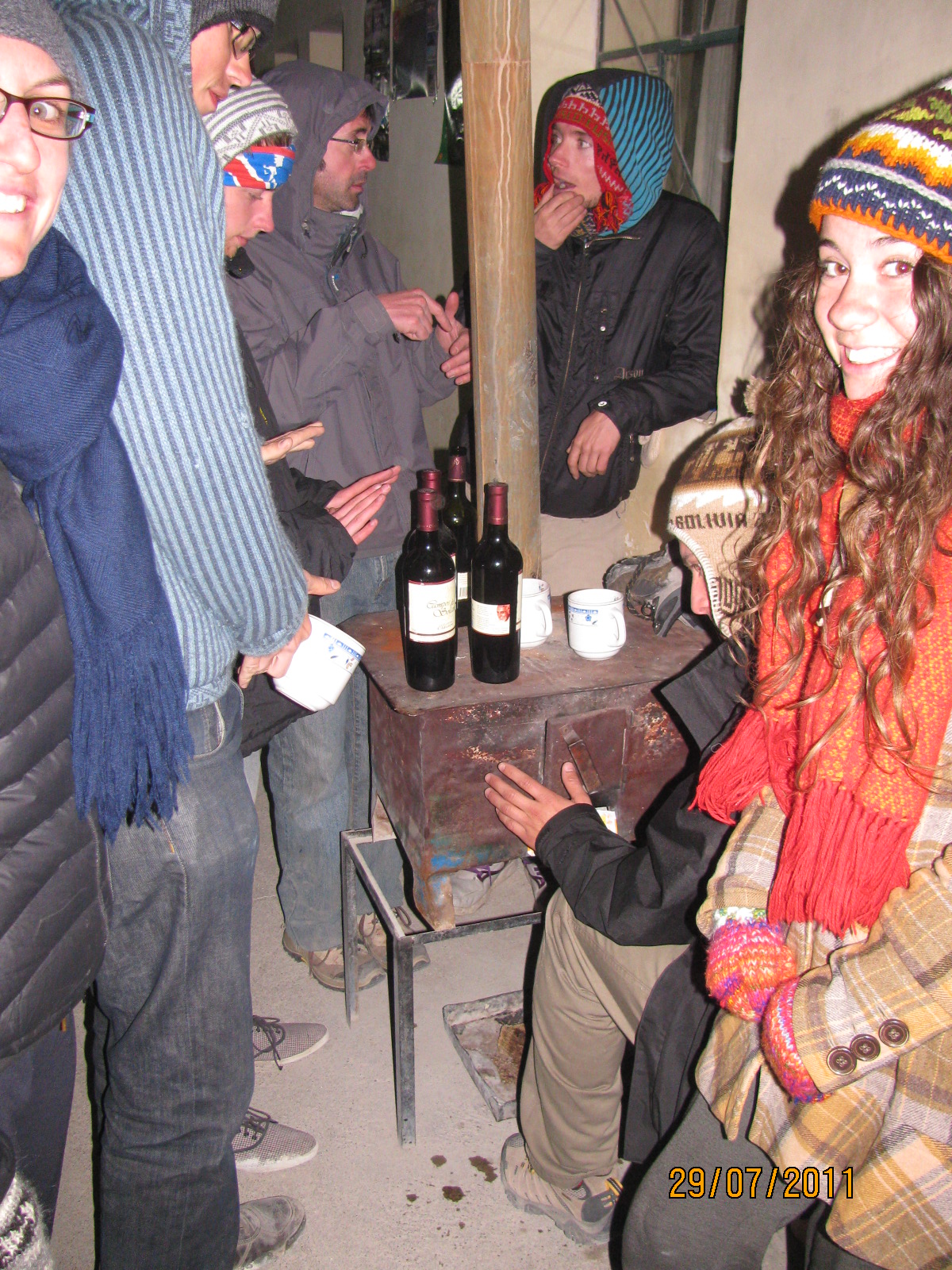
Our "lakeside" accommodation had been described to us by the tour company as "basico". Well they were right about one thing. It was a rectangular concrete row of rooms with a common area running alongside, and only a meagre wood stove to heat the whole facility. At least they sold wine, but it was so cold we had to heat it on top of the fire before drinking it. In the morning the window of the bedroom was caked in inches of ice and our five litre bottle of water was frozen solid.

The final day of our tour involved a brief stop at the Chilean border, in a super-remote part of the Atacama desert that was knee-deep in snow. Finally it was time to drive back up to Uyuni, which now seemed like a pumping metropolis compared to the remote Bolivian altiplano, but we did manage to squeeze in a visit to some extremely steamy geysers with bubbling mud and a breakfast swim in some thermal springs. It was surreal to be sitting in a hot bath with snow and ice just metres away in the frozen lake.

Warming the vino on the crappy stove
We were kept entertained on the long car trip by the amazing mountains, lagoons, crazy rock formations and wildlife. Despite the bleakness of the landscape, there were countless herds of llama, alpaca and vicuña, a kind of a cross between a camel and a llama, and lots of very woolly pigs. We also spotted rarer creatures, a magestic mountain fox and an obese Andean rabbit.

After this schlep our next aim is to escape the cold on a heated (we hope!) night train up north, where we will descend a few thousand metres - and the beer will not be so stupidly fizzy when poured out of the bottle. Next stop; the mediterranean climate of Cochabamba.

Monday, July 25, 2011

Loopy La Paz

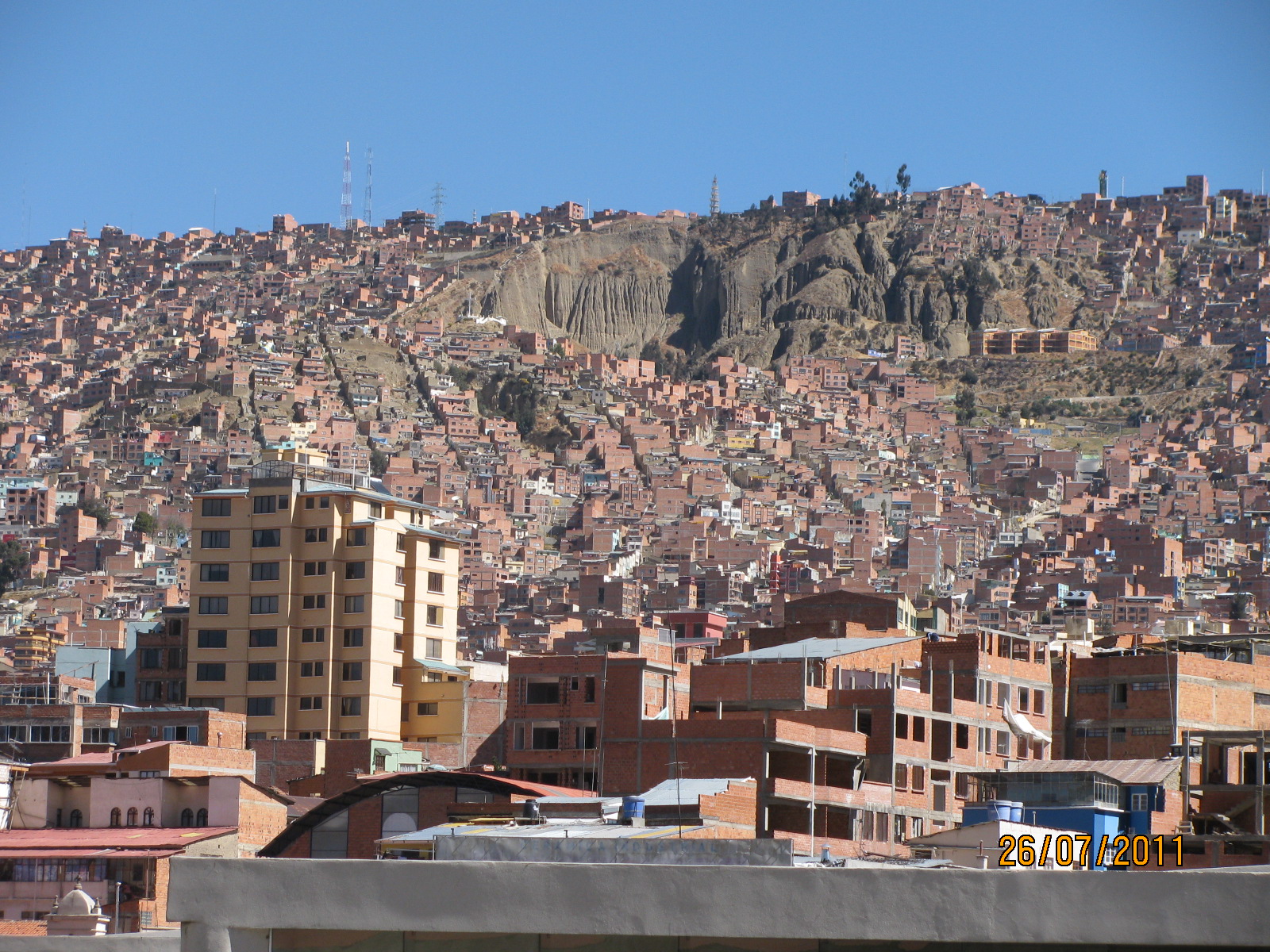
I've discovered a new meaning of chaos: La Paz, Bolivia's unwieldy unofficial capital city - at the world's highest altitude. Approaching the city on the bus from the main "highway" is a pretty nondescript experience - until the bus throws itself headlong into the incredibly steep canyon in which the city precariously sits.

The main part of the city - government buildings, plazas, office buildings etc - occupy the base of the long, narrow canyon, with the fancier residential neighbourhoods in the lower, southern districts. Arising steeply up the sides of the canyons to dizzying heights of over 4000 metres are unwieldly masses of DiY red-brick shoeboxes.

But La Paz's unique mountainous setting, in the shadow of the gorgeous 6000+ metre Mt Illimani, affords stunning views from just about any street a few blocks up from the flat centre district at the bottom of the canyon. And funnily enough, the red brick (there is also a lot of makeshift mud brick throw-ups) blends in almost perfectly with the surrounding mustard-coloured hillsides.

Aside from Prado, the main north-south drag in town, the streets in La Paz are arranged up the hillsides like a tangled mess of spaghetti. Some are so steep you feel like you need those gay trekking poles to help you stay vertical as you climb up. Towards the top of the canyon you really feel the altitude quickening your breath and burning your lungs.

Unfortunately, Bolivia's drivers do not take into account the windiness, narrowness or gradient of the city's streets when they hit the roads. Crossing roads here is absolutely terrifying - even more terrifying than crossing Mexico City's 10-lane boulevards. Little green men for pedestrians are absolutely non-existent here, and even when the typically choked roads are moving at a snail's pace, it is difficult to weave between cars as they simply rev their engines and barge into you to fill up the gap.

But La Paz's chaotic streets are the main attraction here. From the Inca ladies tucked inside street stalls to shield from the cold, to mini buses rolling past with their conductors yelling out their destinations as fast as race callers "SanPedroAeropuertoSopocachiElAlto", you are never short of some entertainment.

Peaceful Inca lady protest
You can buy almost anything at the markets and street stalls which line most of the centre of town, everything from batteries to bread, tissues and beauty products. The informal economy to which these street stalls contribute has played a central role in Bolivia's economic improvement over the past 20 years and reduced its dependence on its ailing silver mining industry

The city is also home to frequent demonstrations, which require police roadblocks, further exacerbating the traffic chaos. Revellers at one protest, which marched up the main street on a Friday afternoon, attracted even more attention as countless (extremely loud) firecrackers were let off. Another more mellow affair took place a few blocks up the hill where bowler hat-clad Inca ladies waited patiently outside a government building.

Cheap eateries abound in La Paz, but we skipped these in favour of restaurants, where you can get a really nice meal for a fraction of the price in most other Latin American countries. We had enormous tandoori chicken baguettes at an English pub (ok so we were only there to watch the rugby), delicious falafel and shish kebab at a Middle Eastern restaurant and hearty beef Madras at a British Indian curry house. Ok so by now, after eight months on the road we are missing the variety of foods we enjoy at home.

Apart from working out our lungs climbing the hills on a quest for the best lookout in town and gawking at some impeccably dressed indigenous ladies in shiny full skirts and delicately woven stalls, we spent a good part of our time in La Paz watching the final matches of the Copa America, Latin America's premier football tournament. We delighted in yelling "GOOOOOOOOOOOLLLLL" for as long as possible after every goal, and giggling that it was a "gay" final when Paraguay and Uruguay qualified.

Sunday, July 24, 2011

Down at the Copa

Fans of the latino bossa nova classic "Copacabana" will cast their minds to the iconic beachside suburb of Rio de Janeiro, but our trip across the bleak Andean high plain across the Peruvian/Bolivia border bought us to a very different Copacabana.

This town, just kilometres from the Bolivian border, also abuts a body of water - Lake Titicaca, arguably the world's highest, sitting pretty at an altitude of 3800 metres above sea level. In fact, the lake is so big it pretty much looks like a sea, with lurid royal blue water and strong wind-induced currents that make the water lap energetically at its grey-sand beaches.

The only thing that really gives Titicaca away as a lake is a backdrop of imposing mountains. On the Peru side, they are the bleak, treeless hill tops common all over the altiplano, in stark contrast to the majestic snowy peaks of the Cordillera Real or Royal Mountain range on the Bolivian side.

Getting to Copacabana from Cuzco should have been a cinch. An overnight bus to a non-descript Peruvian town called Puno, and change in the morning for a three-hour hop over the border to Copa. Our mistake was attempting to plan ahead and book both bus tickets with the same bus company, assuming there would be a bus with seats assigned to us.

Arriving in freezing Puno at 4:30am with just a few Peruvian soles (about $3) to our names, we had to wait in plastic chairs in the bus terminal until 6am when the bus company ticket office opened. The attendant took our onward ticket (which was just a note scrawled on a bit of paper) and walked us over to a different bus company counter. This company then issued us with a ticket for a bus that not only left later, but was 1/3 of the price than what we had originally paid in advance.

Sunset on the lake
When I queried the price difference and asked why our bus company sold us a ticket for a bus service that did not exist, they simply said that if you buy the ticket in advance somewhere else, that office takes a commission and this explains the price difference. I said that they should pay us the difference or refund our money - after all there were at least five other operators going to Copacabana that we could have gone with for less.

By this time an extremely narky lady had turned up to the ticket office and told us to go away and stop bothering her, so naturally one of my no-sleep-trying-to-express-outrage-in-Spanish arguments ensued. This of course had no effect, but luckily Adam spotted a police officer trying to help out another couple who had also been ripped off (nice to know we weren't the only ones!). He said we should be paid the money and went over to the company to demand it. It should have been that simple but in typical latino fashion several phone calls had to be made to the other office in Cuzco, then the head office, then god knows where.

It quickly became apparent that the police officer meant well but was effectively impotent in the situation. During the kerfuffle the lady at the other bus company who had issued the cheap ticket snatched it off us because we hadn't given her the original proof of purchase (we were showing it to the police officer to try and get our money back). Meanwhile the clock was ticking and it was two minutes until the bus was due to depart, and we had no ticket and no refund. And no local currency to pay the ridiculous 50 cents "bus station" tax.

At the eleventh hour the ticket snatcher returned our ticket, held the bus for us and ushered us on, unfortunately minus the refund for our massive overpayment but at that point we were exhausted and pleased to get out of there. And we learned a lesson - never buy bus tickets for an advance destination! And lesson two - Peruvians are nice people but given the chance, will always try to fleece a few extra soles off you.

The tranquil lakeside retreat of Copacabana was not a huge visual departure from other Peruvian towns in the highlands, but we soon noticed a distinctly more laidback feel, and a slower pace of life in general. From getting stuck behind large groups of highland Inca ladies dresed in bowler hats, shawls and full skirts spreading themselves out across the pavement, to waiting in a shop for a simple transaction or sitting in a restaurant for up to an hour before receiving a drink, Bolivians do not seem to be in a hurry.

Inca ladies may look sweet and innocent in their curiously layered outfits and bowler hats positioned precariously on their heads with long black braids falling down their backs, but is is immediately clear that they are in at the top of the social hierarchy here. They control the vending stalls that line the streets, work in the shops and are the masterchefs calling the shots in family restaurants.

Fresh caught trout
For a country where nearly one-quarter of people are said to be malnourished, there are some extremely large ladies waddling around here. They're generally not tall, and with the layers of shawls, aprons, blankets, skirts and petticoats they get around in to stave off the cold, have a positively spherical appearance. I can't work out if it is all the layers they wear, or whether they stash their valuables under their aprons or whether they all become obese after the age of 30.

Perfectly positioned on the shores of Lake Titicaca, Copacabana's many cheap and cheerful family run restaurants serve up delicious versions of the regional delicacy - trout, or trucha as it is locally known. For 35 bolivianos, or $5 Aussie dollars, you get a massive slab of grilled tender pink flesh, crispy at the ends but deliciously tender in the middle, along with piles of rice, salad and hot chips.

In the 24 hours we were in Copa, we managed to order the trout three separate times, each done differently. The first was simply cooked in lemon and butter, the second was smothered in a blissfully gooey coating of cheese and the third was sauteed in white wine and garlic.

While sitting at an outdoor cafe, we were approached by one of Latin America's ubiquitous wandering shoe-shine guys. Normally our shoes are not of the shineable variety, but Adam was wearing some rubber-soled slip ons with a leather upper. Adam instinctively said no, but the man looked at us with pleading eyes and said in a hoarse voice that we could pay him whatever we wanted.

Adam relented, and as the guy was shining the tops of his shoes, told us that he was a Peruvian who had come to Bolivia in search of work but had been unable to find anything. He had resorted to shoe-shining, to the unfortunate discovery that barely anyone in Copacabana had leather shoes. "Everyone wears sandals and sports shoes here," he lamented. As a result he was trying to get back to Peru, but had nowhere to live and was sleeping outdoors, in subzero temperatures. We gave him his bus fare back to the Peruvian border town, and said that we hoped that his luck would soon change.

Many travellers stay longer at the lake to take tours to some of the islands - Isla del Sol, with its Inca ruins is the most heavily promoted, and there are man-made floating islands that locals use to farm fish. We decided to skip the island visits and guided tours to indigenous villages, as they appeared a little fake and put on.

Monday, July 18, 2011

Back door to Machu Picchu

The hype surrounding Machu Picchu, Peru's archaeological showpiece has been steadily building since 2007 when it was voted one of the new seven wonders of the world. Two weeks ago the site celebrated 100 years since it was "uncovered" (although it was already known locally) by Yale archaeologist Hiram Bingham in 1911.

After watching countless documentaries and hearing accounts of family and friends who had visited this mystical citadel in the clouds, I was a little apprehensive when finally it was our turn to visit - would Machu Picchu live up to the hype? Had it been too built up for me to enjoy the experience? And more importantly, how would we wade through the hoards of tourists the site now attracts?

The first challenge was to find an economical means of reaching Machu Picchu from the nearby colonial centre of Cuzco, which plays host to hundreds of thousands of visitors. The two most common ways of getting there - there is no road access to Aguas Calientes, the nearest town to the site - is to either hike the Inca trail or take the specially designed tourist train.

The Inca trail books up months in advance, and is reportedly bursting at the seams even though daily numbers are restricted, and the train cost a bomb. The few cheaper class tickets sold out weeks in advance. Keen to avoid being too ripped off, we reverse engineered a route that involved going to the closest town to Machu Picchu accessible by road, and then walking to Aguas Calientes from there.

Cuzco
This involved a hair-raising ride in a shared taxi from Cuzco through the sacred valley, up through the surrounding mountains, over a snow-white pass high in the clouds, and down a series of frightening hair-pins until we had descended a vertical 3km and had traded dry, high grazing land for verdant rainforest. We changed cars at a town called Santa Maria and continued along the steep slopes of the lush river valley, climbing higher again until we reached Santa Teresa, the closest town to Aguas Calientes.

For most of this ride the car swung its way around gravel roads carved awkwardly into the steep cliffs, and barely looked wide enough for two cars to pass each other. Many times the car went within centimetres of the roadside, which fell away in an almost vertical drop. It does not help on these trips that the drivers pretty much hog the middle of the road, and tend to veer onto the wrong side of the road when they take sharp corners so they can hurl around them at the fastest possible speed.

We stayed the night in Santa Teresa and continued on foot the next morning, grabbing a lift to the start of the trail located at the nearby hydroelectric power station. A train line connects the plant with Aguas Calientes, and there is a walking track alongside this, making it possible to reach the town by foot in just over two hours.

Glimpses of Machu Picchu's terraces from the walking track
This is the real Inca trail - the route by which hundreds of (mainly indigenous Inca) power station workers are ferried to and from work every day. We didn't need to pay $500 US to experience the Inca trail - we had discovered the modern-day one free of charge! It was a beautiful walk as well as the train track is built along the river bank and because we were lower down, the steep hills were covered with lush rainforest. Best of all, we were actually walking alongside Machu Picchu, albeit several hundred metres below it, and could see glimpses of the stone terraces high up on the hills above.

Aguas Calientes, being a town that exists solely for tourism, was never going to charm our souls but I didn't think it was too bad a place to spend the night. The only thing that got really annoying is that some restaurants tried to extort a 20 per cent service charge, even though there was nothing written about it on their menus. I simply refused to pay it, and said that other places charged 10 per cent so I was happy to pay that. Funnily enough all of them backed down and accepted - I think they are used to gringos who just pay any additional charge that appears on their bill without querying it.

Walking along the train track through the river valley
A modern fleet of tour buses waits patiently at Aguas Calientes to deliver the masses of tourists to Machu Picchu, but its also possible to walk there on a set of imposing stairs that connects a zig zagging road up the mountain. It was tough going given we appraoched the task on a full stomach in the hottest part of the day and did not bring any water. Some of the steps were enormous and very steep, and we climbed almost vertically for about 40 minutes.

We timed our arrival for 2pm, as the morning tour groups had started to dissipate, so we did not find too many crowds when we passed through the turnstiles. And even after all of the build-up, it still took my breath away when I caught the first glimpse of the aerial view of the site (otherwise known as the money shot). I think it is mainly the location and the mighty building skills of the Incas that is most impressive about Machu Picchu. Walking around it I kept asking myself  "how the hell did they get that rock up here?"

The site is basically built on the summit of a large mountain, with another peak, Waynu Picchu, providing an awe-inspiring backdrop. The way the stones are assembled, without the use of mortar, and different shapes and sizes that all interlock, is amazing. The construction was more solid than many of the dodgy mud brick dwellings that Peruvians build today - in fact the foundations of most buildings in Cuzco are big Inca stones, with colonial structures added to the top.

Most of Machu Picchu consists of stone farming terraces cut into almost vertical rock walls. It made me wonder how many tipsy Incas had tripped and fallen to their deaths over the years. The site has other sections that are believed to be for residential and ceremonial uses (including a sun temple), but no one really knows why the site was really built and what happened there. Archaeologists speculate this and that, like one area being used as a prison, and the hut up on the lookout being that of  "the caretaker of the funerary rock" but really its all guesswork, so better to enjoy the city as an interconnected unit than get hung up on what each building was used for.

Escher-style Inca stonework
That night at the hostel, we got a taste of what Aguas Calientes is all about - it means "hot water" in Spanish - but for all the wrong reasons. We were sound asleep in our dorm room when our drunk roommates arrived loudly and one of them decided to have a shower in the ensuite bathroom. The idiot managed to wrench the hot tap out of the wall, and within minutes the bathroom and bedroom had flooded and we had to hurriedly pull all our belongings off the floor to avoid the inundation.

One of the hostel staff mopped up the mess and turned the water off, but didn't tell anyone else about it, so when the water was turned back on in the morning (when we were still in bed) the bathroom started flooding again. Conveniently the others had woken up really early, made heaps of noise and left lights on and left by 5am so it was left to us to deal with.

Having taken the back door way to Machu Picchu, which was really interesting but took a day and a half, we decided to zip home on the train and bus. The train was pretty funny - the carriages have windows built into the roof, giving you a great view of the steep hillsides on either side of the river valley. They try to make it a "luxury" service by serving food and providing entertainment. This included a weird dance by a local person in a really loud satin outfit and a spooky plaster mask, and a "fashion show", where the attendants paraded up and down in alpaca garments from the train company's clothing line.

Wednesday, July 13, 2011

Lounging in Lima

It could be the dense grey blanket of perma-fog that constantly envelops Lima or perhaps its the dreariness of its Americanised chain-store neighbourhoods, but Peru's capital didn't inspire us to be very active.

In fact, we barely left the four-block radius of our hostel in the sanitised Gringolandia of Miraflores during our three-day visit. The exception was a walk down to the waterfront to check out a shopping mall that had been built right into the sea cliffs - which looked like they could erode into the sea at any second.

The surf looked quite good, with perfectly formed waves rolling into shore at neat intervals, but the beaches weren't much to look at, as most of them were covered with masses of what looked like imported pebbles to stop the sand being dragged away.

Miraflores' population looks to be at least 50 per cent American. The neighbourhood is crawling with security guards, some of which cruise around on those hilarious segways, to give the transient gringo the feeling that this part of Peru is safe enough for them to walk around on the street in a daze flaunting their iphones and novelty oversized SLR digital cameras.

For Peruvians, its clear that if you can afford to hang in Miraflores, you've made it. You walk your designer pooch complete with matching lead and jacket, go to cafes to sip lattes and purchase overpriced artesania goods from fancy shops or at the markets in Parque Kennedy, named after the decidedly un-latio JFK.

Fortunatley we were able to break up the foggy malaise with back-to-back futbol  matches from the Copa America tournament that is being played this month in Argentina. Whenever a match was on TV, our hostel seemed to play host to an itinerant gang of drop-ins hailing from one of the countries playing. This provided a great boost to the mood - there's nothing like watching a room full of Peruvians or Argentinians go crazy when their team scores a gol.

The commentators added to the excitement, blatantly favouring one team and saying nasty things about the other. Every time a goal is scored (unless it is against Peru) they yell "GOL" at the top of their lungs, for as long as they possibly can. It's as if every time they are trying to break some prior record of how long they can yell GOL for. Sometimes they can still be trailing off the word after a full two minutes!

Other Peruvians have not made life so fun. People in administrative positions are constantly on mega-power trips, and do their best to make the simplest task as complicated and confusing as possible. For some reason, everyone is obsessed with stamps. I have not had so many documents stamped (often with multiple different imprints) and signed, then stamped again since the 1980s before computers.

At the pharmacy you request a product and instead of being given it, you are handed a little bit of paper with a number. You take this to the next counter, where it is stamped and you pay for it, and you receive a stamped receipt. Then you move to a third counter with your stamped receipt, where it is stamped again and you finally receive your purchase.

Another not-very-nice habit of Peruvians is to loudly point out what race you are when you are walking down the street. We have had scores of people see us, point, stare and yell GRINGO at the top of their lungs. This extends to people you might deal with in shops, and other public places. Occassionally, like when a guy at the bus terminal addressed us as gringos, I point out that we were not gringos as this was a term only applicable for North Americans, but mostly we just ignore them. And its not just us whiteys that have to contend with racist taunts - anyone of Asian appearance has to put up with CHINO or CHIFA being yelled at them.

The gringo abuse isn't likely to abate any time soon, as we are off to see Peru's biggest tourist attraction - Macchu Pichu. We have just flown into Cuzco, where we managed to save 75 per cent off the price of a taxi by walking outside the gates of the airport and waiting along the roadside. We are expecting to run into hoards of backpackers gearing up for the Inca Trail. Hopefully we will manage to take cheap public buses to the ruins and slide in for a visit at a non-peak time, if one exists!

Friday, July 8, 2011

The Andes part two - THE MOUNTAIN


Whoever wrote Marvin Gaye´s motown classic "ain´t no mountain high enough" clearly hadn´t attempted to climb one. For us, Mt Vallunaraju in the Peruvian Andes, at 5686 metres, certainly fit the bill. It´s by no means among the tallest among the imposing Cordillera Blanca mountain range in central Peru, and is rated one of the easier technical climbs - important, we thought as we had never really done anything at high altitude before, let alone scale a summit.
Mt Vallunaraju - 5686m


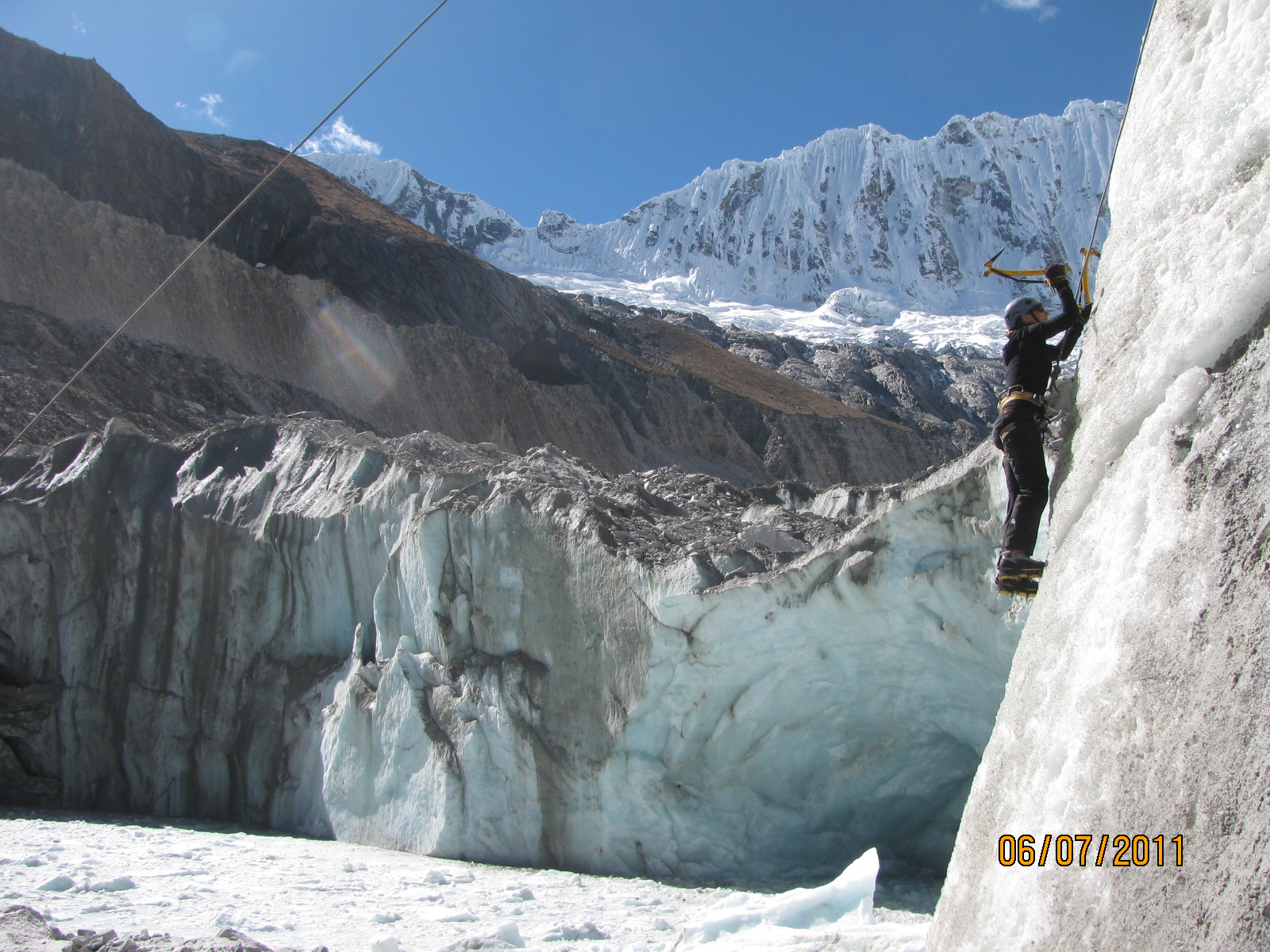
Before the mission, we did a day of ice climbing instruction at the base of a beautiful sparkly blue glacier not far from the mountain´s base camp. The idea is to scale a vertical wall of solid ice using only crampons - large metal spikes that attach to the bottom of your shoe - and small pick axes. The guide made it look pretty straight forward - smash your pick axe into the ice wall and then kick at it with the crampons, and keep your feet at 90 degrees to the wall so they lock in and hold your weight. Catch up with your feet and then stretch the pick axe up to a new spot. Repeat until you have climbed to the top of the 20 metre wall.

Sounds easy in theory, doesn´t it? But in truth, I absolutely sucked on my first attempt. I couldn´t get my crampons to lock into the wall, and my heels rose up, making me slip down the wall. At one point I was hanging on with one pick axe (ok and a harness rope just in case) scrambling to find my footing. I ended up getting the crampons tangled in the legs of my pants, tearing them to shreads.

I persevered, and after donning a second pair of socks (as my rented snow boots were too big), I was able to lock my feet into the ice better and start developing a rhythm. I still slipped around a bit but was able to make it to the top of the wall without too much trouble. Predictably, Adam fared considerably better on his first attempt - after all, he was able to observe and learn from my mistakes (!) He still found it tough going though, and his feet slipped around a few times before he was able to get to the top of the wall.

We spent the night in a tent in base camp, that was haphazardly thrown up by one of the boobs from the tour company who had neglected to select flat ground or peg out the tent cover so the inside wall didn´t get wet. The first part of the ascent was a winding track up an extremely steep rocky wall - there was no time to warm up, as the steep gradient started straight away. After scrambling over big boulders and walking up slippery dusty paths with our packs on for the first hour, the ascent became more gentle, and it was easygoing until we reached the high camp, a rocky outcrop sandwiched between a handful of imposing peaks.
High camp - 5100m

The high camp offered beautiful views of the surrounding mountains, farmlands and the town of Huaraz, where we had based ourselves. It was lovely sitting around relaxing in the sun, before it disappeared behind the mountain range and the temperature plummeted immediately. At 6pm it became uncomfortable to sit around outdoors, even with all of our warmest clothes on, so we retired to our tent.

The early bedtime was necessary at any rate, as the wake up call for the summit climb was an ungodly 1am! I don´t think I have ever attempted to get up that early (under normal circumstances I would just not go to bed), but we needed to get in a few hours of shut-eye to have energy for the ascent. We drank coca tea (sadly just the teabag form) and set out just after 2am. To walk up to the snowy part of the mountain involved scrambling over more smooth boulders - made more difficult by our cumbersome snow boots.
View of the summit from below

At the start of the glacier we donned crampons and ice picks. The first section was like a wall - luckily this time I was able to get the equipment to stick into the ice properly. After this we crunched steadily uphill through the ice. Some sections were so steep we had to lean on our pick axes and walk sideways, which made my legs and feet ache. And there was the ever present high altitude. With each step the air thinned gradually more, making it harder to keep our breathing in a smooth rhythm and not hyperventilate.

It was pitch black so we could only see a few metres in front of us - this was probably a good thing so I wasn´t able to see how far we had to keep climbing! Adam and I were both roped to the guide, in case one of us was to fall. Eventually we passed a large crevass and the gradient flattened out slightly. We were directly below the summit (actually there is a second, smaller summit tacked onto the side of the mountain so we were below that as well), which was barely visible in the continuing blackness.

The summit!
Up here it had snowed recently, and we frequently found ourselves knee-deep in fresh powder, so I tried to stick to the path worn by others to make it easier! Adam found this bit particularly energy draining, as he fell deeper into the snow than the rest of us did. At this point we had to slow down, as we were trying to time our arrival at the summit exactly for sunrise. If we arrived too early it would be too cold to wait up there until the sun appeared.

The final ascent involved an almost vertical climb up a snow and ice wall, which I thought was nearly the end and threw all my energy at. I then baulked at the steep path to the summit - stairs had been carved into the ice, and there was quite a bit to walk up after that. I took to the stairs sideways and almost bent over, leaning on my pick axe as I gasped desperately for air. I was then able to walk straight on, but it was still very steep. There was the odd tug on the rope from Adam behind me indicating that he needed a few seconds to catch his breath. Finally the path levelled out and we trudged the final 20 metres to the summit!

As we caught our breath, we saw a soft pink glow outling the surrounding peaks, and we were able to see virtually the entire mountain range in one glimpse. After a view minutes the sun poked its way through one of the summits to the east of us, casting the other mountains in an intense pink sheen. The sad part was that it was difficult to enjoy the beauty of the moment, and the joy of completing the ascent because it was just too damn windy and cold and we were so exhausted that even taking photos was an effort!


One of the many treacherous crevasses
 The biting wind wasn´t much of an inducement to hang around, so we began our descent. It was quite awkward and slow going at first down the summit section and snow wall, but as it became less steep we were able to speed things up a bit. At this point we were able to see all of the cool features - crevasses, icicles and the ice cave below the summit that we had been unable to see in the darkness on the way up.

All up, it took us about 3.5 hours from the start of the glacier to reach the summit, and just over an hour to descend! We then returned to high camp, chilled and exhausted, and crammed ourselves with high energy snacks. After we had packed up, we had to haul full packs with all the camping and cooking equipment down a steep, rocky and slippery path (I stacked it on my butt at least three times) to the base camp where we took a taxi back to Huaraz.

Vallunaraju (on right) among the other peaks


Tuesday, July 5, 2011

The Andes part one - acclimatising in Huaraz

Most travellers make a beeline for Cusco and the Inca trail when they visit the Peruvian Andes, but the high costs, crowding and need to book up to six months in advance put us off this option.

The Cordillera Blanca

Sure, we will visit Macchu Pichu, but we opted for the high-altitude adventure playground of Huaraz, in a mountain range to the north of Cusco, for trekking and other fun. Huaraz, at 3000 metres above sea level, is neatly sandwiched along a narrow valley separating two immense piles of mountains - the Cordilleras Blancas, or white mountains, and the Cordilleras Negras, you guessed it, black mountains.

I´m not going to bore you with facts and figures but basically the Cordillera Blanca is an imposing row of stunning white peaks running the length of the valley, that include Huascaran, Peru´s highest peak, at somewhere over 6800 metres. At the foot of the mountains lie glaciers, crystalline blue lakes and pretty alpine meadows.

The Cordillera Negra, on the other hand, was not a bunch of spooky, jagged precipices that I had imagined, but a more conventional set of scantily forested hilltops. They aren´t as pretty as their white cousins but they shield the area from warm, moist winds blowing off the Pacific and so allow the Cordillera Blancas to exist, which is quite amazing given we are just a few hundred kilometres from the equator.

Our first trek to acclimatise to higher altitudes was like a postcard-perfect tour of the prettiest peaks and most amazingly coloured (but most pathetically named) Laguna 69. After travelling up a bumpy mountain road in a crowded mini-van with typically bad suspension, we alighted at the trail head, at an altitude of 4000. At this point it was the furthest Adam and I had been from the sea in our lives.

Laguna 69
We could feel the effects of the altitude the second we started walking. Our heart rates and breathing sped up as if we were jogging, yet we were strolling along a flat field. As the trail started to ascend, we had to slow down to a hasty plod, or we would start hyperventilating. I developed a stitch after not too long, and had to fight to hold my breath in and out for long enough. And the hill we were walking up was hardly steep at all! It felt as if we had both become morbidly obese overnight and were also carrying sacks of lead up a hill. I could feel the thumping of my heart rate beating out of control in my ears.

Luckily we had the view to distract us. The mountains seemed so close that you could reach out and touch them (although in reality from there it would take days to ascend to the summit). Trekking and mountaineerin is certainly not a past time for the impatient. You have to go as if in slow motion, and stay this way until your body is forced to adapt to less oxygen.

Mighty Huascaran
 We walked right by Huascaran, Peru´s highest peak, through a meadow where all the animals grazing in it had cute woolly coats, until after about 2.5 hours we got to the highest part, at 4600 metres, and the lake stretched out in front of us. Those who know me will remember that blue is my favourit colour, and this incredible bright turquoise hue did not disappoint, especially with two beautiful mountains as a backdrop.

Next, we spent three days in the mountains on the opposite side of the valley, the Cordilleras Negras. The area is home to an immense collection of rocks and boulders, grouped together in a valley in what is known as the "rock forest," and unsurprisingly it is mecca for rock climbers. Some of the rocks look larger than the pillars in stone henge, and are arranged completely randomly, but in all there are over 150 possible rock climbing routes and innumerable activities for bouldering, or climbing smaller rocks without ropes and harnesses.


Hatun Machay refuge with rock forest in background

We opted for the more carefree bouldering, which requires less equipment and expertise - normally when we rock climb there are ropes already set up but with this area you had to be able to put in all the pitches yourself. Equipped with a crash mat which had straps like a backpack, we set out into the forest and clawed our way up boulders and other weirdly shaped rocks of differing sizes and shapes.

A refuge has been built to house the many hoardes of compulsive climbers that descend on the area. It was pretty basic - there was no shower and electricity for only two hours a day, but it had a big kitchen, a warm fire, and most important, a bed (albeit with a strange u-shaped matress).

The refuge and rock forest was surrounded by rolling hills, the highest being 4800 metres in height, which we walked up, again for acclimatisation purposes. We also planned to catch the sunset, but we left it a bit late and the trail wasn´t very clearly marked, so we ended up walking too far along the ridge and didn´t spot the actual peak until the sun had set and by the time we got up there, it was dark.


Bouldering!
 Our head torches stumbled on this group of three mountain-crazed Austrians who were in the region for 6 weeks and planned to climb several mountains, including Artesonraju, better known as the mountain in the Paramount Pictures logo. They were lying there on the summit in their sleeping bags, and were sleeping up there to better acclimatise to the altitude - the refuge is 600 metres lower. Let´s not forget that at 6pm it was probably already below zero, with fierce winds, and it would have been up to -10 over night but these guys didn´t feel the need to pitch a tent!

After three days of bouldering and walking up hills, it was time to return to Huaraz, if only for a shower! And we needed some rest for the real adventure...stay tuned for part two!

Saturday, June 25, 2011

From the Amazon through the Andes to the Beach (in 24 hours)

Travelling on a cargo boat was an amazing experience, at times an idyllic one, sitting back in our hammocks gliding past the stunning Amazon rainforest and rustic villages that punctuate the riverbank. But after three days and nights, sleeping in hammocks with over 50 other people close by and listening to awful Peruvian folk music on other people's stereos, we were a little stir crazy and were glad to disembark at the muddy port of Yurimaguas, a town in precisely the middle of nowhere.

Bye bye, Amazon
Yurimaguas is only remarkable in that it has a road that connects the Amazon River to the rest of Peru. Three hours in a mini-bus took us to the larger, more relevant town of Tarapoto, which has connections to other parts of the country, albeit through treacherous windy mountain roads. Separating the Amazon Basin from the rest of Peru are the mighty Andes. Any bus trip from east to west in Peru inevitably involves a windy trip thorugh the mountains.

From the myriad of bus companies on offer, regrettably we chose badly. The lack of air-con didn't really matter, and ostensibly it was a good choice because the bus was very modern with comfortable seats.The problem was there was hardly any leg room between seats (known in the travel industry as "seat pitch") so when the people in front of you put theirs back, you are basically pinned to your seat and can't move your legs.

For Adam's lofty height of 6"5', this is particularly an issue. You can imagine the trouble he had sitting in his aisle seat, given that I was feeling squished in my window seat and I am only 5"8'. The 15 hour trip over the Andes, through winding mountain roads where virtually every bend was a hairpin, had us sliding from side to side every few minutes.

Where the Amazon meets the Andes
Worse still, at one point a guy got up and started preaching to the passengers - he was one of those evangelical christian fruitcakes, and he was standing right next to us, yelling all of this crap about god etc etc. At this point we wished we hadn't bothered to learn Spanish so we couldn't understand any of it. After a few minutes we both inserted ear plugs and tried to ignore him.

When we awoke the lush tropical rainforest had disappeared and we found ourselves in Chiclayo, a town in coastal Peru, in the middle of an arid, scrubby desert. We changed buses and headed 6 hours further north, to the small beachside settlement of Mancora right near the Ecuadorian border. The landscape change was stark compared to the verdant jungle to which we had become accustomed in the past two weeks.

Loki - pretty schmick for a youth hostel!
All we could see was a flat, yellow expanse of sand in every direction, interrupted only by dry-as-a-bone scrub and the odd sand dune, implanted with the curvy lines of inexorable wind gusts. The mountains were bare, and chopped their way all the way to the glistening turquoise ocean.

Mancora itself is little more than a collection of restaurants and souvenir shops clustered on the main highway to the Ecuadorian border. But away from the main road and on the beachfront lie a motley collection of palm thatch restaurants, guest houses and Loki, the mother of all youth hostels. Enormously curvaceous in shape, the white-washed walls of its accommodations are straight out of the Greek Islands. With two bars, a restaurant, a gigantic pool and a ping-pong table, its pretty flash for a youth hostel, especially when you can get a dorm bed for as little as $9 a night.

The only problem with Loki is that, while it might have been a great place to hang out a couple of years ago when it was a little-known backpacker getaway, the secret is clearly out. And that means knobs. Lots of them. Unfortunately it seems to be popular with Australian bogans. It's probably one of those situations where if we were five to 10 years younger (and single) we would have had a whale of a time, but listening to drunken Aussies who are practically paralytic by 5pm and singing the theme song to Home and Away made us feel violently ill.
Sunset view from our room at Mancora
The hostel had a plethora of organised activities, but they repelled rather than appealed to us, because they had this high school camp feel to them - for example, we studiously avoided the organised tug-of-war, beach volleyball and (especially) karaoke.

Peruvian food has been mighty carbohydrate-heavy. They heap mountains of rice on every meal, breakfast, lunch and dinner, and as if this isn't enough there is also the ubiquitous mushy plantain (bananas so gross you have to cook them), beans and potatoes.

Fortunately on the coast, its all about seafood. It is fresh and super-cheap. We are gorging ourselves on ceviche, where fish, prawns, squid and octopus meat are marinated in lime juice so it gently cooks itself but is still immensely tender. Served with spanish onions, garlic and chili, this ensures a deliciously tart flavour.

Friday, June 24, 2011

Amazonian adventure part four - the cargo boat

The Amazon has barely any roads (probably a good thing from an environmental perspective). Here, the river is the way people and goods travel from place to place. Dozens of cargo boats ply the wide, muddy expanse of the Amazon, calling in at remote indigenous villages that would otherwise be beyond the reach of civilisation.

Cargo boats depart daily from the regional centre of Iquitos, heading downstream to the tri-border with Colombia and Brazil and upstream further into Peru, to places which eventually link with the country’s road network. Besides cargo including sacks of rice, crates of fruits and vegetables, electrical goods and even livestock, the boats take passengers on their two upper decks.

We travelled for three nights and two days to Yurimaguas, where there are buses that run to across the Andes to Peru’s coast. Let’s be clear – this is no luxury cruise with plush cabins, big buffets and on-board entertainment. The passenger decks are big empty expanses with hard metal floors. You bring your on hammock and string it up on the rails running along the length of the deck.

Crowded downstairs second class
Downstairs is much larger, and absolutely packed to the gills with people, with entire families squeezed into a single hammock space, their mountains of baggage, food and even pets. We spotted one lady cradling a baby howler monkey in her hammock, while another was breaking up bread to feed to her pet green parrots she had stashed under one of the benches. In the background, we could hear the chirping of baby chickens.

The top deck was smaller, less crowded and more airy. It cost just 10 soles ($3) more so the decision to string our hammocks (purchased the day before at the markets) upstairs was a no-brainer. We were basically the only foreigners on board, apart from a couple of weird French hippies and a friendly girl from Argentina.

The much more spacious top deck
This is not a journey for the impatient. The boat stopped all the time – it is the only supply line and transport option for the remote villages in the area. People on the banks waved plastic bags to gain the driver’s attention. Some of the villages looked extremely basic, with no electricity and only a few rickety thatched huts, while others were much more solidly constructed and had power lines and a central plaza.

Throngs of hawkers awaited the boat’s arrival at some of the larger stops, pushing their way on board and roving around the rows of hammocks trying to offload their goodies in plastic buckets balanced on their heads. There were drinks in plastic bags, gelatine desserts, popcorn and flavoured rice wrapped in banana leaves.

Calling in at a small village
Besides the occasional interruption of a stop along the way, the journey was blissfully relaxing. We spent the lion’s share of the time idly swinging in our hammocks, watching the beautiful rainforests and rustic villages pass slowly by. Unlike travelling on the ocean, the river was as smooth as silk, making it easy to read, play cards, watch movies on the computer and of course, catch up on the blog!

I was a little worried that we wouldn’t be able to sleep well with up to 50 people in quite a confined area, and especially in a hammock. Fortunately though we seem to be getting used to the hammock-as-a-bed concept, and have worked out a way to sleep diagonally in them so you can have your back as flat as possible and not wind up with your shoulders scrunched together. And being on a moving boat, there was no need for claustrophobic mosquito nets.

Waking up in the hammock looking out on the passing jungle as the early morning mist lifted out of the trees was quite surreal. The width and shape of the river varied wildly throughout the journey, sometimes being over 1km wide while at other times we passed islands, channels and junctions with other rivers.

It was a great opportunity to mingle with Peruvians and practice Spanish, who on the whole were really friendly, especially a man who ran a group of schools for indigenous kids in a remote area who was really keen to chat.

However, some seem to have very different ideas on personal space. We had nabbed hammock spots on the end of a row, which we thought would give us more room for our stuff (and for Adam to stretch out his legs). Instead, people grabbed hold of his hammock and bumped into him every time they walked past, even at night time when he was sleeping, so he was being constantly bombarded by people. People weren’t shy about pushing in front of us in the meal or bathroom queues either.

Peruvians also don’t seem to understand the concept of bringing music into public places. People around us had mini stereos, which they cranked with strains of their favourite music – accordion folk music, Christian rock and a weird, manic brand of Peruvian pop, sometimes from the minute they woke up, which was shortly after 6am when the breakfast bell sounded.

All up, the three-night trip cost 80 soles ($27) each, and included meals and water (which we purified just to be on the safe side). Meal times were hilarious - I felt as if I were on some kind of floating prison or boarding school. A bell would ring five times, after which a mad rush would ensue as people clamoured to the kitchen to avoid waiting in a long line.

The food was reasonable, but usually contained a massive proportion of rice, with just a small piece of casseroled meat, beans and potatoes and the obligatory mushy broiled plantain, a regular feature in Central American, Colombian and Peruvian food. One time there was spaghetti with a nice sauce and piece of chicken, but even that was served atop a mountain of rice. 


Amazonian adventure part three - jungle tour

Four-day jungle boat trip 
 
The instant we reached the confluence of two rivers that mark the official start of the Amazon River, we spotted a school of freshwater dolphins arcing in and out of the fast-flowing brown water.

Some of the dolphins were grey, and like their ocean cousins they had a pointed dorsal fin, only they were much smaller. Others though, were completely different. They were pale pink in colour, and dotted with spotty grey patches. The pink dolphins do not have dorsal fins, instead they have a weird looking, chunky hump running along their backs.

From here, we changed into a smaller canoe, known as a peque peque for the sound that its outboard motor makes, and headed up a smaller tributary. Immediately we noticed changes in the vegetation along the riverbank. The trees were taller with fatter trunks, the canopy was thicker and there were vines dangling everywhere. A handful of villages and jungle lodges, all made changes with wooden huts and thatched palm leaf roofs, were built along the banks.

The biggest difference though, was that the water was much darker in colour. Instead of the turbulent muddy brown of the main river, it was now coffee black, so still that you could see a mirror image of the beautiful rainforest and sky in front of the boat.

Mogli the Kid

Adam and Mogli outside the lodge
We spent the first night of our four-day jungle tour in the company’s secluded riverside lodge, and amazingly our group of three plus guide and the boat driver had the place to ourselves. The lodge was originally built for teams of scientists and documentary makers who visited the area.

We were hardly roughing it – the main area was a massive hut totally enclosed by mosquito netting and there was a separate hammock-equipped chill out area. We stayed in an enormous cabin a few metres down a thatched walkway, which again was totally enclosed in mosquito netting as well as a second, finer net over the bed. I was amazed to find we had an ensuite and running water.

The afternoon was spent monkey spotting. At this time of day they often pop down to the river for a drink and a dip. Our chances of spotting animals, entirely dependent on the water level of the river and the amount of flooding in the area, was not that high. But at least we were guaranteed an adventure, rather than staying at one of the lodges closer to town that contained zoos of animals like anacondas and alligators.

Three-toed sloth
Amazingly, our guide spotted a three-toed sloth clinging to the top of a tree along the river bank. After we gawped at the sloth from afar, Mogli the Kid decided to climb the tree and coax the sloth down. True to their name, sloth movements are so slow and dopey that they are pretty safe to handle. We thought he was joking, but minutes later he had squirmed his way up the tree and was shaking its limbs, trying to get the sloth to fall onto a lower branch.

Now I can’t say I approve of all of Kid’s methods, but it was pretty funny seeing him and the driver, Chaco, scale the tree and shake the sloth off its branch. As it neared the bottom, it fell into the water (luckily sloths can swim). Kid grabbed it under its arms, so there was no chance it could maim us with its three-inch claws. Although with the pace that it moved, I’d be surprised it could be quick enough to strike anything!

Kid’s taste for adventure and infectious enthusiasm made the trip an amazing experience. He was always ready for anything, and would capture any animal he spotted with his eagle eyes, including a bizarre looking jungle porcupine he found on the first night after everyone went to bed. Another night, he found two big hairy tarantulas and let one of them crawl up his arm, over his back and onto his face!

Tarantula!
Kid was never short of a yarn – he told stories of his village, a two-day boat ride upriver, about his hunting expeditions for tapirs and wild boar, close encounters with jaguars and jungle potions that his people obtained from vines, palm trees and frogs. You need to know what you’re doing if you want to extract these substances – a certain type of frog provides a hallucinogenic substance while from another they extract a poison which they put in blow pipes and use to hunt animals!

The campsite – and mozzies

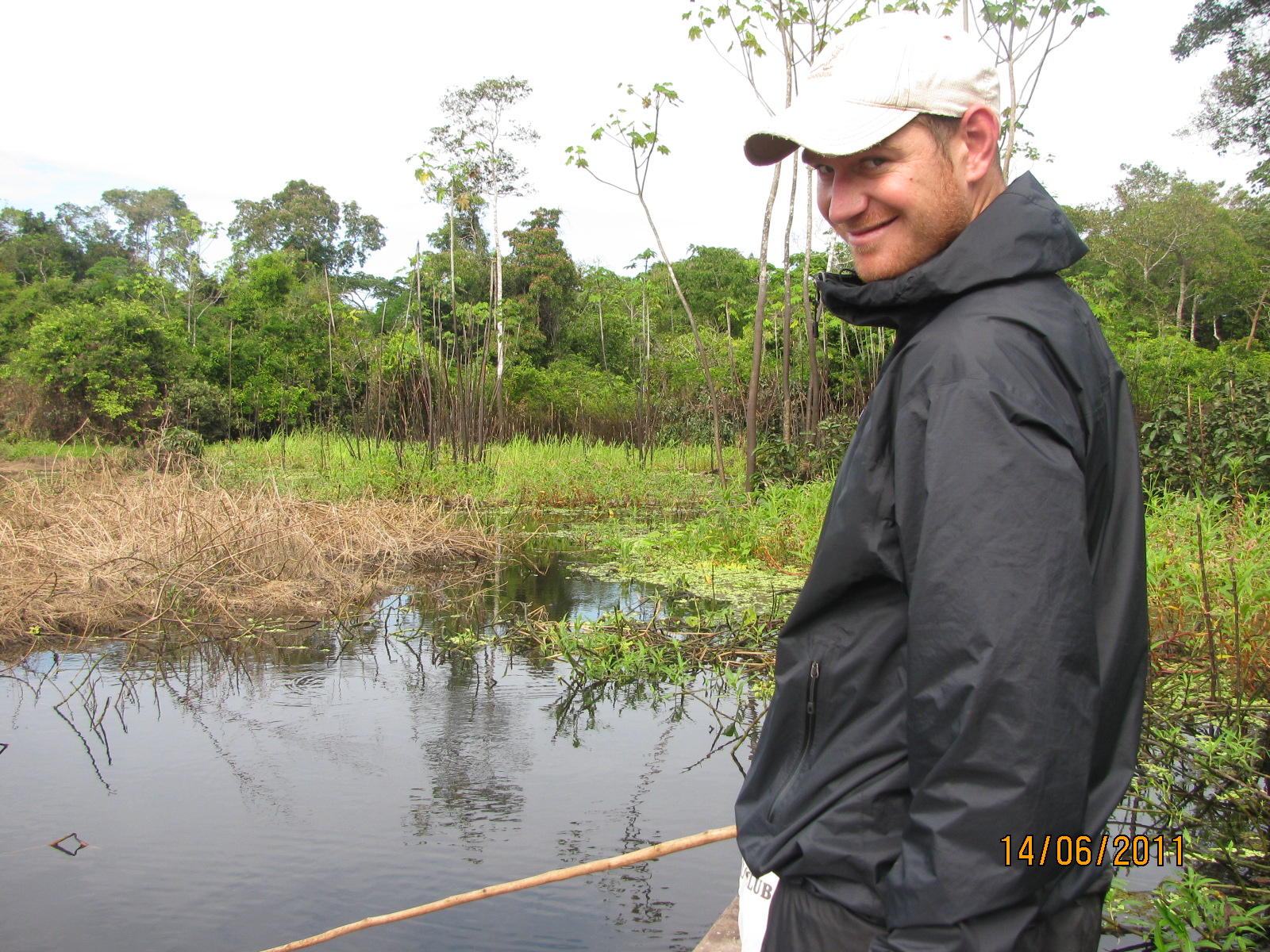
After a night in the luxury of the lodge, it was time to head further upriver to find better fishing and animal spotting locations. The boat took us into a network of smaller, swampier creeks. At some point the creeks were impassable, jammed with masses of beastly thick floating reeds. Everyone in the boat had to hack away at the reeds with machetes and use wooden paddles to coax the boat through the swampy mess, which was crawling with spiders, grasshoppers and snakes.

Our campsite was a small clearing often used by native fisherman. Our guides brought a live chicken with them in the boat – apart from being lunch on the last day, chickens are used to warn against lurking predators. If a puma or jaguar roams into camp one night, the theory is that it will feast on the chicken first and won’t come after any humans!

As soon as the boat rammed into the steep muddy bank, we were greeted by a blizzard of mosquitoes. Being an Australian, I am well used to having a few mosquitoes buzz around outside at twilight. But this was like landing on a planet where mosquitoes ruled the world.

Even though it was the middle of the day and we were covered head to toe, we were constantly surrounded by a cloud of mozzies intent on sucking our juicy blood. They quickly seized on any exposed skin – I was bitten on my face and finger tips, and they somehow managed to bite me through my waterproof pants. Adam had big welts on both knees with scores of bites on each where the mozzies had permeated his clothing.

Deeper into the jungle

We were really keen on exploring deeper into the jungle, but the problem is that any uncleared area is inundated by mosquitoes. We put our plans for a night walk to spot animals on hold and jumped back in the boat, which is the only place to get away from the mosquitoes. Cruising through one of the lakes under the luminescent glow of the moon and the stars was a celestial experience in itself. Then Kid spotted a pair of illuminated red eyes lurking among the reeds - a baby alligator!

Typically, he was keen to catch the animal and show it to us before releasing it back to its hideout. Now as I said I don’t fully agree with his methods, but once he had grabbed hold of the alligator and allowed us to hold it, it was a pretty cool experience. To catch it, he speared it in the bottom of its jaw, which he said would hurt it “like a toothache,” and then pulled it from the water.

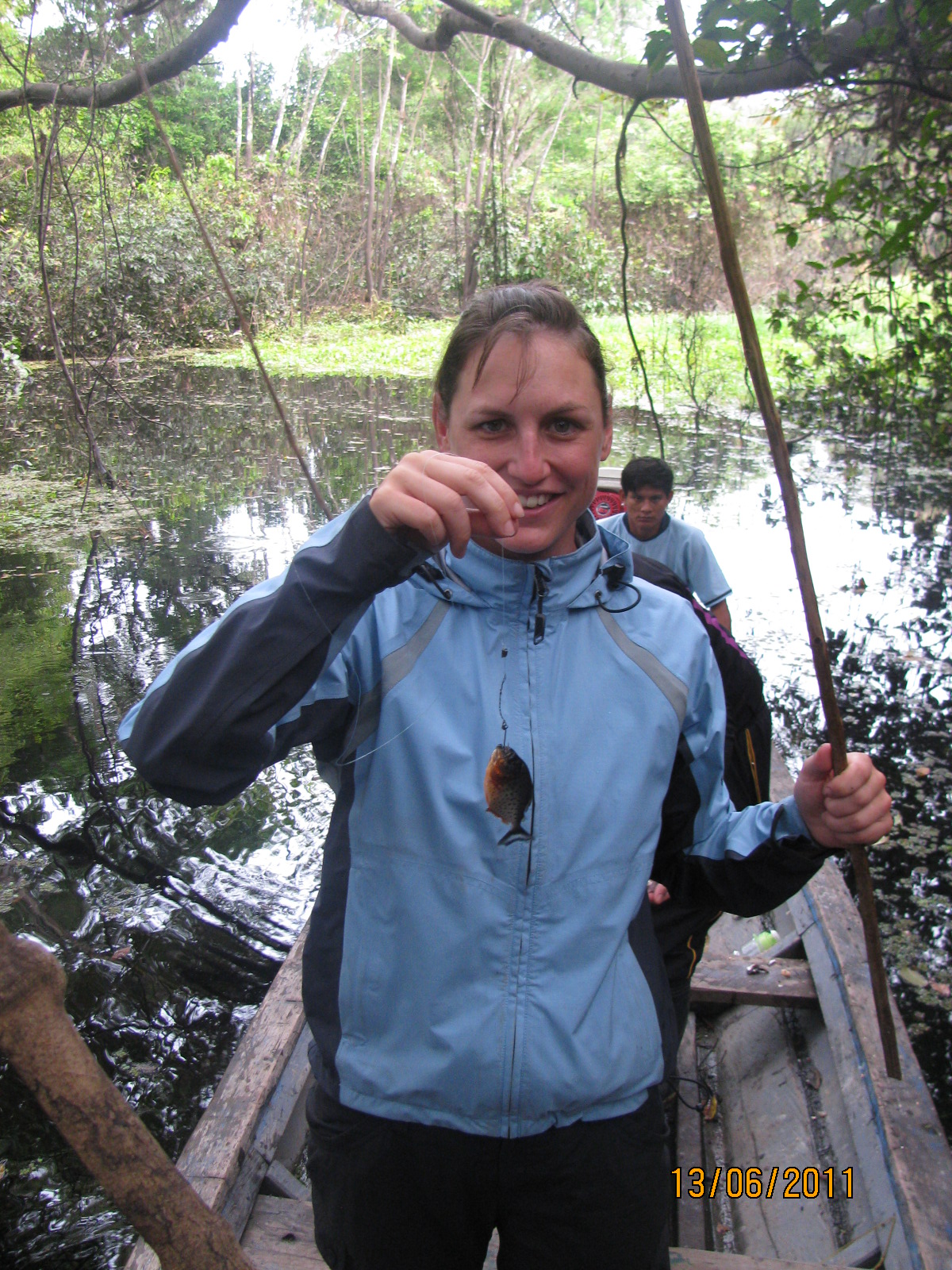
Our days were spent cruising through the creeks and lakes trying to find the best places to fish for piranha. I had not even realised it was possible to eat them, but I soon discovered they are a regular fish like any other, only with big sharp teeth. This makes it really difficult to remove the hook from the piranha’s mouth when you catch one.

Tiny piraña
We caught plenty of fish, including the aggressive piranhas. The problem was that most of them were tiddlers. Our fishing equipment was pretty basic – just fishing lines and hooks attached to long branches, with no reels to cast out further and no sinkers to get the bait to the bottom of the river where the bigger fish lurk. Adam was particularly disappointed that we did not catch a plate-sized piranha that we could eat. We did catch enough edible fish for two night’s worth of food, including some creepy looking pink catfish with long whiskers.

When it wasn’t raining, a huge variety of birdlife were easily spotted flying between trees along the riverbank. Adam woke early one day and spotted a pair of elusive toucans, but they had flown away once he returned with the camera. An endangered scarlet macaw – a giant, red parrot – hung around the lodge quite a bit, squawking noisily. We also spotted enormous brown and white hawks, kingfishers, herons and heard the hilarious sound of the jackass bird – I can now see how they got their name, they sound like a bunch of birds imitating a donkey!

One rainy morning we moored the boat in a swamp and trekked into the jungle, fortunately the mosquito cloud was a little smaller. Kid weaved this way and that, hacking off branches and vines with his machete to make a path. The rain meant that most of the animals were hiding, but he did show us some cool jungle plants, such as a vine that was filled with fresh water and another vine that emitted an iodine-like substance that could be used as an antiseptic.

The ever-hopeful piraña fisherman
Another vine produces ayahuasca - a hallucinogenic substance popular with nitwit hippies who rarely find the high they’re after and instead end up throwing up for hours and crapping their pants. My favourite was an enormous tree that is used as a “jungle telephone.” If you whack it with a stick it emits a deep thudding noise that can be heard from miles away. More spookily, we saw a fresh jaguar paw print in the mud- it would have been at least the size of my fist!

We lucked out a bit in terms of spotting animals – the river’s high level meant that animals did not need to converge on the river to find water. It wasn’t really our main goal to be photographed with wild animals - we just wanted to experience the rainforest.

That said we still had an itching desire to see some animals, so we visited a sanctuary for orphaned animals to check out some jungle beasts after we returned to Iquitos. Here are some of the pics!

Sloth

Toucan

Anaconda

Anaconda