Saturday, June 11, 2011

Amazonian adventure - part one

The triple frontier

It takes just two hours to fly from mountainous Bogota, with its crispy cool climate, to the Colombian outpost of Leticia on the banks of the Amazon River. Bustling Leticia is practically unreachable by road; the town’s orientation is towards the mighty river, reliant on supplies from cargo boats and transportation via speedboats that ply its muddy waters between Colombia’s neighbours, Peru and Brazil.

Leticia’s location is no accident – a tiny speck in the middle of South America, it is perched right on the Brazilian border, adjacent to a Brazilian town called Tabatinga. In fact it is so close to Brazil that you simply walk 200 metres down one of the town’s main streets and you cross into Brazil. No gates, no signs, no border control. On one side you are in Colombia, where all the shop signs are in Spanish, on the other they are all written in Portuguese and you are in Brazil. On the other side of the river lies Peru, a five-minute speedboat ride away, so it is possible to be in all three countries in a matter of hours.

Not quite the same as the "Aguila Ninas"
Motorbikes, scooters and Asian-style tuk-tuks rule in these frontier towns, where those on each side of the border speak a bizarre mix of Spanish and Portuguese and accept up to four different currencies in the shops. Jungle tours are big business here, among travellers arriving by air from Bogota, as we did, or from the upstream Peruvian port of Iquitos or from the Brazilian Amazonian hub, Manaus.

There are a multitude of operators spruiking, but the tours all seem basically similar – involving a boat ride down one of the smaller tributaries of the Amazon, a few nights either camping (under tropical strength mosquito nets) or in lodges, piranha fishing, night tours spent looking for anacondas and caimans (which look like alligators) and day trips to spot birds and other jungle wildlife. In the end, we decided to wait until we were further into the jungle in Peru, as the prices seemed a little steep.

Brazil - enjoying a coldie as the sun sets over the Amazon
Though Leticia and Tabatinga are side by side, there are some big differences when you cross the border, even though at first the only thing that changes is the shop signs. Confusingly, Tabatinga is on Brazil time, which is one hour ahead of Leticia. And while Leticia is packed with bakeries, Amazonian restaurants and motorcycle sales and repair shops, Tabatinga is lined with fashion outlet stores, with rows and rows of the ubiquitous Havaiana brand flip flops (sorry my Australian friends, I must use international lingo in this blog) and their cheaper imitation, Ipanema brand.

Oops.... eating endangered species :(
The Amazon is bursting with countless varieties of river fish, including giant river monsters which are endangered and therefore you don’t want to see them ending up on your plate. Adam found out later on that the innocuous fillet of Pirarucu he enjoyed cooked in coconut milk is actually an endangered species, the largest freshwater fish also known as the arapaima.

It is still being fished commercially in the upper reaches of the Amazon despite a ban being in place. There are however, several kinds of fish in plentiful supply. I had a delicious fillet of El Dorado, a white fish with the consistency of a kingfish, cooked in a spicy tomato and onion sauce.

This triple frontier outpost is the jumping-off point for our adventure into the Peruvian Amazon. Our first leg in the journey was a 10-hour speedboat trip upstream to a town called Iquitos in Peru, the largest town in the world not accessible by road. To get to the boat, which departed at 4am, we first had to cross the river to the Peruvian port of Santa Marta.

On the docks for a 2am departure
Confusingly, the boats left from the Brazilian side of the border, so we had to spend the night (well half the night because we got up at 2am) at a seedy “bagpackers” hostel close to Tabatinga’s seedy but bustling market and port precinct.

After a few days in Iquitos, we will take a tour by canoe deeper into the jungle (Adam, predictably, is particularly excited about fishing for piranhas and other river fish) while I am hoping to be able to wrap an anaconda around his neck if he spends too much time fishing!

The next leg is to ride on one of the big Amazon cargo boats further upstream, right to the source of the river, to another speck on the map, the Peruvian town of Yurimaguas. The journey will take three days and two nights, in which we will sleep in hammocks on the top deck of the boat.

Stay tuned for the next instalment in our Amazonian adventure!
The mighty Amazon - clouds so low you can nearly touch them

Tuesday, June 7, 2011

Big ups to Bogota

Colombia's capital city Bogota has its nice and not-so-nice areas, ranging from flash apartment blocks and malls to rundown alleyways crawling with homeless people and hookers. If nothing else, there's something for everyone here and its all relatively easy to find. The city, which has more than eight million inhabitants, is at an altitude of 2600 metres and set against a stunning backdrop of pine forested mountains.

One thing that didn't leave us alone was the rain. It's been a pretty recurrent theme since we arrived in Colombia a little over three weeks ago. We've had barely a day where it did not rain at some point. During our four-day sojourn in Bogota we have probably seen the sun twice for a one-hour period each time.

Apparently though we have avoided the worst of the inundations, as Colombia experienced terrible flooding in April and May, with thousands being made homeless, road and bridge collapses and serious transport delays. Getting around Colombia has not been too bad for us, but some bus trips took noticeably longer than they were supposed to. The trip from Rio Claro to Bogota took an agonizing 11 hours, a lot more than the advertised five hour journey.

The massive rainfall of late is to do with the La Nina weather pattern and has been drenching Colombia for most of the year. Its a good thing Colombians do not let a little thing like constant rain dampen their spirits. Even in the most solid downpours there were people out and about in Bogota, walking, cycling, riding motorbikes and enjoying the many green spaces the city boasts.

Some home cooking in the Cranky Croc kitchen!
From the minute we arrived - at 1am on Saturday morning after the horrendous bus trip - there was activity everywhere in the downtown streets and in the colonial district of La Candelaria, which is packed with bars and clubs and is where we stayed in a hostel run by a Bogota-based Australian. We really liked the atmosphere at the "Cranky Croc", and it was kind of nice to be in the majority in terms of nationalities, as not surprisingly, the place was crawling with Aussies! It was equipped with a BBQ, fireplace and the proprietors were very proud of their "Aussie-style doonas."

We were in Bogota on a long weekend - on the Monday it was a public holiday. Instead of the streets being absolutely dead (as happens on most Australian public holidays as everyone goes to their mates' place for a BBQ), they were throbbing with activity, as couples, families and teenagers came out to play.

The streets were crowded with vendors, selling chorizo sausages wrapped in thick tortillas known as arepas, waffles served with various types of spreads, jams and even chocolate freckles and the obligatory BBQ corn on the cob guys. Street performers kept the masses entertained - mime artists, storytellers and even an old lady singing Colombian folk songs!

This I did not expect...people walking llamas
One funny thing I have noticed all over Colombia is that pretty much every street stand, and even lone people stand around wearing big signs advertising phone calls. They rent out their mobile phones for an average of 10c a minute. Come to think of it I don't think I have seen many public phone booths but in most countries mobile phones are so cheap that even five year olds have them. So I'm not sure why using strangers phones is so popular here!

As is the same all over Colombia, everything is owned by a small, high-powered elite who obviously are very-well connected in political circles, and the rest of the population is pretty much left to fend for themselves. The rich seem to keep themselves quite separate from the rest, employing security guards with giant automatic weapons to guard their apartment blocks and driving around in big four wheel drives with the doors locked.

Lots of sandstone buildings...reminds me of Sydney
Far away from the neat and tidy apartment buildings, Bogota is ringed by shabby brick shoeboxes rising up the surrounding mountainsides in nearly every direction. The city is packed with homeless people, many of whom look like they are teenagers. I'm not sure if they live in some of these outer areas and come into the city to make money, or whether they actually live on the streets. Either way we were absolutely mobbed by them everytime we went walking around in the city. It is sad the way the government seems to look after certain parts of society, completely ignoring others.

Many of the people asking us for money were junkies, but unlike typical heroin addicts or drunks that you might see in other countries, these junkies were high on cocaine. Here, it is cheaper to buy than a bottle of rum, hence its popularity among street people. Unfortunately this meant that people asking us for money had a lot of energy, and were prepared to pursue us eagerly for it, which made it difficult to shake them off.

Enjoying delicious Ajiaco soup!
We saw one guy with a blanket around himself standing in the middle of a charred mess. At first we thought he was burning rubbish, but we quickly realised he was burning plastic cabling to access the copper wiring inside which presumably he could sell for quite an attractive price, given the spiralling value of copper recently.

Aside from walking around town (in the rain), visiting some nightclubs and a shopping mall, we did not do too much sightseeing in Bogota. But we did come across some great cheap eateries, including a place around the corner that sold delicious meat and chicken empanadas for just 50c each and a cafe where we tried Colombia's specialty, ajiaco, a delicious thick vegetable soup crowded with potatoes, corn and other goodies.

We are abandoning Bogota's crispy cool climate and embracing the sticky, sweaty jungle for the next installment in our adventure: THE AMAZON!

Sunday, June 5, 2011

DO NOT go to Rio Claro - unless you like RATS

I think the title of this blog pretty much sums up what we thought of the so-called "nature refuge" at Rio Claro - a few hours east of Medellin on the main highway to Bogota. Seems like the perfect place to stop and break up a journey, right? Wrong!

It's kind of a shame really - this mega rich Colombian family owns this nicely built eco resort on the banks of a pristine mountain river and offers an all inclusive tariff with activities such as kayaking, rafting and zip lines for only a few dollars a pop.

The problem is they didn't give any thought to the truckloads of bugs, rodents and other "animales" in the vicinity and stop them from breaking into the rooms. The aptly named "eco-lodge" contains beautiful timber-constructed rooms, but they are open on one side - ie have no window and no flyscreen.

With no mosquito netting over the beds, its an insect free for all, with ants, wasps, moths, grasshoppers and the occasional mosquito sharing the room. Note: this is not a good environment to read with a head torch late at night - we got swarms of bugs landing on our books and buzzing around our noses. Not good to breathe through mouth in these situations.

Fortunately our cabin had four walls and windows, but there were big spaces on either side of them where insects could crawl through. And worse...a rat. Adam awoke in the night to hear sounds of our plastic food bag rustling. First he thought I was kindly preparing him a midnight snack, until he opened his eyes and came face to face with a hungry rat! After we shooed it out and blocked up the big space under the door where it made its escape, I found it a little difficult to get back to sleep, even though we hung the food bag up on a hook.

The rat experience and the weather had us on our way the next morning, a day earlier than expected. It had rained constantly throughout the night, and the so-called "Clear river" was a swollen muddy brown, and the hotel owners would not let us hire inner tubes and ride down it until the river abated. So we left without doing any of the activities. The one good side to this stop-over was the food - although the all-inclusive price worked out to about $85US a day for the both of us, so it wasn't really worth it.

Next time we'll be catching the night bus instead of thinking we'll have a relaxing time at the "eco-retreat"!

Memories of Pablo in Medellin

Cocaine kingpin Pablo Escobar has left an indelible in his home town of Medellin, a lively and modern city of two million nestled in a big green valley in Colombia's northwest.

There's no escaping it: Pablo was a serious gangster. His activities in the cocaine trade and gang war against the rival cartel based in the southern city of Cali resulted in a terror campaign that saw hundreds of bombings and a giant death toll inflicted on his home town. Only in 1993 when he was gunned down by the CIA (although conspiracy theories abound), did the city lose its mantle as the world's most murderous city and become safe for foreigners to visit.

El Poblado -  financial and entertainment district
But at the same time, Pablo has left an incredible legacy. Needing to launder the billions of dollars he made annually from the cocaine trade, he invested heavily in Medellin's infrastructure - building schools, hospitals, roads and even a flash metro system that puts Sydney's CityRail to shame. Sleek, modern and air-conditioned, the metro zips passengers along Medellin's central north-south axis in style.

Like Pablo Escobar, many things about Medellin simply don't add up. It is an incredibly diverse city - at one end is the chic financial centre and Zona Rosa, or entertainment district, full of modern high rise apartment towers, banks, and shaded streets lined with sidewalk cafes, bars and nightclubs. Further along the valley is a stark contrast, where rows and rows of shabbily built brick shoeboxes line the steep hillsides.

One of the many things I liked about Medellin is that it is so well-planned. A relatively large population is well-contained within quite a reasonable area, with lots of medium-density housing built along key transport corridors (Sydney planners take note!). In many ways it is as modern as any European or US city - without the urban sprawl.

On another note, even though clearly not everyone lives in a nice house or apartment, the cityscape as a whole is an impressive site because the buildings are all built with attractive terracotta bricks, rather than the ugly grey cinderblocks used in other Latin American cities, so even the most basic of neighbourhoods are relatively easy on the eye.

Another strange thing about Medellin is that while it is in a developing country, it has an ultra-modern cable car that connects with the metro system, rising up its steep hills and over some of the poorer barrios. It sort of reminded me of a chair lift in the ski slopes - the capsules are suspended on cables and stop at a platform at the bottom of the hill, and move around in a circle, giving you a few seconds to jump in one before it turns around and heads back up again.

The view from these babies was amazing - its so rare that you get to travel above residential areas and it provided the perfect opportunity to stickybeak into people's houses, shops and schools. You could watch groups of kids playing football on concrete pitches and see right into rooftop coutyards that are haphazardly attached to most houses, where people hang their laundry, hang out and store all manner of junk.

Once you reach the top it isn't over - you can change for another cable car that takes you even further up the hill. It is sad to see the quality of life deteriorating as you ascend, as the suburbs become more and more like slums, but from here you can see the whole of Medellin in all of its contrasts. The view is absolutely priceless.

Rich and poor - Medellin's slums with financial district behind
To our surprise, the ride kept on going past the top of the hill and into a dense pine forest behind the city. When we alighted we realised we were in the middle of a big new national park boasting a network of walking trails, restaurants and even horse rides. We really weren't dressed to go on a hike, so we selected a short walk through the forest and prayed that the city's incessent rain hadn't created too much mud.

Natural beauty and smart planning aside, perhaps Medelllin's best asset is its amazingly friendly people, or Paisas as they are known. Normally you would expect city people to be a bit more uptight and aloof than country folk, but we did not find this with Paisas at all. Many stopped to chat to us in the street, and one kind group even offered us a lift home in the driving rain from a hotdog stand we had visited for a midnight snack.

Earlier that day we grabbed a cheap set menu lunch at a diner in a small laneway in the centre of town. The place was all set up with benches and individual seating, and the majority of the (male) clientele were in there alone. The Colombian set menu is the best and cheapest way to fill yourself up, and is even better value than fast food joints.

You are served a soup, made of varying ingredients - on this occasion it was tripe, the entrails of which I studiously avoided, but the soup itself was really tasty. Then you pick between a slab of beef, pork or chicken (or fish if you pay extra) which comes with a mountain of carbohydrates - rice, beans, fried bananas and even chips sometimes. For good measure, it is garnished with a limp-looking side salad. The price? $US2.

The street hustlers - porno salesman covering face!
The day we visited central Medellin, we were walking around with two Dutch guys, who were around the same height as Adam. The three of them attracted a lot of attention everywhere we went - stares, giggles, comments - I don't think anybody had ever seen a group of people that tall! After lunch we were hanging out in the laneway, watching men gamble on dice and other games in these mini-casinos that are set up all over town. Instantly we were surrounded by Colombians, keen to have a chat and laugh.

Very quickly though it became apparent that they had other motives - one old man, who was raucously drunk (at 3pm) started trying to sell us drugs, while another started trying to flog Adam copies of porno movies and prostitutes - when he thought I wasn't listening!

Tuesday, May 31, 2011

Trekking to the Lost City

The Lost City - sounds like something out of an Indiana Jones movie, doesn't it? Its a collection of pre-Columbian ruins buried deep in the rainforests of the Sierra Nevada, on Colombia's north coast, only accessible by a reasonably tough 5 day trek.

The 44 kilometre trek winds through lush hilly farmland, pristine virgin rainforest and finally a cloud forest. The actual city itself is a series of hundreds of circular stone terraces covered in various varieties of moss. The site was only "discovered" by treasure looters in 1972 - although indigenous groups have claimed to be living in and around the ruins, the descendents of the Tayrona people who are thought to have built the site somewhere between 600 to 800 AD.

The ruins themselves were interesting, but let's face it; its no Machu Picchu, a far more breathtaking and complex structure that was built hundreds of years later. The best part of the Lost City is that it is so far away from civilisation that it is only possible to hike there - so the journey that matters more than the destination.

Our group was pretty exhausted by the time we arrived at the ruins on the third day. We had been hiking mosly uphill for five hours, then had to scramble along the river banks and up a punishing 1200 stone steps to reach the first set of stone terraces, the entrance to the city which was once used as a marketplace to trade goods with other tribes.
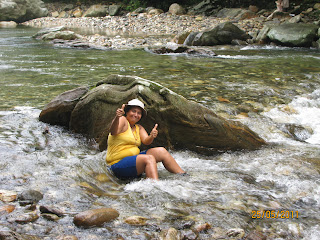
The hilarious Maria
We ummed and aaahed between two tour operators, eventually opting to go for the upstarts Magic Tours rather than Turcol, who until recently had a monopoly over the treks. Our guides were a highly entertaining and friendly husband and wife team, Luis and Maria, as well as Jordan, the master chef who walked ahead of us in order to arrive at camp early to prepare delicious meals.

Overall the trek was quite well organised, however my one gripe is that they severely overloaded our group. The day we left was the last possible departure date before a five-day long indigenous festival, and the tour operators seemed to try and pack as many people into the group as possible. The first day we started out with eight people - a great number - but at the end of the day were joined by another eight people.

Considering the numbers, the guides did a great job, but refused to split up the groups so we often had to stop and wait for up to an hour for other members of the group to arrive at a rest stop or a river crossing. On the first and second days the distances covered were ridiculously short - 3.5 hours on the first day and and just 2 hours on the second day - these could easily have been combined into one day.

Trying to force a smile after climbing all of those stairs!
Minor complaints aside, it was a spectacular experience. The scenery was breathtaking, especially as we ascended through the steep mountainsides adorned with pristine rainforests and up beyond the clouds. The trail was interesting and varied - it started off fairly easy on day one, but included a number of long, steep seemingly neverending climbs to get the blood pumping!

It rained for a few hours every day, so much of the path was wet and slippery, and in some cases, covered in squishy ankle-deep mud. We crossed through a number of farms, and at these points the sloppy mud was intermingled with mule and cow poo, which had everyone concentrating extra hard not to slip over!

We crossed an inumerable number of streams, mini-waterfalls and larger rampaging rivers where it would have been easy to be swept away. On the first river crossing, I saw Luis casually wade across without taking his shoes off, so I thought that was the thing to do. I crossed over first, not realising that the rest of the group were carefully removing shoes, socks, shorts and anything else that might get wet. After the crossing was an intense 45 minute climb which I suffered through with my squishy wet hiking shoes.

Fortunately with all of these rivers around there were plenty of places to strip off and have a swim. Each place we camped had a really cool swimming spot, many with rapids to jump into and float down, and a couple with 10-metre high boulders that some of the braver souls enjoyed launching themselves off.

Aside from said river crossings, much of the third day involved scuttling along rocky paths that clung precariously to the river. In many places we had to cling to slippery wet boulders and negotiate piles of mossy rock and slippery tree roots.

Each night we stayed in purpose-built camps - big shelters with wood-fired stoves, long bench tables and rows of hammocks to sleep in. At first the whole hammock thing seemed like a novelty - I mean, who hasn't fallen asleep in a hammock on the beach? It felt quite nice at first, being enclosed cocoon-like in a hammock with a mosquito net over top, but the cozyness quickly turned to mild claustrophobia, especially as we were all packed in like sardines, with barely a few centimetres between each hammock.

The hammocks
Sleeping in hammocks puts the difficulty of getting up at night to go to the bathroom on a whole new level. One time I tried to put it off for what seemed like hours, then eventually I tried to silently swing myself down to ground level, avoiding the mud and into my flip-flops. This went ok, but trying to get back into the hammock was the hard part. I sat down on the material, lent back but somehow failed to get into the middle part and I went right over the back, and stacked it on the muddy floor!

One of the camps we stayed at was right behind the home of an indigenous family, but it did not turn out to be the authentic "meet the tribe" experience that we had been promised - we were told we would be introduced to some of the Spanish-speaking ones, but all we got was a quick talk about them from one of our guides, which was translated into terribly broken English by one of the people in our group. We tried to say hello to some of the kids and women that we saw, but for the most part we were pretty much ignored or avoided. At one point a little girl even started throwing rocks at us, compounding the feeling that we weren't very welcome there.

We did benefit from our guide's explanation of some of the more bizarre points of these societies. Men generally marry twice in their lives - the first marriage is an arranged one where an 18-year old man shacks up with an older, more experienced woman who teaches him the lie of the land, so to speak, as well as the duties involved in being the head of the household.

These marriages are short-term, lasting from three months up until a year, at which point the man is able to take a wife of his choosing, who doesn't get much say in the matter and is generally 12-14 years of age. Basically as soon as a girl gets her first period, she is marriage material. Once married, the sole aim of this couple is to procreate, and have as many children as possible to maintain the tribe's population - which took a major hit when the Spanish invaded.

The Tayrona are one of the few groups in Colombia that are permitted to grow coca leaves for personal consumption. Since the US cracked it a few years ago and started spraying poison on coca plantations, the Colombian government has tried to stamp out coca plantations, but indigenous people are allowed to continue the ritualistic practice they have followed for centuries.

Basically it involves chewing the coca leaves after they have mashed them up with crushed snail shells in a wooden pipe-type object called a poporro. Only males over the age of 18 are allowed to indulge, and our guide seemed to think that they weren't just getting high willy-nilly, that it was more of a special occasion thing.

Being in a tropical part of the world, the mosquitoes were ferocious. Everyone returned with a join-the-dots picture of itchy bites all over their legs, despite collectively spraying on mountains of repellant. We all stank too, thanks to the mud and the oppressive humidity, we were bathed in sweat the entire time, and had trouble drying our clothes overnight. Most mornings we were pulling on at least one wet slimy item from the day before. By the end of it everyone had garbage bags full of dirty laundry that smelled like toxic waste and were practically racing each other back into town for a shower and a bed that wasn't a hammock!

Friday, May 20, 2011

Crazy times in Cartagena

Arriving at the historic port of Cartagena, we immediately noticed the first of a series of very dramatic contradictions that characterise Colombia.

Sailing into port, we were surrounded by rows upon rows of luxurious looking apartment blocks along a palm-lined esplanade. The curious thing was that even though the majority were residential towers, very few of them had any lights on, save the occasional penthouse and row of lights marking the lift shafts.

On closer inspection it is apparent that this is money laundering par excellence - the billions of dollars generated from Colombia's rampant cocaine trade had to be cleaned up and spent on something, and real estate must have been one of the better ways to sink the dirty money into worthwhile projects. The only problem is that the apartments are unaffordable for most Colombians, hence the large number of empty floors.

Pirates shaped the course of Cartagena's history
Right beside this mini-Miami of shiny white towers sit the crumbling walls of the ancient city, fortified since the 1600s to ward off an almost constant spate of pirate attacks on the city, most notably by the infamous British pirate Sir Francis Drake. He seems to have achieved somewhat of a hero's status in British folklore, but around here he is described in Spanish as something akin to the "evil imperial forces."

Encased between the impenetrable walls is the remarkably well-preserved old town, all beautifully painted stone buildings with bougainvillea overhanging upstairs terraces. Although obviously set up to be a big gringo hangout, it was a surprisingly pleasant place to walk in and around, and we ended up being detained there for a couple of days longer than we had anticipated.

El Castillo de San Felipe
Inside the walls is an ancient fortress built on a mound overlooking the city, complete with rusted cannons pointing out at the sea. Visiting the complex, we discovered it was pretty elaborate, and was equipped with a network of underground tunnels where the besieged Cartagenans could hide out during a pirate attack. It also had an underground aquifer running through it so nobody would go thirsty. 

Our stay in Cartagena was made more pleasant by the fact that the dorm room in our hostel was pleasantly air-conditioned at night, providing welcome respite from the oppressive heat. It became ultra-muggy on a couple of occasions when it rained in the afternoon. It was quite a well-organised modern hostel, especially compared to Central American standards, but after a couple of days we moved to a hostel that had a pool and a more, shall we say interactive vibe, with a reputation for organising big parties. Both hostels were great places to meet people, and strangely the town seemed to be a mecca for other Australians. We spent much of our time with a fun couple from Canberra who were travelling in South America after living in Whistler for the Canadian ski season.

Cartagena does have a bit of a yuppie vibe to it, and its quickly apparent that this is where wealthy Colombians come to relax and party, but parts of it do have a more authentic feel to it. Some bustling food and trinket markets cut through the centre of the old town, selling all the usual tropical favourites like enormous mangoes and avocadoes, yet more fruits I hadn't heard of (many of which look like oversized passionfruits) as well as the trademark Colombian fried snacks, filled with various meats and cheeses.

Maybe it was the heat, but things in Cartagena moved really slowly. One day we went for lunch, which consisted of a "menu of the day" where you chose between chicken, fish and beef, and get a free bowl of soup thrown in. As soon as we'd commandeered a table at the crowded restaurant, we were completely ignored by the indifferent waitress who shuffled around at a glacial pace.

Without asking us what we wanted to order, she slapped down the bowls of soup, and took about half an hour to bring our drinks over - and only after we'd asked a second time. Our actual meals didn't come for over an hour - fortunately they were good value and tasty - each came with rice, fried bananas, beans and salad and cost less than $5 apiece. Getting the bill was another half-hour long exercise, and the whole experience took us just under two hours, for a comida corriente which ironically means "fast food" in Spanish.

Curiously, the statues all had afros!
The bus from Cartagena to Santa Marta, our next leg of the trip, fared little better in the efficiency department. We eschewed the hostel-advertised shuttle because it looked expensive and they always take longer given that they roam around town picking people up from all of the different accommodation places. Instead we jumped in a cab to take us to the bus station on the outskirts of town.

As soon as we'd left the walls of the quaint old city, it became clear that this part of Cartagena is a stark contrast to the rest of the city, whose population is over 1 million. The taxi weaved is way through dusty potholed streets, avoiding bicycle taxis, rubbish carts and stray dogs, and the concrete housing gradually became shabbier and more ramshackle.

We had no chance to check out the departures list when we arrived at the bus terminal - instead we were herded onto a bus by a hyperactive tout who assured us it was a direct service to Santa Marta, would only take 3.5 hours and would be leaving straight away. It turned out he lied about all three things. The bus did happy laps of the surrounding area until it picked up enough passengers, which took an hour, we had to change halfway to another bus, and the whole trip took about 6 hours door to door.

At least the cops get around in style!
The supposedly "direct" bus stopped every few minutes in each town to pick up more passengers, and at one point it seemed to stop at every single fast food joint along the way to grab dinner for the driver, then other people on the bus would randomly jump off to grab themselves a fried goodie.

To top off the experience (made worse by the fact that we'd had a pretty big party the night before), for the last hour they had turned the TV on in the bus but the reception quickly disappeared, leaving a disturbingly loud static noise ripping apart our eardrums.

Tuesday, May 17, 2011

How to get to Colombia - in style

It was quite a shock to discover that there are no roads connecting North and South America. Instead, a wild malaria-infested jungle known as the Darien Gap separates the skinny isthmus of Panama and northern Colombia.

Crossing over from Central to South America requires a little creativity, and unfortunately a sizeable wad of US dollars – the currency of choice in Panama. Flights are expensive, a one-way ticket costing several hundred dollars, and the option of climbing aboard a narcotics-infested cargo ship (although probably more of a risk of a bust going in the opposite direction) didn’t exactly appeal.

Coolrunning II
Luckily, a bunch of ingenious yachties have invented a solution. For little more than the cost of a flight, they shepherd groups of backpackers from Panama to Cartagena on Colombia’s beautiful Caribbean coast, with three days of cruising through a chain of Panamanian islands thrown in.

Finding these seafaring types wasn’t difficult – hostels in Panama City advertise upcoming departures on their noticeboards and help you arrange a berth on a yacht. Of course choosing a captain is quite a gamble, seeing as you’re not able to meet them in advance and check out the state of the yacht. We heard tales of people who had sailed to Panama from Colombia of overcrowding, people having to sleep on deck, running out of food and a certain mentally unstable captain playing with himself below deck in plain view of his cabinmates.

Fortunately we struck it lucky with Austrian couple Sandra and George, who are preparing to sail around the world on their 43 foot yacht Cool Running II. They had spent the past few months sailing across the Atlantic and around the Caribbean, and had done the crossing from Panama to Colombia several times already.

We were also lucky to have a small crew – aside from us and our captains, our only other person was a German girl, so there was ample room to stretch out on the yacht and sleep in separate berths when it got too hot.

The weather didn’t exactly turn itself on for the first three days of sailing through the San Blas island archipelago – a storm delayed the start of the voyage itself was delayed by a day. But as we cruised in and out of microscopic islands dotted with palm trees and ringed by spotless beaches, we barely noticed the looming clouds and intermittent rain.

The San Blas islands are on the opposite side of Panama to Panama City, and getting there required a ghastly 4am wakeup call and hair-raising ride in a four-wheel drive over the country’s central mountain range to reach the Caribbean cost of the country. We were dropped off in a jungle clearing alongside a murky brown river, a speedboat arrived, and somehow the driver knew just where to deliver us, to the Cool Running II that was moored near the mouth of the river.

Eating like kings
Within minutes of boarding the yacht and receiving a warm welcome from Sandra and George, we were being fed a delicious European breakfast (including cream cheese, which I have not eaten for months!). This theme continued for the entire five day trip – there were substantial breakfasts, delicious summertime salad lunches and hearty Austrian food dinners. They even baked chocolate cake, and on the day we sailed over the choppy open ocean from the island chain to Cartagena, there were delicious baked sausage and cheese-stuffed doughy treats to enjoy.

Besides eating like royalty, Sandra and George also made sure we got the best out of the San Blas Islands. There are over 300 in the chain, ranging from the fairly large and populated, to outlying ones inhabited by just one or two indigenous Kuna families living in simple palm thatched huts.

We moored alongside a beautifully unspoilt isle that couldn’t have been more than 40 metres in length and just a few metres wide. Three or four Kuna families lived there, and when we came ashore in the dinghy, some of the children raced out to say hello and chat.

Our captains had a pretty sound local knowledge of which islands were the best for snorkelling. One tiny island – just a lump of sand really, too small to even support a palm tree, had a fantastic reef wrapped around it that dropped away from it in a steep shelf. Different types of coral were layered all the way down, and the variety and sheer number of fish were amazing.

Later we checked out another island that was home to a Kuna family and also had a reef you could access easily from the beach. This time we saw a group of three metre-long barracuda in the metre-deep water (and regretted not having bought the spear gun!).

It was great to come face to face with them, but after a while we did start to feel a little uncomfortable, especially when one of them started moving slowly towards us. Could there be truth to the old fishwife’s tale we had heard on the Corn Islands that barracuda mistake white people for fish when the water is a little murky?

Adam the ever-hopeful fisherman
Cruising in and out of the islands was blissfully easy from a sailing perspective, seeing as there was no wind we had to use the boat’s motor rather than the sails. Adam was keen to learn to sail though, and quickly became Captain George’s apprentice, eagerly lapping up advice on when to use the main sail, how to tie various complicated-looking sailing knots and how his GPS system and navigation instrumentation worked.

So when we finally left the islands to sail across part of the Atlantic to Colombia, Adam’s excitement was palpable. “I hope its really, really rough,” he enthused, picturing five-metre swells rolling across the top of the yacht as he strapped himself to the side while lure-fishing for giant marlin.

I, on the other hand, was mildly terrified. Not because I had any doubts that our sturdy vessel or our trustworthy captains would complete the crossing, but because I was worried I would be seasick the entire time – which depending on wind speed could last anywhere from 24 to 40 hours. I nervously refrained from drinking the day before we hit the open seas, and gingerly tucked in to the delicious Austrian beef casserole they had cooked for the occasion before we departed.
George - our fearless captain
The actual experience turned out to be somewhere in between our varying expectations. It was a bit rocky and rough at times, and when below deck you would find yourself being instantly shoved from one side of the cabin to the other. There was enough wind to use the sails for roughly half the journey, which excited Adam immensely, especially when he was entrusted with helping raise the main sail and make adjustments to the steering.

Fortunately, I did not get seasick, a combination of a steady diet of seasickness tablets and not drinking during the day. If anything, the heat of the sun baking down on the unshaded deck provided greater discomfort than the rolling waves, but it was possible to find some shade at the back of the boat and drag our feet in the water to cool down.

Arriving in Cartagena port at  night-time
As we started the crossing at night, it was an amazing experience to wake up in the morning rocking gently back and forth in time with the waves, and emerge from below deck to find out we were in the middle of the ocean, bobbing along with absolutely nothing else in sight in any direction. The only things we saw the entire trip were a couple of half-empty cargo ships and some wayward flying fish that jumped out of the sea and into the boat at random intervals. At night time the deck was beautifully illuminated by the silver moonlight reflecting off the main sail.

We reached the wide open embrace of the port of Cartagena just after sunset the following day – after 28 hours at sea. We cruised past the luminescent container port, the historic pirate fortress walls and rows of high-rise apartment blocks until we reached a sheltered inlet where dozens of other yachts – no doubt many of them containing other seafaring backpackers – were moored.

Waking up on the yacht moored in the middle of Cartagena’s massive harbour – the centrepiece of a city with a population of over a million people – was totally surreal. The harbour was flanked by the container port, huge apartment towers, a stone wall and a pretty palm-lined esplanade.

Wednesday, May 11, 2011

Old meets new in Panama City

Panama City's historic old quarter
I have a theory as to why Panama City looks the way it does. Back in the day, some Spanish architects built a colonial city centre, with quaint colonnaded buildings arranged around a central plaza, with avenues running north south and streets running east-west. Exactly the same as every single other colonial town in Latin America, and based precisely on ancient towns in Spain.

But the Spaniards only built on half of the available land around the bay, leaving the other part a stinky, muddy wasteland, until gringos arrived and built the Panama Canal. Awash with cash, somebody decided to let Donald Trump along with a clutch of other mental real estate developers in to pimp out the other side of the bay.

The result of this developmental dichotomy is bizarre. Face to the south, and you are greeted by an imposing wall of shiny glass 50 story-plus apartment blocks (or condos as they are known around these parts). Take a 180 degree turn, and you are transported back 300 years in time as you stare at a motley mix of colonial buildings, some beautifully restored and painted and others crumbling and derelict.

Someone let Donald Trump loose here
The sight of Panama's waterfront pretty much sums up the cultural vibe of the city. Expensive four wheel drives thunder through the 8 lane-roads in the centre of town, as designer-clad residents with oversized sunglasses make their way from their air-conditioned apartments to shopping malls and offices. A few blocks back, the glass-plated skyline gives way to drab concrete high-rise slums with tiny windows, no balconies, and I'm fairly certain, no air-con.

Rich and poor live side by side in the old quarter - the Presidential palace adjoins a crumbling decaying mass of slums, street stalls and a large number of homeless people camping out under shop awnings. Nonetheless, it was a fascinating place to base ourselves, and we were in luck with the hostel we chose, Luna's Castle. Set in a huge, rambling colonial mansion, there was always plenty happening yet we never felt that it was too cramped or overcrowded. It was a great place to hang out and meet people, helped by the generous happy hour at the bar below the hostel, with 50 cent beers.

Old meets new in Panama City
We quickly discovered that Panama City is a bit of a shopping mecca, and devoted a bit of our time to sussing out the various shopping malls and comparing prices of clothes, shoes and other bits and bobs to back home. We stocked up on a few items that were roughly half the price of what we would pay in Australia - a handy time to do so given that we have been travelling for over five months, wearing the same clothes day in day out and some of our things were in serious need of replacement.

We didn't sample too much of the local Panamanian food - for the most part I have been fairly non-plussed with the food on offer in Central America - which is heavy on the fried bananas, beans, eggs, rice and pork chops. Panamanian food featured all of these staples plus these gigantically thick corn tortillas, which are deep fried and turn out like a super-heavy hash brown. Not exactly what you feel like quaffing in 35 degree heat!

The further south we have ventured, the higher the humidity has crept up. It is pretty oppressing here - to the point where you are praying for it to rain just so you can get some semblance of a cool breeze across your sticky skin. I have developed heat-induced cankles - I kid you not there is absolutely no definition between my calves and my swollen feet, despite indulging in three or more cold showers a day.

It's now our fifth day in Panama City - we're enjoying every minute of it but at the same time we're hanging out to start the first leg of our passage to South America - five days cruising on a 43 foot yacht from the Panamanian port of Carti on the Caribbean side over to Cartagena in Colombia! It involves three days chilling in the San Blas islands off the coast of Panama, then two days sailing on the open seas to Cartagena. The trip has been put back a day because the weather has been bad, but with any luck we should be setting sail aboard the yacht tomorrow morning!

Pimped out Panama City buses

Thursday, May 5, 2011

Baru - the volcano that wasn't

Our trip into the beautiful Chiriqui highlands in northern Panama to ascend the imposing Volcan Baru didn't exactly work out as planned.

We arrived in the gateway town of Boquete exhausted after two days' travel that included a soaking speedboat ride, a delayed flight, a frantic search for a bus at three different terminals, two eight-hour bus trips, a crowded local bus ride and two border crossings that took us from the Corn Islands in Nicaragua to Panama.

Volcan Baru, whose summit is over 3,000 metres high, can be scaled via an 11km track which you can do without a guide and doesn't require any ropes or complex mountaineering manouvres. Even better, you can camp right at the summit and walk back down the next day. Sounds perfect, right? We gathered our preparations and were set to leave the next morning when Adam kicked his foot against a big rock and sliced the top off his toe, and couldn't get his hiking shoe on.

We were staying at a really nice hostel - a huge house with a fully stocked kitchen set among beautiful gardens with a little river running through them. The only problem is the room that we had booked wasn't in the actual house - it was this slapped together, awkward little cubby house overlooking the river.

It was in a great position, but there were big gaps between the walls and ceiling and mosquito screens that didn't fit the shape of the wall. And there were mosquitoes aplenty. Even though we bought mosquito coils, we awoke in the middle of the night with mozzies buzzing all around us after the coil had burnt out. After this, we didn't exactly feel like hiking anyway, so Adam's foot provided a good excuse for us to rest up.

The treehouse - great location, but total bugfest
That night we decided to pitch our tent on the lawn behind the house instead, because it was mosquito-proof. Meanwhile, we bludged around in the big comfortable living area of the house, watched CNN and cooked ourselves delicious food - which we hadn't been able to do in nearly 2 months. This was all fine until it started to rain. It wasn't particularly torrential but it rained steadily all night.

I was sleeping great until a strange wet feeling at my feet informed me that our tent was not waterproof. The entire bottom end of my sleeping bag was soaked through. I curled up and attempted to sleep in a little ball in the dry half of the sleeping bag. Meanwhile, Adam's pillow at the other end was getting wet. In the morning massive puddles had accumulated in the corners of the tent.

In light of the waterproofing fail and the continuing rain, we decided that going ahead with the hike was simply inviting further disaster and so we called it off, packed up our bags and set off on yet another bus trip to our next destination - Panama City!

The tent - waterproofing fail

Wednesday, May 4, 2011

Paradise...right here

After whizzing our way through about half of Central America in under a week, we needed to slow down and unwind. And what better place to do so than the stunning (and cheap!) Caribbean paradise of the Corn Islands, about 30km off the coast of Nicaragua.

Many backpackers skip the Corn Islands as they are a bit of a schlep from the mainland. From Nicaragua's capital Managua its a five hour bus trip, two hour river boat and a rough nine-hour ferry ride – plus a speedboat ride if you want to stay on the smaller, more relaxed Little Corn island.

The alternative is to take a flight in tiny propellor plane. It was a bit of a splurge but we opted for the latter. After crossing four countries in 48 hours and spending the night in the sweaty armpit that is Managua, we did not exactly feel like roughing it.

After an early flight, by 10am we were on an exhilarating speedboat ride to Little Corn Island from Big Corn, where the airstrip is, bumping our way through the choppy swell. Living up to its name, little Corn Island is tiny. Long and skinny, you can cross from one side to the other in under 10 minutes. 

We met a lovely couple from the UK at the hostel in Managua who were on the same flight. They had arranged for a guy to meet them at the wharf and take them to their accommodation. We had nothing organised, so we tagged along with them and were able to rent a room at the same place, a well-build array of tidy, modern cabanas on a secluded beach on the quiet side of the island.

I could use words to describe this place, but I would be in danger of running out of superlatives and messing with over-used clichés trying to articulate the virtues of this little corner of paradise (there I go already!), so I'll use some pictures instead.

Sold yet? It didn't take us long to fall in love with this diminutive land mass, only 1.6 sq km and free of roads, traffic and over-enthusiastic development that plagues so many other beautiful Caribbean hideaways. 

Apart from a handful of laidback bungalow accommodations on the beach and a small village with a few restaurants, the island is home to just a few hundred people - many the direct descendents of pirates and shipwrecked African slaves, mixed in with indigenous Nicaraguans. They speak an extremely kooky version of Creole English, which was nearly impossible to decipher!
Islanders have a unique way of greeting each other. When you walk past a person, you say "ok", and after a few seconds pause (we're on island time here) they respond "alright." When you want to say something is good, you say "right here."

It was extremely tempting to just lay back in a hammock and do nothing (and there was plenty of temptation, with hammocks adorning every second palm tree), but there was a surprising amount to do on the island, and at relatively little cost.


Everyone's on "island time"
Most of the island is surrounded by a coral reef, so you can go in and snorkel right off the beach. We had to swim out a few hundred metres to reach it, and the coral was really only good in certain spots, but it was good exercise for us nonetheless. After a couple of days of tireless swimming, we rented a kayak to explore some of the more far-flung spots. We weren't disappointed. We saw a couple of big stingrays and plenty of coloured parrot fish, and also this enchanted forest of bright orange coral arranged like tree branches.

After stopping in at some of the beautiful untouched beaches on the north coast of the island, we decided to continue paddling and circumnavigate. As we headed around to the west of the island, the side closest to Big Corn Island, it became much calmer and easier to paddle. The southern tip of the island was a different story. Here, sizeable waves crashed into many bunches of offshore rocks.

To take a course in between the rocks and the shoreline would have been very bumpy, and we probably would have capsized. So we gave the rocks a wide berth and paddled all the way around the southern tip, before entering the calm shore in a break in the reef. At times it felt like we were almost paddling out to sea, but the surf wasn't really that rough, as long as we had our boat pointed into the wave and we were not side on.

The kayak
We'd heard stories of people that took snorkelling trips with local boatsmen and saw things like hammerhead sharks and sea turtles, so we decided to give that a go. This time we went right out onto the far side of the reef, where the swell was fairly rough but there were an amazing amount - and variety - of fish to watch. The coral was fairly similar - most of it was dull shades of green and brown reminiscent of army fatigues.

Almost straightaway, a small nurse shark drifted by our group and disappeared into a coral cave. Moments later, we came face to face (ok so we were snorkelling and a few metres above) with another, much larger one which was just under two metres in length. We watched, awestruck as it cruised around the reef, stopping by a sandy patch of the ocean floor to roll over on its back.

Later on, we saw a small, but perfectly formed sea turtle, which had khaki-coloured markings on its shell in similar tones to the coral. It was amazing to watch it flapping its front feet like wings as it floated around the reef. We also saw a few eagle rays floating by. Unfortunately that day the water was too murky to spot any hammerhead sharks. Our boat captain said the barracudas that hung out alongside the hammerheads would confuse our white-man flesh for fish and gobble us up! (Has to be up there with one of the craziest gringo jokes I've heard).

On the island itself there was wildlife aplenty, including the usual tropical suspects such as geckos, iguanas and turtles and an almost out of control population of crabs. Most were pretty small and benign looking, clear in colour with funny alien-looking eyes perched on the tops of their heads. Many shells on closer inspection turned out to be hermit crabs, with hairy orange legs sticking out to drag themselves across the sand.

Far more sinister were the much larger red and orange crabs that emerged out of their burrows just after sunset and ran wild on the walking tracks criss-crossing the island. These wre completely unlit and our only way home after a night out at one of the restaurants. 

Even these paled in comparison to the monster-sized blue crabs that looked to have bullet-proof shells. They blocked our path on pitch-black night walks on several occasions, and only reluctantly moved after being stunned with the torch and heavily prodded with a stick. I quickly developed an acute case of crab-a-phobia, and by the end of our stay was too afraid to use one of the tracks because of the size of some of the inhabitants living in burrows alongside!

Monday, May 2, 2011

Four countries in 48 hours

In just two days we traversed four countries, a haul from Guatemala to Nicaragua, passing through El Salvador and Honduras.

It’s not as bad as it sounds because it’s possible to cross these petite Central American nations in just a few hours. Although when we finally arrived in Nicaragua’s capital Managua it felt like we had accomplished something – on the map we had covered almost a third of Central America’s skinny isthmus.

The reason for dashing through these countries at such a frenetic pace is that we have just reached the halfway point in our Latin American adventure – five months down, five months to go. Having started our journey in Mexico, we realised that we have a lot of distance to cover to reach Argentina to fly out by September 18.

Our plan was to hop, skip and jump through to Panama in order to arrive on the Caribbean coast of Colombia by the middle of May. We would break up the journey on the remote Little Corn Island, off the coast of Nicaragua, and also visit the adventure paradise of Boquete in Panama’s northern highlands.

We covered the first leg of the journey, from Antigua to San Salvador, in a cramped minibus for seven hours which included a long wait in the immigration queue at the hot and sticky El Salvador border crossing. The reason for the delay had nothing to do with extra scrutiny of passports or luggage searches. The customs officers were operating at an excruciatingly slow pace, single-finger typing our details into their computers.

San Salvador seemed relatively upmarket compared to Guatemala – lots of flashy cars, modern office buildings and shopping malls. We didn’t spend much time there, but it was enough to establish that it is very Americanised. Signs, billboards and other forms of advertising dominate the streetscapes, along with US gas stations and fast food restaurants.

People are clearly obsessed with security here. Rings of razor wire top tall concrete walls built around houses with thick metal grilles over the windows. Shops, including pharmacies, banks and even fried chicken joints are patrolled by guards with automatic weapons casually slung over their shoulders.

The bus from San Salvador to Nicaragua left at the ungodly hour of 5am, took 12 hours and required two border crossings. We were in the parched, scrubby landscape of Honduras for a sum total of three hours. We shivered for the early morning as the bus’ air-con system went into overdrive, then became progressively hotter and more parched as the system struggled to cope in the heat of the day.

Central American capital cities are not usually something to write home about, and Managua is certainly no exception. Managua had its heart ripped out when the centre of town was destroyed in a 1972 earthquake and never rebuilt. As in Haiti, international aid money poured into Nicaragua but was diverted by corrupt government officials and so the former town centre lies derelict. Now Managua is an uninspiring sprawl of makeshift barrios or neighbourhoods arranged along a highway that cuts the town in two.

We arrived as the sun was setting, and quickly established that it was not a good idea to go strolling through the ‘burbs to visit one of the local eateries. Even though our barrio felt safe, other parts of town had a decidedly sketchy feel to them. We ended up walking to a nearby shopping mall, partly to enjoy the air-con and partly because we somehow felt safer eating in a big lit up building. This probably reduced our chances of being mugged, but still this didn’t stop a small child from trying to pickpocket Adam.

Fortunately we had less than 12 hours there. The prize for passing through these salubrious locations, which involved getting up at 4am for three days running, was five luscious days on the Corn Islands, a former pirate hangout 30km off Nicaragua’s Caribbean coast where you can snorkel right off the beach and lobster is as easy to come by as chicken. 

  
Eye on the prize.....