Monday, August 27, 2012

Mythos time - sailing the Greek Islands

The Greek economy may be on the brink of collapse, but the doom and gloom isn't affecting the islands - its outdoor restaurants are packed, bars are pumping and marinas are crowded with schmick-looking yachts.

Obviously, the crisis hasn't kept the tourists away - among the Italians, French and Americans was a healthy contingent of Greeks. Were they escaping crisis-hit Athens to forget about their troubles for a while, or were they the unaffected ones, the non-tax payers with fortunes squirreled away in offshore accounts?

To explore the Greek Islands, we took a 7-day sailing trip on a 50-foot yacht, run by upstart sailing tour company Med Sailors. The group began offering skippered yacht tours in Croatia just last year, and expanded their offering to include Greece this summer.

Travelling in a flotilla of three yachts, with 8-10 people plus a skipper on our boat, we set sail from a marina in Athens. We explored a set of islands in the Saronic gulf, reaching westwards from Athens around to Corinth and down the coast of the Peloponnese - the big hand-shaped peninsula that dangles off the Greek mainland.

Finding Marina Kalamaki, the mooring for the Med Sailors yachts, wasn't easy. But it's probably because we forgot to print off the PDF instructions showing the exact address. The Med Sailors website said the tour left from the Athenian port of Pireaus. We took a taxi there, but it turned out to be a hub for enormous cruise ships, with over 50 separate bays.

Eventually we tracked down Kalamaki, a few kilometres to the south. Finding the exact co-ordinates of the yacht among the hundreds of masts looked impossible - until our friend Ryan, known for his thorough, boy scout-style packing skills, pulled out a pair of binoculars and located the Med Sailors flag hanging off a mast.

Storm brewing
Ryan quickly established his credentials as the group's drunk and disorderly sailor. His first question in the group briefing related to the amount of esky space available for beer. Keen to live up to his new-found reputation, he hit the supermarket, eagerly loading up on cases of Mythos, our Greek beer of choice.

Setting sail, we got to know the rest of our group of 8 plus our skipper, Christophe. Aside from us three Aussies, there was British couple Andy and Nat, Sarah, another Brit, Judy, a Kiwi and some other guy who needn't be part of this story. We were on the water for less than three hours when a freak storm blew in - we were just about to dive in the water for our first swim, when the sky turned orange and everything started flapping violently.

At this point we were just about to drop anchor at Perdika on the island of Aigina, but the sea was too rough so we took shelter behind a nearby rocky escarpment. The storm passed, but the skippers were reluctant to stop there for the night, so we continued sailing with the wind behind us until it got dark. We stopped at the town of Methana, a settlement on a peninsula connected to the mainland by a strip of land. It had a nice waterfront strip with rows of tables and chairs, but was an otherwise unremarkable place.

The storm slightly messed up our itinerary for the week, as we weren't supposed to stop at Methana until the way back to Athens, but the Med Sailors crew handled the change of plan smoothly. We didn't really care where we stopped and when, as long there was time to do a little sailing and stop to swim and refill the Mythos esky.

Christophe hoists the Australian flag
After the freak storm, the weather totally cleared up, and it was all blue skies and plenty of sun. The next morning we attempted sailing - only to discover that the main sail wouldn't unravel properly after being broken by the additional crew member not mentioned in this story. We made do with the jib, or sail at the front of the boat, meaning we fell significantly behind the two other yachts.

This didn't seem to ruffle the feathers our beloved skipper, Chistophe. In fact he seemed relieved when we didn't follow the other boats too closely, and did our own thing. Christophe's renegade vibe was contagious, and soon everyone wanted to moor away from the other boats, and trashed talked the other crews (who were pretty boring groups of 30-somethings anyway).

We quickly established ourselves as the wild boat, naming our yacht "Mythos III". Ryan, often accompanied by Andy and Adam, got the party started early in the day. Once Mythos Time was declared, it was all over. Ryan decided it was his personal mission to get Christophe as wasted as possible - everytime Ryan said "What time is it?" Christophe would have to answer "Mythos time!"

The second night we moored in a marina in the town of Poros, the largest settlement on the island of the same name. Poros, with its collection of white buildings and terra-cotta rooftops lining a hilltop, had a lot of character. At the top was a beautiful watch-tower, offering stunning views of the surrounding islands and mainland.

Idyllic Poros
The next day it was back on the boat for another attempt to pull out the main sail, which fortunately unravelled this time following the expert touch of Christophe. Only a couple of people had really helped with the sailing at this point, whereas others were either permanently drunk or just content to sunbathe and read at the front of the yacht.

At Poros we had stocked up on pool noodles, investing in one for each person on board. Stopping for a swim, we began a trend of elaborate jumps and dives off the boat, and lounging in the water wrapped up in pool noodles, beer in hand and sunglasses on heads. By the end of the week, we had honed these activities to a fine art!

The next day it was a short hop to Ermioni, a little peninsula on the mainland with a marina on one side and cliffside bars and swimming spots on the other. After sunset, we feasted at a restaurant on a pier by the marina that describes itself as "the oldest restaurant in the Saronic gulf." It was easily the best Greek meal I've ever eaten - it may as well bill itself as the "Best restaurant in the Saronic gulf."

Best Greek meal in the Saronic gulf
After devouring a series of mouth-watering entrees, including plump vine leaf rolls, creamy taramosalata, greek sausage and tender calamari, we were pretty stuffed but our mains were already on the way. Crispy pizzas from the restaurant's woodfired pizzas were delicious, but the lamb Kleftiko that Adam and I shared was simply outstanding. Served in a clay pot with a shank bone poking out, the supple, tender meat was encased in a rich stew and topped with stringy, melty saganaki cheese.

We retired to the boat for drinks and card games. Judy introduced us to an amped-up verson of Snap where there were an array of excuses to slap down on the cards - someone deals a queen, etc. The result was slightly violent - a pile of hands crashing down on the cards every few seconds. The game was abandoned after the first round, on the consensus that it was too stressful!

Hydra
The next morning we sailed further south, arriving at the hilly island of Hydra in the mid-afternoon. Unlike many islands that are visited by car ferries and have roads and buses and trucks, Hydra has two modes of transport - scooters and donkeys. A series of cobblestoned footpaths connects its quaint town, rising up the hill from the main square in front of the marina.

Up the hill and further around was a spot, aptly named "Sunset bar", offering panoramic views westwards across to the Peleponnese mainland. We ordered cocktails and sat around, waiting for the heavy humid air to dissipate and the sun to set. Afterwards we ate at a restaurant tucked away on a little lane behind the main square. It was set in a charming vine-covered courtyard, and we got a few laughs from the translations - Coq au Vin was Cock in Wine and there was also a Lamp in Lemon Sauce.

Unfortunately, our fun angered the waitress, who maybe thought that we were laughing at her expense for some reason. Things became a little awkward at the end of the meal when she told us all that we had been complete smart-asses for the duration of our visit, even though we were just having fun.

View from Hydra's Sunset Bar
The following morning we travelled northwards, returning to the village of Perdika where we had been unable to moor on the first day. I really enjoyed this leg of the trip as nearly everyone got involved in helping to sail the yacht. Christophe showed us how to tack - move the jib sail from one side to the other to catch the wind, use the navigation equipment and steer the yacht. We had competitions to see who could achieve the highest speed while at the helm - Adam held the record of 9.5 knots.

There was no space at the Perdika marina, so the three yachts anchored together in the bay and we took the dinghy into town. By this point in the trip we had gelled into a pretty cohesive unit, and we had an amusing dinner at a waterfront restaurant which consisted mainly of a series of drunken toasts to various things. "to Christophe the Great!" everyone cried, smashing our glasses together. The other, boring crews looked on aghast - we had firmly cemented our reputation as the noisy, drunken sailors.

It's Jager time!
Our final stop was Aigina, a little further around the island from Perdika. The weather had been heating up towards the end of the week, so we sought refuge in an air-conditioned bar. I had not really planned on drinking but felt compelled to as the cocktails were priced about the same as a fruit smoothie.

One strawberry mojito turned into several, and by the time I knew it, Ryan was ordering rounds of Jagers and it was only 4pm! The bar, instead of kicking us out, sent out free Kamikaze cocktails with multiple straws for us to share. We then placed a bulk order of pork and chicken Gyros for a sunset feast to mop up the alcohol.

That night, most of us slept in a hotel on dry land to escape the heat. The cosy cabins of the yacht were pretty stuffy and airless at night, especially if you were a couple! The next morning we motored back to Athens, stopping for one last nostalgic pool-noodle-and-sunglasses swim before arriving back at the marina.

Mythos III crew


Saturday, August 25, 2012

Incredible Istanbul

Straddling Europe and the Middle East at the end of the Silk Road, Istanbul has for thousands of years been a travellers' nexus and a meeting point of cultures. Yet the city is completely unique - somehow it doesn't really belong to either continent.

We were a little apprehensive about visiting Turkey's most famous city during the month of Ramazan (as it is called locally). Would it be appropriate to eat and drink in public and, more importantly, consume alcohol?

Don't be put off from visiting during Ramzan!
It turns out our fears were completely unfounded. Turkey takes a very liberal apprach to Islam. Plenty of people were observing Ramazan by fasting, praying and wearing traditional clothing, but plenty were not.

 Bufe restaurants and coffee houses were packed with locals and doing a roaring trade all day long. There were also swarms of pilgrums visiting from other parts of the country. The old parts of the city - Sultanahmet and the Bazaar quarter - teemed with an almost seemless blend of locals and tourists, creating an amazing buzz.

The atmosphere intensified when the sun went down, as Ramazan observers hit the streets in droves, packing out parks, streetside restaurants and cafes to break their fast. The city's mosque's were ablaze with colourful lighting, spelling out a message which I assume loosely translates to "Happy Ramazan." I can only imagine what this place is like on Eid, the festival marking the end of Ramazan.
 
Inside the Hagia Sophia
Istanbul, with a colourful history spanning three empires and over 2000 years, is so crammed full of historical and cultural sites its easy to feel overwhelmed. Sultanahmet square is a logical starting point. It is flanked by the city's most important mosque, the Blue Mosque and the stunning Byzantine church (later turned into a mosque) the Haghia Sophia.

We were stunned by the magical interiors of the Hagia Sophia - one of the things I love about this building is its unique blend of design, art and iconography, arising from a series of conversions to different religions over the years. The Hagia Sophia was built in 360 AD as the cathedral of Constantinople in the Byzantine empire (the continuation of the Roman empire after emperor Constantine shifted the capital from Rome to here). It has been converted from an Orthodox place of worship, to a Catholic church and then a mosque over the years. It has since been declared secular and is now a museum. Inside, ancient Christian mosaics rub shoulders with bold islamic calligraphy.

The multi-domed Blue Mosque
Opposite the square, the imposing Blue Mosque buzzes with activity all day long. Unlike the Hagia Sophia, the Blue Mosque is a working monument, playing hosts to thousands of Muslims who pray there daily. We arrived right after afternoon prayer time had started, and were diverted into a free information session. The presenter said some interesting things about the history and structure of the mosque, but then went a bit religous and dogmatic on us.

We then covered up and went in - I put on a headscarf, but was told my knee-length skirt wasn't long enough and was given a sheet to wrap around my legs. The entire interior of the mosque is covered in beautiful blue decorative tiles. Despite the building's size, it felt quite claustrophobic in there, and a little bit weird walking through an area dotted with people prostrating and praying.

There was a distinct lack of oxygen - the floors are covered with a luxurious, thick carpet and the space is too big to air-condition. The air was heavy with a pungent smell of body odour. I was glad I visited but it wasn't a place where I wanted to linger.

Sultanahmet rises up from the Bosphorous, a busy channel that slices Istanbul in two and is the main route between the Black Sea and the Marmara Sea, which leads into the Mediterranean. It is a bit of a tourist mecca - streets lined with restaurants, bars, tile and rug shops.

Looking out over the Bosphorus
Yet the precinct has a fun, vibrant atmosphere, and wasn't overly tacky like tourist hangouts normally are. Most places were several stories high, with rooftop terraces where you can sit and watch ships cruising along the Bosphorus.

Most cities have a central market - Istanbul has a whole section of town dedicated to its bazaars. The centrepiece is the Grand Bazaar, a sprawling labyrinth of interconnected buildings - all delightfully air-conditioned. The complex houses all manner of merchants and goods - jewellery, painted crockery, rugs, tiles, paintings, scarves, clothes and shoes.

The bazaar overflows onto the surrounding streets all the way down to the Golden Horn, a waterway branching off the Bosphorus that separates old Istanbul from the newer commercial centre of Beyoglu. My favourite bit was the Spice Bazaar, an L-shaped complex rammed with spice merchants. Stalls were piled with cumin, saffron, cinnamon, special spice blends, teas, figs, nuts, nougat, caviar, turkish delight and baklava.

Spice bazaar
The salesman were tenacious - cast so much as a sidelong glance at their produce and they are all over you like a rash. It probably didn't help that I was by myself - Adam and Ryan had decided they'd had enough sightseeing and escaped to a pub. One merchant gave me a full rundown on all of his merchandise, scooping up spice mixes to so I could smell them and hand-feeding me turkish delight!

Everyone we came across was friendly and welcoming. People seemed genuinely interested and were keen to chat, laugh and joke around. This applied to people in shops and restaurants, and also just random people we met in the street.

When we visited the Rumeli Hisari - or Fortress of Europe - a half hour bus ride out of the city, we met a big family group. The patriarch was so amazed by Adam's size he wanted to have his picture taken. After the first shot, his daughter asked to have her picture taken with me, and for the next 10 minutes they turned into the paparazzi, snapping photos of everyone.

Adam's Turkish admirer
There was a moment of confusion when they asked where we were from. We said Australia, and they went quiet and looked confused. One said a word in Turkish that sort of sounded like "straaii?" We shrugged our shoulders, and it wasn't until she then said "Tel Aviv?" that we realised they thought we were from Israel! We then said "Aust-ra-lia" and the mood instantly improved, and everyone burst out laughing.

The fortress itself is pretty cool - overlooking the Bosphorus, it was built by the Ottomans after they took control of the city in 1453. Its ramparts and towers were used to throttle supply ships going back and forth between Istanbul and the Black Sea. Besides a lonely guy at the ticket office, the site was virtually unmanned, so we were free to climb on top of the walls and climb up to the towers. It was sweaty work in the midday heat, but the reward was a stunning view across the Bosphorus to a string of grand Ottoman summer palaces on the opposite shore.

The most elaborate Ottoman grandeur is on display at Topkapi Palace, residence of a string of sultan rulers for more than 400 years. The centrepiece is the harem - home to the sultan's many wives, concubines and immediate family. Arranged around a shaded pine courtyard, the harem is a series of stunningly decorated rooms - painted blue tiles edged in gold and elaborate calligraphy. There are exhibitions of sultans (and sultanas!) clothes, jewellery, calligraphy scrolls and weapons - the centrepiece is the jewel-encrusted Topkapi dagger.

Beautiful Turkish tile art

Wednesday, July 4, 2012

Sailing the Dalmatian coast


Its clear turquoise waters are straight out of a Caribbean film shoot, but Croatia's stunning Dalmatian coastline is more than your average tropical paradise.

Sailing is the ideal way to explore the Dalmatian coast. You don't have to spend hours on trains or buses and you can just about dock up wherever you want. Marinas are often smack bang in the centre of town, where all the action is.

Cruising up to big bustling ports in Dubrovnik and Split was a surreal experience. One minute you're lounging on top deck watching the buzzing city get bigger and bigger - the next you're in the thick of it, exploring the myriad of tiny alleyways or kicking back with a drink at a waterfront bar.

There are plenty of operators to choose from, catering to everybody from backpacking thrill-seekers to sedate middle-aged holiday makers. We settled on the Kapetan Kuka, a medium-sized vessel chartered by adventure travel company Travel Talk.

Sleeping up to 35, the boat is bigger and roomier than a yacht but not massive and impersonal like a cruise ship. Better still, it was still small enough to be able to leap off the top deck and into the water to cool off!

At the first briefing with our fellow cruisers on top deck, it quickly became apparent that we'd be doing more than lazing around in the sun all week. With a large contingent of single, testosterone-fuelled Australian males, this was going to be a booze cruise.

We struck it lucky with the weather - although our trip was early in the season, temperatures topped 35 degrees most days and we barely spotted a single cloud in the sky. The heat wasn't noticeable when the boat was cruising along through the pancake-flat waters of the Adriatic sea, but it was baking hot when we anchored at small inlets for a swim or docked up at marinas.

The cruise

Starting in the busy port town of Split, the boat headed south to the large island of Hvar, before continuing to the emerald isle of Mljet. We then continued to the stunning medieval fort town of Dubrovnik, before returning to Split, via the island of Korcula and the laid back coastal settlement of Makarska.

Aside from these amazing towns, coastal inlets and nature reserves, the best part of the trip was simply chilling out on the top deck as the boat cruised past tiny isles, rocky limestone cliffs and pristine coves. Mornings were spent lazing on cushions, being cooled by the breeze as we waited for the captain to drop anchor so we could dive into the crystal clear water.

Party time

We docked up at a new spot shortly after lunch, and afternoons were spent exploring medieval fort towns, swimming at rocky beaches or just lazing around in the shade drinking beer. Most of our fellow cruisers had popped the top off a cold one by 11am, and continued on into the wee hours of the morning. Cocktails were a hit at sundown, served up in 1 litre wine carafes by Kapetan's hardest-working crew member, Bartender Ivan.

Everywhere we went, the cocktails seemed to get bigger and bigger, and came in all sorts of weird and wonderful contraptions, including buckets and oversized plastic beakers. In one bar, we donned US army helmets, against which the bartender slammed his cocktail shaker before pouring out a frothy pisco-style blend. The straws were also enormous, and seemed to get longer and more brightly coloured as the week progressed.

Croatians certainly make the most of their landscape when it comes to partying. Besides boozing up on the boat, we went clubbing in the bowels of a 15th century fort, a subterranean cave and several narrow alleyways. There was also a bar with a stripper's pole available for general use and rigged with CCTV projected onto a giant screen outfront so everyone could watch random drunken fools making with the pole.

Hvar

The sheltered harbour of this pine-forested island was seized upon by the Venetians as a naval base and haven for merchant ships travelling along the Adriatic coastline. The Venetian influence is still evident, from the town's beautiful piazza and cathedral, to the narrow alleys lined with white-stone buildings topped with terra cotta roofs.

We arrived at this peaceful port just as the sun was setting over its medieval fort perched high above a sheer limestone cliff face behind the town. Hvar is one of Croatia's largest islands, and is home to about 3,000 people but is almost entirely dependent on the annual migration of tourist hoards from other parts of Europe. In the off-season, its a completely different place apparently, with unemployment as high as 70%.

Mljet

This is one of Croatia's most southerly islands, and compared to its northerly cousins, is relatively pristine. A national park, the island's rocky capes are blanketed in a thick layer of emerald pine forests. Inland are two salt water lakes, connected to the sea by man-made canals.

There's not a whole lot here but that's part of Mljet's appeal. We took a minivan a few kilometres inland to the larger lake, and a short ferry ride later we arrived at the site of a former Benedictine monastery, dating from around 1200. This tranquil lakeside stone building was fringed with brightly coloured blooms and sturdy date palms. Conveniently, right next door we found a shady waterside terrace serving up mugs of cold beer and ice cream.

Another ferry took us over to a pebbly beach on the smaller lake. The pristine pine forests stretched all the way up to the piercingly clear water lapping gently on the shoreline. It was a beatiful spot for a relaxing swim, aside from having to negotiate through the lumpy, uneven pebble river bed on the way in and out.

Sunset coincided with happy hour on the boat. We enjoyed cocktails served in massive wine carafes and big brightly-coloured straws as the light gently faded over the surrounding islands. And, to complete the "shipwrecked in the Caribbean" theme, dressed up as pirates, drawing silly tatoos on each other with eyeliner pencils.

Dubrovnik

I was slighlty concerned I had built-up Dubrovnik too much, but my fears were swiftly erased when we passed through the city's robust fortress walls and into the old town. Exuding the stately charm of Venice, the elegance of Prague and the sturdy medieval gradeur of San Marino, Dubrovnik is both breathtakingly immaculate yet at the same time relaxed and accessible.

Surely there is no other place in the world like it. The city's white limestone buildings are beautifully maintained, surrounded fully inact stone walls and then encircled by the dazzlingly blue waters of the Adriatic. It's tropical paradise and a rugged medieval outcrop all rolled into one.

Strolling atop the city's chunky fortress walls was an unforgettable experience, as the long summer afternoon bathed the city's terra cotta rooftops in a mellow peachy glow. Everywhere you look is an amazing angle, gazing at window sills lined with flower pots, into neatly arranged courtyards or down over the walls to sea-side bars built into the rocks.

A tiny hole in the city wall led to one of these bars, perched atop a series of big rocks adjoining the sea. It was the most incredible place to enjoy a drink in the sun before diving off the rocks and into the water for a refreshing cool off. This was an ideal antidote to arriving in the old town on a sweaty bus in 35-degree heat.
 
Later that night, we partied outside a bar in one of the city's steamy alleyways enjoying cocktails in big brighty-coloured buckets. We then headed to a club called Revelin, set in a massive stony atrium that was once part of Dubrovnik's wall-and-fortress complex. Here, the cocktails were served in big pink plastic containers in the shape of yard glasses. There were smoke machines, lighting effects, girls dancing in cages and even at one point a male gigolo-looking guy gyrating frantically on the bar.

Korčula

We spent most of the day moored at an isolated inlet, which was a welcome change of pace after our action-packed day in Dubrovnik. I alternated between the smooth wooden deck and a cushion-lined sun lounge, leaping over the railing periodically to cool off in the water.

In the afternoon we moored at the sleepy island settlement of Lumbarda. With stately-looking villas fanning out from the marina into hill tops covered with olive groves and vineyards, it seemed like a reasonably well-off community. Near the marina was an open-sided palm-fringed bar backing onto a calm, pebbly beach.

That night, in another attempt at a theme party, we attempted to make improvised wedding outfits out of black and coloured garbage bags. To spice things up, everyone cross-dressed, with guys wearing yellow, blue and red plastic dresses and girls wearing black waistcoats, top hats and tails. As is always the case when boys enjoy cross-dressing, the result was pretty funny, especially seeing those who consented to having make-up smeared all over them.

The following morning we rented mountain bikes and pedaled inland, past rows of grape-studded vines and hobby farms and into Korčula island's forested interior. The tarmac quickly turned into gravel tracks, and it was slow, hot work grinding our way up the steep hills but the sweeping views of a mountain range on one of the nearby islands made it worth the effort. After riding around for an hour or so, we let loose down the hills, bumping and grinding all the way to the bottom.

Later, we stopped in at the sheltered harbour on one side of Korčula town. With walls and lookouts running part of the way around, it sort of resembled a mini-Dubrovnik, with its maze of white stone buildings and alleys. As with elsewhere in Croatia, Korčula has made fine drinking establishments of its historical features. We sipped on cocktails atop the ramparts of a castle-like lookout tower, where a pully system transported drinks up from the bar in the basement.

Makarska

Wedged between the sheer Biokovo mountains and the sea, the seaside resort town of Makarska has a horseshoe-shaped port on one side and a long, flat pebbly beach on the other. Its shape means that it has plenty of waterfront real estate - there is almost an endless line of beachfront bars and a long esplanade adjoining the marina.

The town seemed popular with locals, who sensibly bought with them bits of cushion to put between them and the coarse pebbly beach. It was pretty uncomfortable lying on the pebbles with just a towel - and we couldn't really be bothered to rent armchairs. By this point in the trip we were feeling pretty lazy, a combination of late nights, endless heat and for many of us, travellers diarrhea (tour guide tried to pass this one off as sun-stroke but we didn't have any symptoms of a heat-related illness!).

Split

After a final blissful morning swim, the boat docked back in at the port of Split, meaning we had come full circle and would soon be booted off the boat to make way for the next round of cruisers. We spent the final evening having dinner under a sweaty plastic awning in a courtyard restaurant and drinking in yet another tiny humid alleyway. By this point, I was starting to get a little claustrophobic, so a few of us escaped the group to enjoy the gentle breeze along Split's beautiful lit-up waterfront.

Split radiates out from the Diocletian palace, built by the Romans in the fourth century AD. Part ruin, part museum, the interesting thing about this complex is that the still-standing sections are in use as shops and apartments. Apparently the palace has been this way for hundreds of years, with nobility and ordinary folk living cheek by jowl.

At the front is the entrance to the original Roman section, today a network of dungeon-like passages winding in and out of high domed atriums and stone courtyards. We visited this part of the palace in the middle of the day to escape the heat. Once inside, it was a good 15 degrees cooler than the sunny courtyard out front.


Friday, February 10, 2012

London's first snowfall paints the town black and white

It was very un-Australian. Not only did we fail to celebrate our national day on January 26th (I even had a glass of Kiwi sav blanc), we then decided to help our cuzzie bros celebrate the expat version of their national booze fest, otherwise known as Waitangi Day.

We weren't too fussed with the expat version of Australia Day - lining up for hours behind drunk Aussie teenagers for a place in the mosh pit of the Shepherd's Bush Walkabout. Over here, Kiwis celebrate in much more style. Following the route of the Circle underground line, they amass in their thousands, stopping in at pubs alongside each station all the way around.

Drinkin in the street
The Circle Line pub crawl begins at Paddington, goes around to Westminster, where there is a brief hiatus for a mass Haka performance at 4pm, then continues back along to Paddington. Some of our cuzzy bros must have spent weeks preparing their outfits. Pretty much eveyone (except us - we wanted to blend in but not give the game away) was in fancy dress - many of them in matching group outfits.

There were the usual bros dressed as kiwis, sheep, half-naked lifeguards and some clad in All-Blacks jerseys or draped in the flag. But there were some incredibly inventive outfits in the melée, which by the time it reached Westminster numbered over 4,000. There was a guy with a big robe on made entirely of sewn-together beer towels, boasting brews such as Tui, Lion Red, Canterbury Draft and Speights.

Another group took a nod from the hilarious Kiwi drink driving ad that went viral on You Tube. The one where the guy is telling his friend not to drink drive, otherwise he might die, and then he won't be able to have one of his chips because they would be "ghost chups." Well one group was dressed as....you guessed it...matching billowy white sheets emblazoned with packet of chip logos bearing the slogan ghost chips.

But the funniest was a guy who may not have been in costume at all. A Maori guy in a blue singlet, black shorts and big gumboots. Oh, and there was another guy with an 80's style boom box who had shoved his iPod in the cassette deck It was belting out Crowded House, Matchbox 20 and other old-time Kiwi favourites.

Tiny English pubs near Circle Line stations had no hope of accommodating most of the heaving masses of strangely-dressed Antipodeans. People spilled out onto the streets, re-fuelling at Tescos instead of trying to try and battle for a pint. The result was entire streets full of meandering, drinking (and later, urinating) people, staggering towards Westminster.

Unfortunately by the time we arrived to watch the Haka, there were so many people we couldn't actually see anything, but we heard the sound effects of the "HEEEE...." and other war-like noises loud and clear. Considering everyone was pretty drunk and obnoxious, the police were being pretty gentle. There was no pushing and shoving, no ordering people around and miraculously, no arrests. This is in spite of people trying to scale a lamp post so they could get a bird's eye view of the crowd and take pictures.

Choice bro...
Most onlookers were pretty confused - I don't think they'd heard of Waitangi day, and unless they knew about sheep jokes they may not have been able to figure out what was happening just by looking at people's outfits. The event did upset some though, with one ill-humoured expat ranting to the NZ Herald that the revellers had urinated all over New Zealand's reputation.

He should probably relax. New Zealand's black and white colours aren't all that obvious to those not in the know, and besides, most probably confused them for a bunch of drunk, urinating Australians and thought "no surprises there."

Even though the weather had been milder than a Wellington winter, it was pretty damn cold that day - a shame for those determined to flaunt their short -sleeved rugby jerseys and jandals. Later on, after we had managed to actually get inside a pub and nab a table, we noticed the season's first few flakes of snow swirling through the air.

Of course, everyone went bananas and ran outside to throw snowballs at strangers. Within an hour, the whole world was covered in a thick coating of fluffy white powder. Against the stark black night, it really looked like the town had been painted black and white.

Soho blanketed in snow


Earlier that day in front of frozen Trafalgar Square fountain


Sunday, January 29, 2012

Eating out in London

London, with its successive waves of immigrants from Europe, the Caribbean and the Indian Sub-continent, is one of the most multicultural cities on the planet. It should be a culinary melting pot, with an almighty restaurant scene. But for some reason it isn't.

It's true that London offers incredible variety - from sleek French bistros to hip pizzerias, modern Mexican eateries and bloodthirsty Brazilian rodizios, but its not easy to find quality at a reasonable price. In most cities, the "you get what you pay for" adage rings true when choosing restaurants. If you find somewhere cheap, it might be nice but otherwise it isn't surprising, while if you splash out a little more, you are likely to get a good feed in a nice atmosphere.

Unfortunately this isn't the case in London. Cheap food is usually just that - average pub meals or a very shady curry or limp noodle dish. Going upmarket doesn't solve the quality problems. Some of the more expensive restaurants we have tried have been alarmingly disappointing. They are so hit and miss, which makes it hard if you are new in town and picking restaurants out of a guidebook or from the internet.

 In many places, mid-range restaurants are incredibly reliable. They may not have the greatest atmosphere, but you can normally get quite reasonable food and not have to pay through the nose. Finding a nice restaurant that I would actually revisit has been a challenge in London. Many times I have thought the food was just ok, and then received a bill for £60 or more for two people (one course plus a bottle of wine).

London's Soho district, near the West End theatre precinct, is bursting with cafes and restaurants, but we have had some average meals. On Old Compton Street, a Japanese noodle joint called Taro was disappointing and pretty expensive. An Italian place called Little Sicily a few blocks over on Rupert Street was downright horrendous. Here, £6 buys you a limp looking wad of bruschetta, while the main size pastas were bone dry and almost devoid of flavour, and set you back up to £15. Adam said his £16 risotto was like forcing down dry cardboard.

Our Mexican dining experiences have been above-average in London, and far better than the usual "Tex Mex" horrors you might expect to find. Covent Garden's Cafe Pacifico has a lively atmosphere, but the food isn't all that amazing for the price. Chiquito in Leicester Square had some interesting combinations that you don't always see on Mexican menus, such as Jambalaya and Duck Fajitas. Cafe Sol, on Clapham High Street was unexpectedly good. We had deliciously melty enchiladas and juicy spiced sea bass. Boho Mexica in Spitalfields has an amazing Mexican pop-art interior, but will leave you with a much lighter wallet and not really fill you up with their trendy share plates.


Mexican fast food joints have really exceeded expectations. Poncho No 8 is a part of a chain, and not very glamorous - burritos are served subway style, in that you line up along a servery counter and choose your meat, other fillings, salsa etc. But you get a delicious burrito for £6 and you can wash it down with one of a wide selection of Mexican beers in their restaurant-style upstairs seating area. 

 On the whole, Thai restaurants we have tried have been pretty good, if a little formulaic. You can generally get a main curry or stir fry for £8-9, but generally the dish sizes were quite small and there was absolutely no taste of chilli anywhere, but I suppose they are catering to local tastebud settings. We were quite impressed with Thai Square in Islington, and it appears to be a chain as I have come across quite a few other places with the same name. 

There is a weird London trend to blend two or more types of cuisine into a bizarre "fusion with a twist" experience. This surgery is mainly performed on Asian food, like "Chinese-Japanese" food, or Thai-Korean-Malay." I have yet to seen hybrid versions of European cuisine, but I am hoping one day I will run into an "Italian-French-German" restaurant or a "Spanish-Slovakian-Dutch" cafe.

In the North London enclave of Fitzrovia is a bar-cum-restaurant called Jetlag, which has a great bar-like atmosphere, but can't really decide what sort of restaurant it is. It's a great place to go with a group who can't agree on what to eat. The menu is share-plate style, hence its better to eat there in a group, and in the same sitting you can eat Japanese gyoza, lebanese felafel and Indonesian satay. I found the concept incredibly bizarre, although it wasn't outrageously expensive.

Brick Lane's Ambala
East London does better on the variety front - there is a great range of food on offer at all kinds of prices. Once-gritty working class neighbourhoods of Spitalfields, Shoreditch, Whitechapel and Bethnal Green are now firmly entrenched on the city's culinary map. Brick Lane is probably the best known restaurant strip in the area, which is curry ground zero thanks to its sizeable Bangladeshi population. But again, curry houses are pretty hit and miss. In my view the sweet shops are the highlight of Brick Lane. The best is Ambala, which also carries a range of delicious samosa, bhuji and other savoury snacks in addition to some of the sickliest sweets you've ever tasted.

A few blocks away on Commercial Street is the uber-trendy Spitalfields precinct. Centred around the Old Spitalfields market, which used to sell fruit and veg, it us now a highbrow flea market, selling vintage clothes, jewellery, quirky homewares and designs from independent and up and coming fashion labels.

Stjohnbreadandwine.com
Spitalfields may have felt edgy and urbane a few years ago, but now it is definitely on the hipster map, which means it is still cool but no longer cheap. Pretty much everywhere has a great atmosphere, and some London culinary institutions are well worth the splurge - St John Bread and Wine will stretch your meat-eating imagination, and radically overhaul your (probably dismal) view on English food. Hawksmoor, a kind of fine-dining steakhouse, I would love to go to but haven't tried, and is meant to be amazing.


Shoreditch also fares well in the budget-cuisine department, with an entire street of hole in the wall Vietnamese restaurants. Again, these are hit and miss, but at least your wallet is not being punished on every attempt. We ate at one place on two separate occasions, and had completely different experiences, so reliability is not a given. This makes it hard if you eat somewhere nice and then want to go back with a different group of friends - you can end up being burned.

Granted, this isn't a review of London's finest restaurants. Most times we are simply after a decent meal in a place with a nice atmosphere that won't cost the earth. But in this city, looks can be deceiving and you need to do your research in order to uncover the real gems.

Monday, January 16, 2012

The British obsession with manners

Saying "please", "thank you" and "sorry" when you bump into someone might not seem like a big deal, but forgetting to is social taboo in a country that prides itself on pleasantries.

Adapting to social etiquette in the UK isn't exactly a cultural quantum leap for an Australian. After all, we already speak the same language and have a shared history. But there are subtle differences in the way Britons and Australians behave.

In both countries, politeness is appreciated, but Britons seem to take an interest in manners to an obsessive level. In Australia, if someone walks into you at a supermarket or on a street corner, you might hear them mutter "excuse me." Or, you might not, and that's the end of it. In Britain, not only will you hear a resounding "sorry!" from the person who bumps into you, they will even apologise if it is in fact you who bumped into them! People are so in the knack of apologising, that a British friend even confided that she often finds herself apologising to inanimate objects she has bumped into.

The stereotype of the abrupt, rude Londoner might need revisiting. London Underground patrons follow a strict etiquette, immediately moving to the right of escalators to let others pass, and are very apologetic if they walk in someone else's way. The only argument I have heard on the Tube so far was a lady angry at a man who tried to push past her. She wasn't annoyed because of the man's pushiness, but was irked by the fact that he didn't say "excuse me" as he was doing so. She promptly instructed him to "improve his manners".

An obsession with manners is matched by growing fears that standards of politeness are eroding in modern British society. Australians are concerned about this too, amid newspaper reports of people not giving up their seats on buses for pregnant women. In London this problem is tackled by offering pregnant women badges that declare that they have a "baby on board" in the vain hope that someone will give up their seat.

The British are concerned about the effect of modern technology on the way people interact in public. I boarded a long-distance train lately, and had to move along a person who was occupying my (reserved) seat. When he moved, the couple opposite looked relieved, and said they were glad he'd moved as he had been talking on his mobile phone the entire journey, and how rude they found it.

Successive waves of immigration has made a discussion of standards of behaviour a touchy subject, because often different standards reflect the heady cultural blend that now defines London. But a general desire to uphold manners appears to be working, as this article in the Observer, on the myth of Rude Brittania suggests. Those interviewed in a study called Charm Offensive, said civility was the single most important contributor to their quality of life.

Interestingly, the study found high levels of civility in some disadvantaged communities, and some striking examples of incivility in more well-heeled areas. A recent blog post by the Telegraph's Damian Thompson criticising Prime Minister David Cameron's manners referred to his trick of turning his manners on and off to suit his own ends. "He exhibits the calculated rudeness of people with very nice manners," Thompson notes.

Apparently this is a common trait among upper-crust toffs, Cameron and other fellow Etonians (alumni of super-posh school Eton). And it puts paid to the theory that no matter how polite you are or mindful of your own behaviour, this on its own will not command respect or social inclusion. When you are introduced to a British person, they will undoubtedly be polite, but at the same time they are sizing you up, working out which part of the social spectrum to pigeon hole you.

Class isn't supposed to matter as much these days, but it certainly still affects how people behave towards each other. People use a series of cues - such as what school you went to, where you live, what school you send your kids to, which pub you drink in. Even the use of certain words can be an indicator of what class you belong to. For example, the use of "pardon" instead of "excuse me" or "sorry" is extremely frowned upon, and casts you a number of levels down the social hierarchy. Well-bred people say they will have "pudding" after dinner, after they have visited the "lavatory" (can you even imagine that being said with an Australian accent?) whereas the lower-classes will opt for a "sweet", after they use the "toilet."

Being Australian helps you partially avoid this crude classification, as fortunately the class system doesn't appear to apply to us. But our love of egalitarianism and upholding of the "fair go" does come at a cost. While no one will care what school you went to, etcetera, you will automatically be placed in a certain area of "unclassifiables" - you might be referred to as someone from the "New World" or "Antipodean".

Now we all know that Colonialism is hundreds of years out of fashion and the British no longer feel they are culturally superior. But remnants of this Old World attitude remain. Take this theory that attempts to explain the way in which people from the "New World" - Americans, and to a lesser extent, Australians and New Zealanders - speak. Apparently the British talk more from the backs of their mouths, leading to a more muted tone, while Americans use the front of their mouths, resulting in an effect that is quite the opposite!

Not that Brits go around acting superior, but this theory goes some way in explaining how they view their colonial offspring. In truth, many have confided they use the word Antipodean not to be derogatory but because they weren't quite sure whether my accent was Australian or New Zealand. Which is fine, considering that I can't always pick up the difference between a Geordie or a Scouser, and didn't know what these terms meant before I arrived. And its a damn sight better than the American I met that claimed I had to be "either Australian or Canadian."

I've repeatedly heard that Australians are considered very "forward". I think this has to be seen relative to the British tendency to avoid using direct terms, preferring a more awkward, dithering interchange where they dance around a topic without actually broaching it. Americans, I'm told, are even more forward, and will dash up eagerly and introduce themselves at the start of a conversation, while Britons start by discussing the weather and sometimes don't get around to an introduction. Many Britons I've chatted to travelling refer to "that intense American" they met. I'm not convinced they are saying the same things about Australians, but I think they can be struck by our directness, which they can find refreshing - and not necessarily a bad thing.

Monday, January 9, 2012

Tourists in Toronto

Our trip to Canada was a family holiday and we didn’t have to put much effort into working out our agenda for the week - our Canadian-based relatives saved us the trouble. With a white Christmas and frantic Boxing Day shopping ticked off the list, we embarked on a day trip to Niagara, over an hour south of Toronto.

Niagara Falls...tack-o-rama
Before visiting eponymous famous falls, we stopped in at Niagara on the Lake, a quaint little town (extremely touristy but not lacking in charm) filled with immaculately tended historic wooden buildings, specialty shops, cafes and restaurants. From the lakeshore, the view was less than spectacular on account of the rainy, foggy weather – the temperature had once again bounced above zero. But you could still make out the impressive Fort William across the other side of Lake Ontario, on the US side of the border. I had a delicious bowl of steaming Atlantic mussels in a curry-flavoured broth at the local Irish pub for lunch.

I had been forewarned about the town surrounding Niagara Falls, so my expectations were well-managed. It’s probably the tackiest, most gimmicky place in Canada, rivalling Vegas with its bright neon lights, casinos and kitsch entertainment.

The Falls...pretty misty unfortunately
There’s an imitation Tussaud wax museum, some kind of Ripley’s Believe it or Not amusement and the streets are bursting with “Canadiana” souvenir shops selling maple leaf everything. I guess Niagara Falls is what happens when a town wants to attract families to its one tourist attraction, which is awe-inspiring for adults to gaze at but not necessarily all that interesting to kids. 

Unfortunately the fog hung low, adding to the mist clouds already generated by the raging falls, obscuring much of the best bits. The Niagara River forms part of the border between the US and Canada, and a smaller, less impressive version of the falls lie on the US side. It was amazing to stand right up close to the Canadian part and be drenched in mist, watching thousands of litres of water cascade into the abyss each second. But the falls paled in comparison to the much larger and leafier Iguazu Falls we visited on the Brazil/Argentina border in September, and made me wish I had seen Niagara first! 

Toronto City view from CN Tower
Now in full tourist mode, we descended on Toronto’s city centre. Our first stop was the CN Tower, which at 553 metres lays claim to being the world's tallest tower. As you might imagine it offers an unparalleled view of Toronto’s city, suburbs and out over Lake Ontario, although you might as well be looking out to sea because you can’t see as far as the other side.

The first viewing level, at 346 metres, is pretty tame, although it has a section of glass floor where you can look directly down to the street right below you. It makes your stomach churn a little (or a lot if you have a fear of heights!) when you walk out onto it. But it seemed only adults were being struck by vertigo, as it was most popular with kids, who were splayed across the floor, posing for photos and gazing down at the microscopic world below. We were then whizzed up to the second viewing platform, 100 metres higher up, which was a smaller circular walkway boxed in by slanted windows. You could lean over the barrier and stare directly down to the city below, which gave me a pretty good rush of blood to the head. 

Waiting for the Zamboni to clean the ice
We attempted ice skating at the downtown rink, but our timing was terrible. After waiting in line for nearly half an hour to rent skates (which were totally blunt and made my ankles roll in weirdly), we jumped on the ice only to be called off five minutes later so the cleaning machine could do its rounds. We shivered as the wind howled through – it was about -10 degrees - and our toes quickly went numb. Right on cue, the cleaning machine broke down, so it took about half an hour for the ice to be cleaned. We resumed skating, but it was so crowded with kids and teens in full-show off mode, weaving in and out of the hordes that we’d had enough after about 10 minutes.

A trip to North America wouldn’t be complete without attending a sporting event. We went to the NBA, witnessing the season’s first home game of the Toronto Raptors. Taking our seats in the nosebleed section, it soon struck me how incredibly steep the bleaches in basketball stadiums are. I suppose it means that more people can be crammed in without feeling too far away, so everyone gets a reasonable view of the action. 

Raptors' fan central!
The Raptors’ opponents, the Indiana Pacers, got away with an early lead in the first quarter, but by half time the scores had just about evened up. After this, the Raptors pulled ahead at times, but were then equalised by successive three-point shots from the Pacers. The Pacers then pulled away by about 10 points late in the third quarter, and despite valiant efforts by the Raptors to make up the difference, the Pacers ended up winning by five points. 

Although I like basketball, I don’t  follow the NBA so the game's outcome had no bearing on my enjoyment. I loved the atmosphere, the enthusiasm of the home side supporters, especially their attempts to psyche out the visitors by waving around complimentary white sports towels every time they had a foul shot.
The NBA is played at the Air Canada Centre, which is right in the heart of downtown Toronto and within easy reach of a string of bars and restaurants, to which we gravitated after the game. We had dinner and drinks at Fionn Maccools, yet another Irish pub. While it followed the standard Irish pub format, the food menu was a standout – I had the most delicious beef and kidney pie, topped with mash rather than the usual tough, flaky pastry. The burgers enjoyed by other members of our party looked equally delectable. 

We continued to posh Belgian-inspired beer hall Bier Markt. Again, this concept is nothing new, but the interior was pretty cool, very minimalist, dark and almost club-like, and there was a DJ who was playing some great old skool hip hop tracks – I even heard one of my favourite Pete Rock and CL Smooth tracks, The Real Hip Hop. And, unlike most bar DJs, he was actually mixing the records together properly! 

The most remarkable feature of Bier Markt is, unsurprisingly, beer. It has to have the most extensive selection of beers, Belgian and French (no really, there are other French beers besides Kronenbourg), German and Dutch, as well as drops from right around the world, the humble Coopers’ Sparkling Ale being the Australian contribution. 

So as well as having traditional Belgian abbey-brewed stalwarts like Leffe in bottles and Hoegaarden on tap, there were also Bavarian beauties Paulaner and Erdinger, Canadian boutique drops and a surprising number of US brews that seemed a cut above the terrible Budwiser and Miller brews.

After this much colder day, there was a pretty decent snowfall. We went for a stroll walking on a trail through the woodlands of suburban Toronto the next day as delicate snowflakes fluttered consistently down to a now sizeable blanket of snow. Winter wonderland achieved!

Friday, January 6, 2012

A very Canadian Christmas


With winters colder than a deep freeze and pancake-flat environs devoid of major ski resorts, Toronto might seem an odd place to visit in December. But for us the purpose was to visit family rather than embark on a wild adventure, and visiting Canada greatly increased our chances of having a white Christmas. 

But on arrival, we were disappointed to hear that it had been an exceptionally mild autumn, and barely any snow had fallen. There had been a good dump of powder a week or so before we arrived, but the temperature had risen again and heavy rain had washed the snow away. 

We spent Christmas day with some in-law relatives at Parry Sound, about three hours’ north of Toronto, which increased our white Christmas chances even more. However, there was no snow on the ground when we arrived on Christmas Eve – we were assured that snow was predicted, but there was a good chance of a chilly but snow-free Christmas day. Where’s the fun in that?

Our non-denominational prayers were answered in the wee hours of Christmas morning. I awoke, in a jetlag induced haze at about 4am to see tiny snowflakes wafting down to rest on a thin, whitish covering on the forest floor. By the time I woke up properly at 9am, a healthy, powdery carpet was visible. Success – my first white Christmas since the 1980s! 

Parry Sound, a secluded collection of well-tended wooden homes arranged around a pretty, forest-lined lake, is a wonderfully peaceful retreat. Not many of the houses on the strip where we stayed seemed to be occupied permanently, instead serving as summer lakeside cabins. But a few hardy souls live there year-round, their houses running off private dirt roads that aren’t maintained by local authorities. In fact the people we stayed with maintained their own road, laying down gravel and ploughing it after heavy snowfalls several times each winter. 

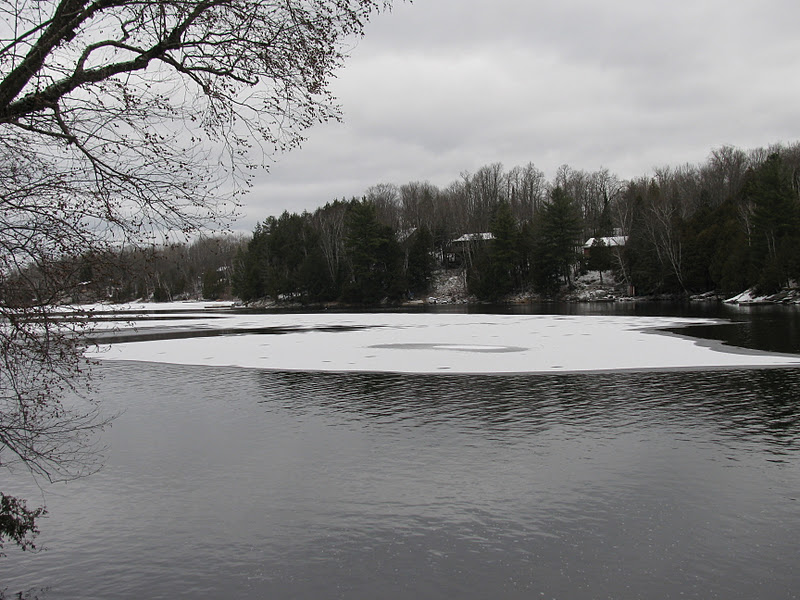
The lake itself was partially frozen when we were there, in the sections where water barely flowed. At one end a collection of rapids collected to form a small waterfall, creating a current that defied freezing. Further up, near a boat launch, a man tiptoed out onto the ice with a sledgehammer. After striking several times into the hard, slippery expanse, he concluded that the ice was three inches thick, and not yet safe to walk around on. Official guidance states that ice should be at least six inches thick before you can walk or skate on it, but people in these parts are known to chance it on four-inch thick ice. 

Christmas day festivities took a decidedly Canadian turn from the get go. We awoke to the smell of pancakes cooking for brunch, which we devoured with fresh berries and maple syrup. It turns out that most maple syrup I have consumed in my life is fake, because the real stuff, tree sap syphoned out of maple trees, is an extremely rare – and expensive – commodity. Our hosts were kind enough to provide the real deal and a bottle of generic “syrup” so that we could taste the difference. 

The present-giving session began with the young generation – two three month old babies, whose haul far outstripped anyone else in the room! Our family had already opened most of our presents before the big day, so we wouldn’t have to cart extra stuff up and back from Parry Sound in an already crowded rental van.

There was something for everyone in our hosts’ quirky take on the Secret Santa tradition. They play slightly differently to your average Kris Kringle or Secret Santa game, where you are assigned a person for whom you buy an anonymous gift. This game was far more conniving. Instead of buying for a specific person everyone buys a generic gift to a certain monetary value, and gifts are placed in the middle of the room. You then draw a number out of a hat to work out who gets first dibs at the pile of presents. You’d think it would be ideal to draw number one, because that gives you pick of the litter, right? Wrong! Number one simply gets to pick a gift and is stuck with it, while the next player can either pick another gift or choose to steal number one’s (already opened) gift. 

The Secret Santa bounty
Players continue to pick or steal gifts in order of the number they have been assigned. If a gift is stolen off someone, that person gets to either open a new present, or steal a gift from someone else. It’s advisable not to get too attached to any particular gift, as it is highly likely another player will pinch it from you at another point in the game. There are limits on how many times a gift can be stolen, and at the end of the game it was a fight to the finish as some of the more popular gifts changed hands until the limit was reached.

I noticed a clear strategy employed by veterans of the game – technically the gifts were contributed anonymously, but afterwards it was pretty clear who had bought what. Many players fought hard to end up with the gift that they contributed to the game! In contrast, Adam and I did not want what we had put in, because our presents were so generic, they weren’t anything that we really needed. Other players had simply bought something they would like and then battled for it. A different strategy altogether! 

It snowed on and off for much of Christmas day. We headed down to the lake with fishing rods and lures, but quickly concluded that it was too shallow to fish off the shore, and too easy to get snagged in the rocks and reeds. Many of the residents had wooden boat pontoons moored just offshore and tethered to trees, but they were frozen in place so we couldn’t pull them back in and jump on.

Don't fall in!
Christmas dinner was divine, with thick, deliciously moist slices of turkey, homemade cranberry sauce, stuffing and beautiful mashed pumpkin (sorry I refuse to call it squash) smothered in rich gravy. For dessert, there were individual baked cheesecakes with a choice of Toblerone, Ferrero Rocher or candy egg flavours. What a feast, and what a relief to enjoy it in a cosy heated house looking out on a crisp winter’s day in a snow-flecked forest! A far more agreeable climate to quaff this kind of food than when it is 30 degrees outside with the harsh Australian sun beating down! 

We returned to Toronto on Boxing Day, passing through the outer suburbs in time for another North American tradition – the sales. In true North American spirit, sales are not confined to just one day, but are held over Boxing Week, a term that up to now I had never heard of. 

Captivating Parry Sound
We parked outside an enormous drive in mall, the kind where a sprawling one story warehouse-type building squats amid a sea of car parking. This design suits lazy types who can drive up to their preferred store, go shopping, and are within staggering distance of their car when they are done. I suppose it makes sense if you are buying heavy items like furniture. 

Most of the shops in the mall were pretty underwhelming, and I can’t say Canadian fashion exactly screams style, but we did manage to walk away with a few cut-price bargains. We had to work for them though – it was quite a challenge wading through the heaving masses of couples, families and groups of teenagers. 

The most impressive shop in the mall was Outdoor World, a department store-sized behemoth selling anything adventure-related. Its auditorium-style interior was adorned with a brutal display of taxidermy – stuffed bears, moose and reindeer, several bird species and even a few (and I’m praying fake) polar bears. At the entrance was a giant freshwater fish aquarium, housing among other things, a meaty-looking catfish. A hunting section stocked rifles, air guns and hunting kit. Adam was inspired by the impressive range of hunting and fly-fishing outfits, including camouflage gumboots and those enormous wading galoshes that come up to your waist.